
























I. Defining the Last Line of Diamond Security
After spending hours researching cut grades, analyzing color charts, and carefully selecting the perfect high-clarity lab-grown diamond, you arrive at the final—and arguably most critical—phase of your design journey: choosing the architecture that will hold your stone. A gemstone ring is not merely a display of light; it is a physical structure that must withstand the unexpected bumps, snags, and impacts of daily life.
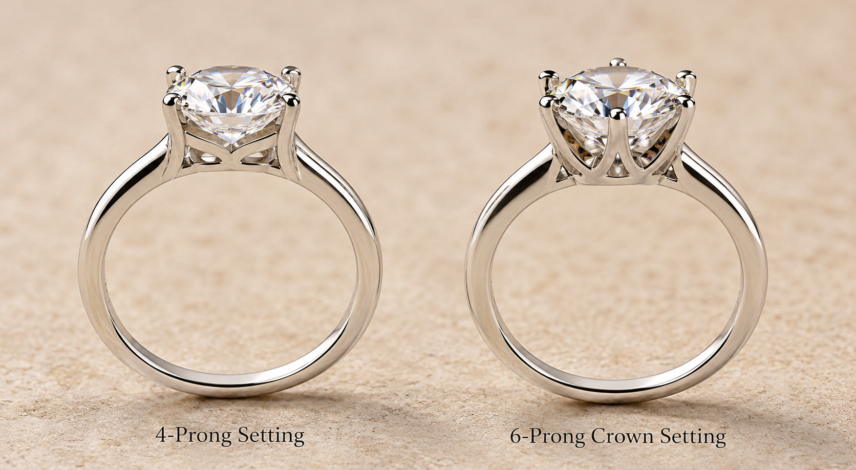
The thin metal claws that grip your gemstone—known as prongs—serve a brilliant dual purpose. They act as a protective suit of armor for your investment while simultaneously serving as a stylistic frame that dictates how large, round, or fiery your diamond appears to the eye. In the world of the classic solitaire setting, the debate between a four-prong and a six-prong layout has split master jewelers and brides for generations.
Choosing between a 4 prong vs 6 prong setting is not a simple question of aesthetic preference. It is a highly technical decision that impacts your diamond ring security, light performance, and how your stone interacts with your lifestyle. Whether you are actively gathering custom ring design tips for a future proposal or retrofitting a family heirloom, understanding the mechanics of these settings is vital. In this guide, we will dissect the optical and physical performance of both settings, helping you select the perfect metal layout to keep your secure diamond prongs locked tightly for a lifetime.
II. The 4-Prong Setting: Modern Minimalism and Visual Maximization
For the buyer who prioritizes a clean, contemporary aesthetic and wants their lab-grown diamond to take center stage with zero visual distractions, the four-prong configuration is an absolute design triumph. By securing the stone at only four strategic geometric points, this layout keeps the metal architecture to an absolute minimum.
The Square Illusion
One of the most fascinating optical effects of a four-prong layout is how it alters the perceived silhouette of a round stone. When four prongs are placed at the standard northwest, northeast, southwest, and southeast corners of a round brilliant diamond, they create a subtle framing effect. To the observer’s eye, this layout box-frames the stone, making a classic round diamond look slightly more square or princess-cut from a distance. This gives a traditional stone a distinctly modern, geometric, and edgy personality.
Maximum Light Performance and Fire
Diamonds do not generate light on their own; they act as high-tech mirrors that reflect the ambient light entering through their top and sides. Because a four-prong setting uncovers more of the diamond’s upper girdle and side profiles, it allows a massive volume of light to penetrate the stone from all angles. With less metal blocking the entry points, your lab diamond can break and bounce light with absolute freedom, maximizing its scintillation, fire, and rainbow flashes.
The Floating Visual "Seamlessness"
Fewer prongs translate directly to less visual crowding on the diamond’s table. A four-prong ring creates a stunning illusion where the diamond appears to float weightlessly above the metal band. Because the metal footprint is so sparse, the boundaries of the stone are completely unobstructed, allowing the true physical millimeter footprint of your diamond to spread out beautifully and look noticeably larger on your finger.
III. The 6-Prong Setting: Royal Lineage and Absolute Structural Armor
If the four-prong setting is a celebration of modern minimalism, the six-prong setting is a testament to timeless heritage, structural excellence, and uncompromising safety. Originating in 1886 with the historic introduction of the legendary Tiffany Solitaire, the six-prong layout remains the international hallmark for high-end bridal luxury.
The Royal Crown Aesthetic
From a design standpoint, placing six micro-prongs uniformly around a stone creates a magnificent, crown-like basket that elevates the diamond, lifting it high above the finger like a sovereign jewel. Unlike the squaring effect of a four-prong layout, a six-prong ring honors and accentuates the pure, continuous geometry of a round brilliant cut. By framing the perimeter at $60^\circ$ intervals, the prongs emphasize the circular border, making the stone look flawlessly round, full-bodied, and classical.
360-Degree Physical Redundancy
When it comes to diamond ring security, a six-prong setting offers a level of physical engineering that a four-prong structure simply cannot match. In a four-prong ring, if you accidentally hit your hand against a car door or a gym weights rack and snap or bend a single prong, the structural integrity fails instantly, and the center diamond will slide right out of the basket.
A six-prong setting introduces vital structural redundancy. If one prong is bent back or sheared off during an impact, the remaining five secure diamond prongs still form a highly effective perimeter matrix. They will hold the gemstone tightly in place, preventing a devastating loss and giving you plenty of time to safely walk into a jewelry workshop for a repair.
The Delicate Border Contrast
While a six-prong layout does place more metal over the diamond’s perimeter—which can slightly break up the border from a bird’s-eye view—it creates a beautifully secure, high-end industrial frame. This delicate metal border acts as a visual contrasting line that outlines the diamond, accentuating the stone’s intense white fire against the polished luster of your precious gold or platinum band.
IV. Hardwood Performance Duel: Security, Brilliance, and Everyday Wear
To help you visualize the trade-offs between these two legendary configurations, let’s pit them head-to-head across the core performance metrics that matter most to daily wearability.
The Security Factor (diamond ring security)
From a purely mechanical standpoint, the six-prong configuration wins the security match by a landslide. It provides a full $50\%$ more gripping points than its four-prong counterpart. This creates a fail-safe layout: if one prong fails, the stone remains locked. A four-prong ring provides standard security but relies on a zero-margin-for-error framework. If one prong catches on a heavy winter sweater and pulls back, the diamond loses its structural balance instantly.
The Visual Scale and Fire Illusion
If your primary goal is to make a 1.5-carat diamond look like a 2-carat powerhouse, the four-prong setting takes the crown. By uncovering the upper girdle and corners, it leaves the perimeter completely unobstructed, allowing the maximum amount of light to flood the stone’s pavilion and shoot back out as fiery scintillation. The six-prong setting, while elegant, places a tighter metal framework around the stone, which can slightly “swallow” the outer edges and make a diamond appear subtly smaller but more intensely framed.
V. The Carat and Shape Matching Matrix: Tailoring the Prongs to Your Lab Stone
Stepping away from general theories, a truly masterfully engineered ring requires you to match the prong count to the exact physical specification and silhouette of your chosen lab-grown diamond.
The Carat Weight Threshold
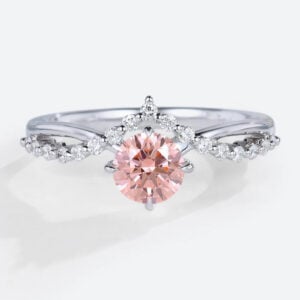
- Under 1.50 Carats: Stick with a 4-prong setting. When a diamond is below the 1.5-carat threshold, its physical surface area is relatively delicate. Crowding a smaller stone with six chunks of metal will create a “heavy metal” effect, where the prongs overwhelm the diamond and choke its fire.
- Over 2.00 Carats: Strongly consider a 6-prong setting. Large-carat lab diamonds possess massive, wide tables and heavy visual presence. A six-prong basket scales beautifully with a large stone, looking less like a constraint and more like a regal crown lifting a massive jewel. Furthermore, heavier stones generate more kinetic force during an accidental impact, requiring the enhanced grip of secure diamond prongs.
The Hard Line Rules for Fancy Shapes
While round brilliant diamonds can freely choose between either option, certain fancy cut lab diamonds have their prong numbers predetermined by the laws of geometry:
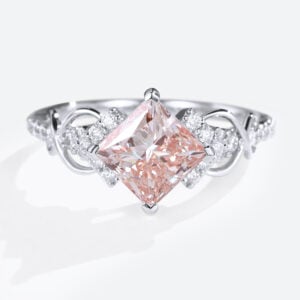
- Emerald, Radiant, and Princess Cuts: These angular silhouettes feature four crisp, sharp $90^\circ$ corners. A 4-prong setting is their only natural match, perfectly hugging the corners to protect them from chipping while keeping the long parallel sides completely open.
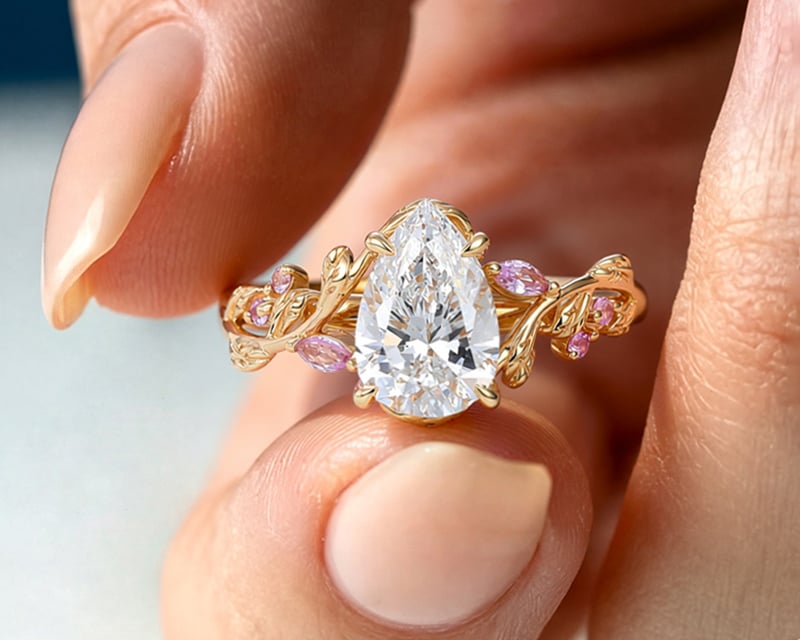
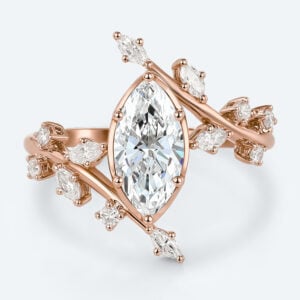
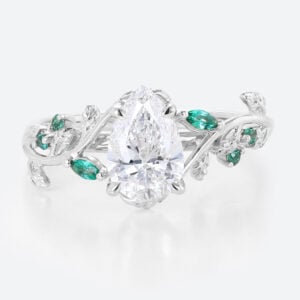
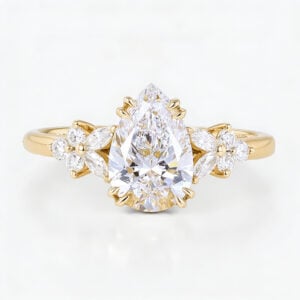
- Marquise, Pear, and Heart Cuts: These shapes possess uneven configurations with highly vulnerable sharp tips. They require specialized asymmetrical layouts—such as 5 prongs for a pear cut or 6 prongs for a marquise—incorporating heavy V-shaped prongs at the tips to shield the sharp points from shattering during daily activities.
VI. Custom Ring Design Tips: The Art of Prong Micro-Sculpting
When most buyers think about a ring setting, they imagine standard, thick metal tabs resting on the diamond’s face. However, in the world of high-end bespoke jewelry, the actual shape and style of the prong tips can completely change how a setting performs visually and mechanically.
Applying these specialized custom ring design tips can help you minimize the metal footprint of your setting while maximizing its hold.
Claw Prongs vs. Round Prongs
Traditional Round Prongs: These look like small, shiny beads resting on the perimeter of the diamond. While strong, their round footprint can look bulky, especially on smaller carat weights.
- Claw Prongs (Petite Claw): These taper into sharp, delicate points that hug the stone tightly. Because they look like tiny arrows, they cover far less of the diamond’s top surface table, allowing more sparkle to break through while providing excellent mechanical grip.
The Double-Prong Illusion for 4-Prong Layouts
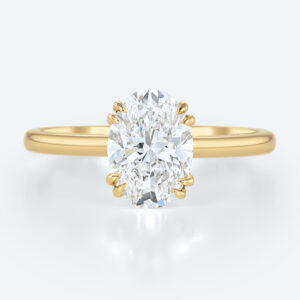
If you love the open fire and floating look of a 4-prong setting but are terrified of losing your center stone, there is a brilliant designer compromise: Double Prongs.
By splitting each of the four corner prongs into two ultra-fine, parallel wires, you create a setting that still frames the stone at only four geometric points, keeping the sides wide open for light entry. However, you gain a vital backup; if one micro-wire shifts, its twin still holds that corner of the diamond secure.
VII. Maintenance Guide: How to Inspect Your Setting at Home
No matter if you choose a 4-prong or a 6-prong layout, no metal structure is completely indestructible. Daily tasks, snagging your hand inside a winter pocket, or bumping against countertops can slowly cause gold or platinum prongs to lift or loosen over time.
To keep your secure diamond prongs functioning flawlessly, practice this simple 30-second maintenance checklist at home once a month.
The Home Tap and Listen Test
Hold your ring up between two fingers by the lower shank.
Bring the ring right next to your ear.
Take your other hand and gently tap the side of the metal band with your fingernail.
What to listen for: If you hear a faint, metallic clicking or rattling sound, your center diamond has shaken loose within its seats. Bring it to a jeweler immediately for a tightening.
The Fabric Snag Check
Gently run the top of your ring across a loosely woven piece of fabric, like a microfiber cloth or an open knit sweater. If the ring catches or pulls a thread on any specific prong, it means that claw has lifted slightly off the diamond’s surface.
Pro Tip: Plan to visit a professional jeweler every 6 to 12 months for a complimentary steam cleaning and prong inspection. They will look at the setting under a microscope to ensure the metal tips haven’t worn down thin (a process that eventually requires prong retipping).
Conclusion: Letting Your Lifestyle Shape Your Setting
At the end of the day, deciding between a 4 prong vs 6 prong setting is not a question of which style is universally superior. It is an honest evaluation of how you intend to wear your jewelry and the size of your center stone.
- Choose the 4-Prong Setting if you have selected a stone under 1.5 carats, favor modern, angular minimalism, and want to unleash the maximum amount of blazing fire and visual scale from your lab-grown investment.
- Choose the 6-Prong Setting if you are setting an heirloom over 2 carats, love classic, romantic lineage, or have a highly active lifestyle where diamond ring security is your absolute non-negotiable priority.
By applying these expert custom ring design tips to your shopping journey, you can balance structural engineering with personal style, ensuring your fingertip masterwork looks breathtakingly beautiful while remaining securely locked in place for a lifetime.