
I. The Illusion on Your Ring Finger
Imagine spending months researching the 4Cs, strictly budgeting your hard-earned finances, and finally purchasing a stunning 1.50-carat diamond ring. It sounds magnificent on paper. But when you enthusiastically hold your hand up next to your friend’s 1.20-carat diamond, a wave of confusion hits you: her diamond actually looks visibly larger than yours.
How is this possible? Is the certificate wrong? Did your jeweler make a mistake?
The answer is no. What you are experiencing is one of the most widespread misunderstandings in the entire luxury industry: the assumption that a diamond's weight dictates its visual scale. For generations, retail marketing has conditioned consumers to treat "carat" as a synonym for "bigness." However, the professional reality is far more nuanced. If you want to maximize your budget and get a stone that truly commands attention on your finger, you must master the delicate relationship between diamond carat weight vs size.
In this educational deep dive, we are going to pull back the curtain on the diamond cutting industry. You will learn exactly why the numbers on a scale don't always align with what your eyes perceive, and how understanding diamond size vs carat will save you thousands of dollars while securing a visually superior stone.
II. Deconstructing the Concept: Weight (Mass) vs. Dimensions (Surface Area)
To truly understand why two diamonds of identical weight can look completely different in size, we must separate physics from geometry. Let’s break down what these two metrics actually measure.
The True Definition of a Carat (The Mass)
Historically, the word "carat" originates from the ancient Mediterranean marketplaces where traders used carob seeds on balancing scales. Because carob seeds possessed an incredibly uniform weight, they became the baseline counterweight for precious gemstones.
In the modern gemological standard established by GIA and IGI, a carat is strictly a standardized unit of mass, not a unit of length, width, or volume. Specifically:
$$\text{1 Carat} = 0.2 \text{ Grams } (200 \text{ Milligrams})$$
When a diamond cutter places a rough diamond on a digital scale, the carat weight tells us exactly how heavy that gemstone is. It is a three-dimensional measurement of total mass. It does not, however, tell us how that mass is distributed through the anatomy of the stone.
The Definition of Size (The Visual Footprint)
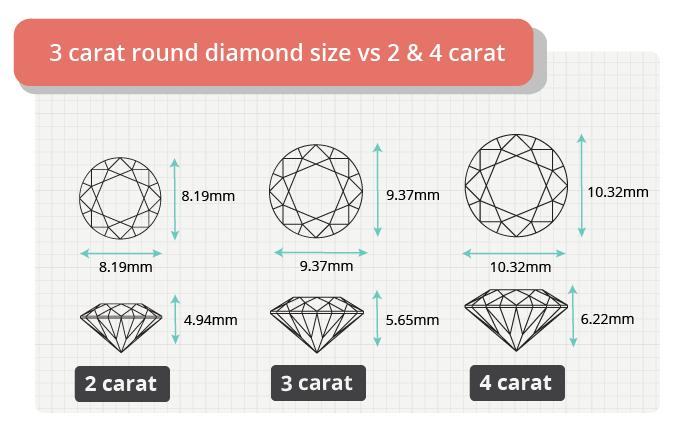
"Size," on the other hand, refers to the physical dimensions of the diamond, measured precisely in millimeters (mm) using digital calipers. When you look at a diamond grading certificate, the "Measurements" line will typically show three numbers (e.g., $6.50 \times 6.52 \times 3.98 \text{ mm}$ for a round brilliant cut).
The First Two Numbers: Represent the length and width of the diamond's top surface.
The Third Number: Represents the total depth from the flat top (table) to the pointed bottom (culet).
Here is the ultimate industry secret: Human beings do not judge a diamond's size by its weight; we judge it by its "face-up" area.
When a diamond is securely set into an engagement ring, the pavilion (the lower half) is completely hidden inside the metal basket or prongs. All you can see is the top surface area projecting upward. Therefore, the visual size of a diamond is a two-dimensional illusion dictated by how much of that 0.2 grams of carbon is pushed to the top surface versus how much is buried underneath.
Think of it like a human being's physical build. Two individuals can both weigh exactly 180 pounds. However, one person might be 6'2" and lean, while the other might be 5'6" and stocky. Their weight on a scale is identical, but their visual presence and physical proportions are entirely different. Diamonds behave exactly the same way.
III. Behind the Scenes: The 3 Main Factors Controlling a Diamond's Visual Scale
Now that you know carat is just a number on a scale, let’s talk about the practical mechanics. Why do some diamonds look incredibly large for their weight, while others look disappointingly small?
Three main factors act as the "invisible puppet masters" controlling this illusion.
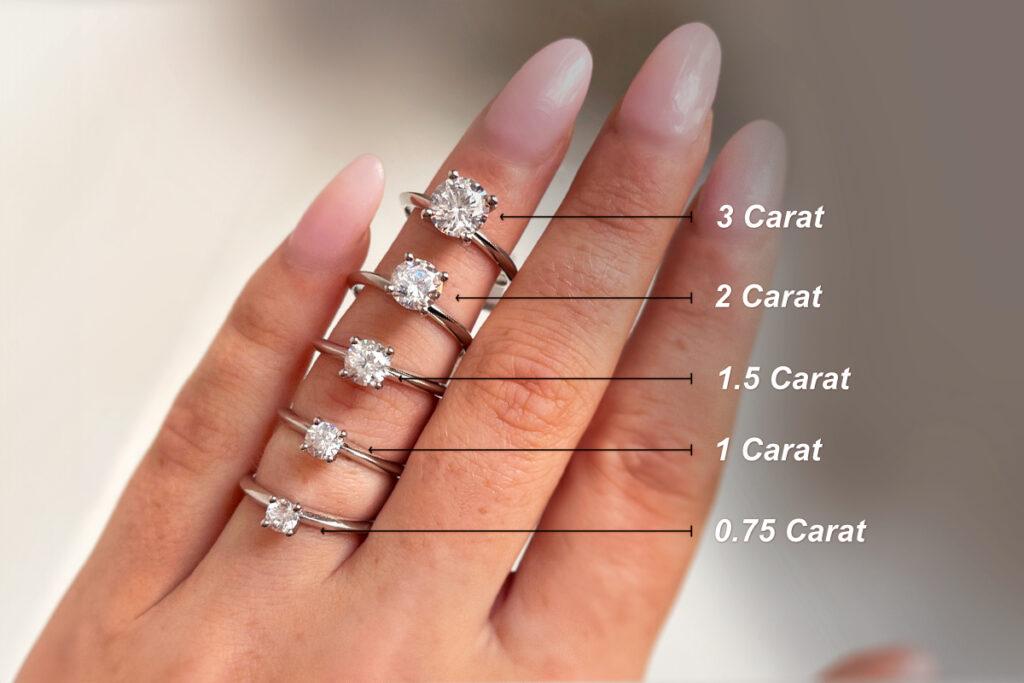
Factor 1: Cut Proportions and the "Hidden Mass" Trap
The Cut grade of a diamond isn’t just responsible for its breathtaking sparkle; it dictates where its weight lives. When a rough diamond is given to a cutter, they face a choice: cut it for maximum visual beauty, or cut it to preserve maximum carat weight.
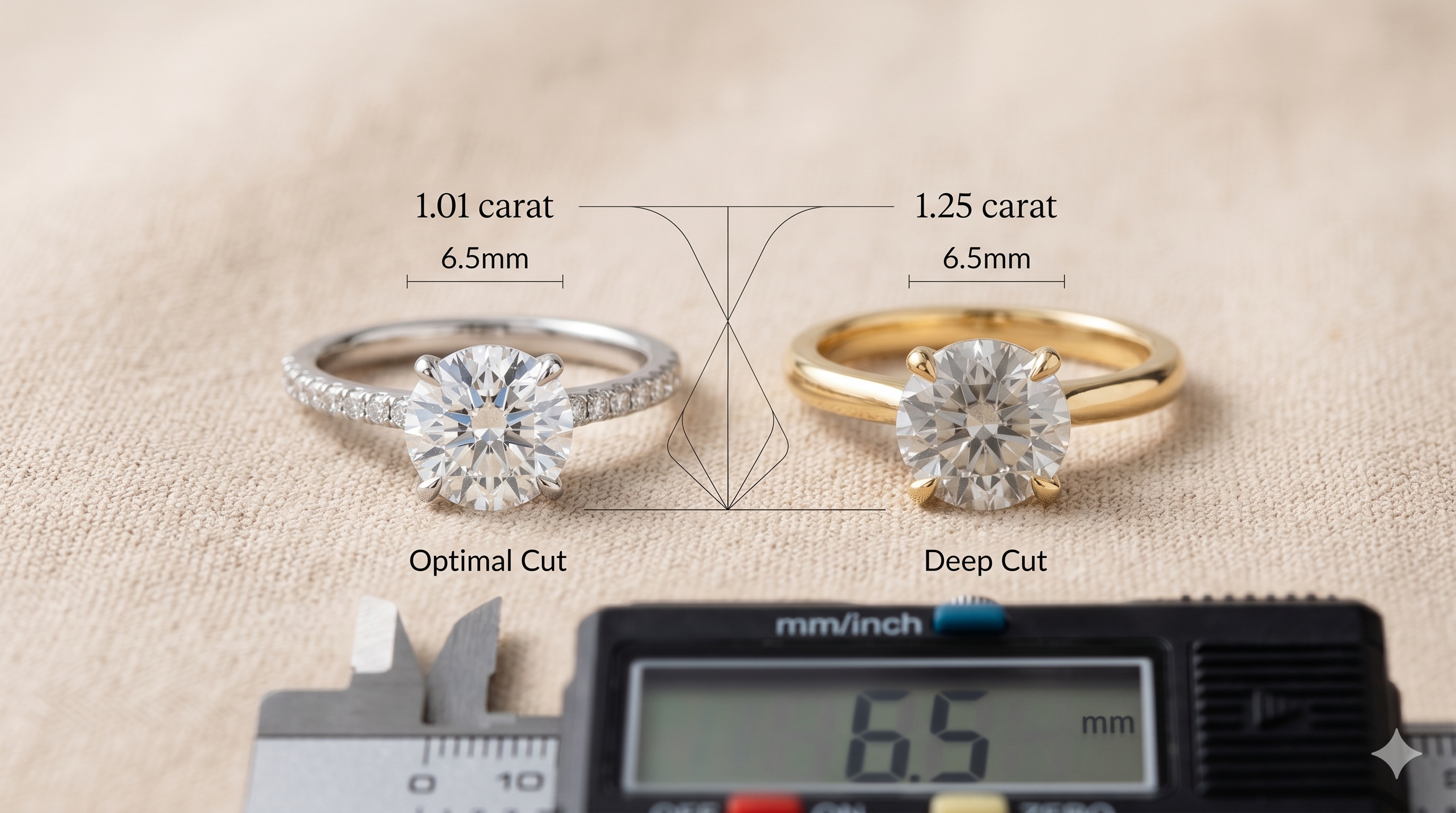
- The "Deep Cut" Disaster (Deeply Disappointing): If a diamond is cut too deep, its pavilion (the lower cone) is elongated. It acts like an iceberg, hiding a massive chunk of its weight beneath the surface where no one can see it. A 1.20-carat deep-cut diamond might have the face-up surface diameter of a properly cut 0.95-carat stone. Not only does this mean you are paying a premium for weight you can't see, but light will also leak out of the bottom, leaving you with a dull, lifeless center.
- The "Shallow Cut" Trap (The Fish-Eye): Conversely, if a diamond is cut too shallow, it spreads out wide like a pancake. While this makes the diamond size vs carat ratio look amazing on paper because the millimeter diameter is huge, it creates a fatal optical flaw. The diamond loses its ability to bounce light back to your eyes, resulting in a glassy, lifeless look known in the trade as a "fish-eye."
- The Ideal Balance: An Excellent or Ideal cut ensures that every milligram of carbon is balanced perfectly between giving you an expansive top surface area and the optical physics required for ultimate fire and brilliance.
Factor 2: The Shape Factor (Some Cut Shapes Just Look Bigger)
If your primary goal is to get the largest possible visual footprint on your finger without paying for a massive carat weight, the geometric shape of your stone is your greatest weapon. Different shapes distribute their mass entirely differently.
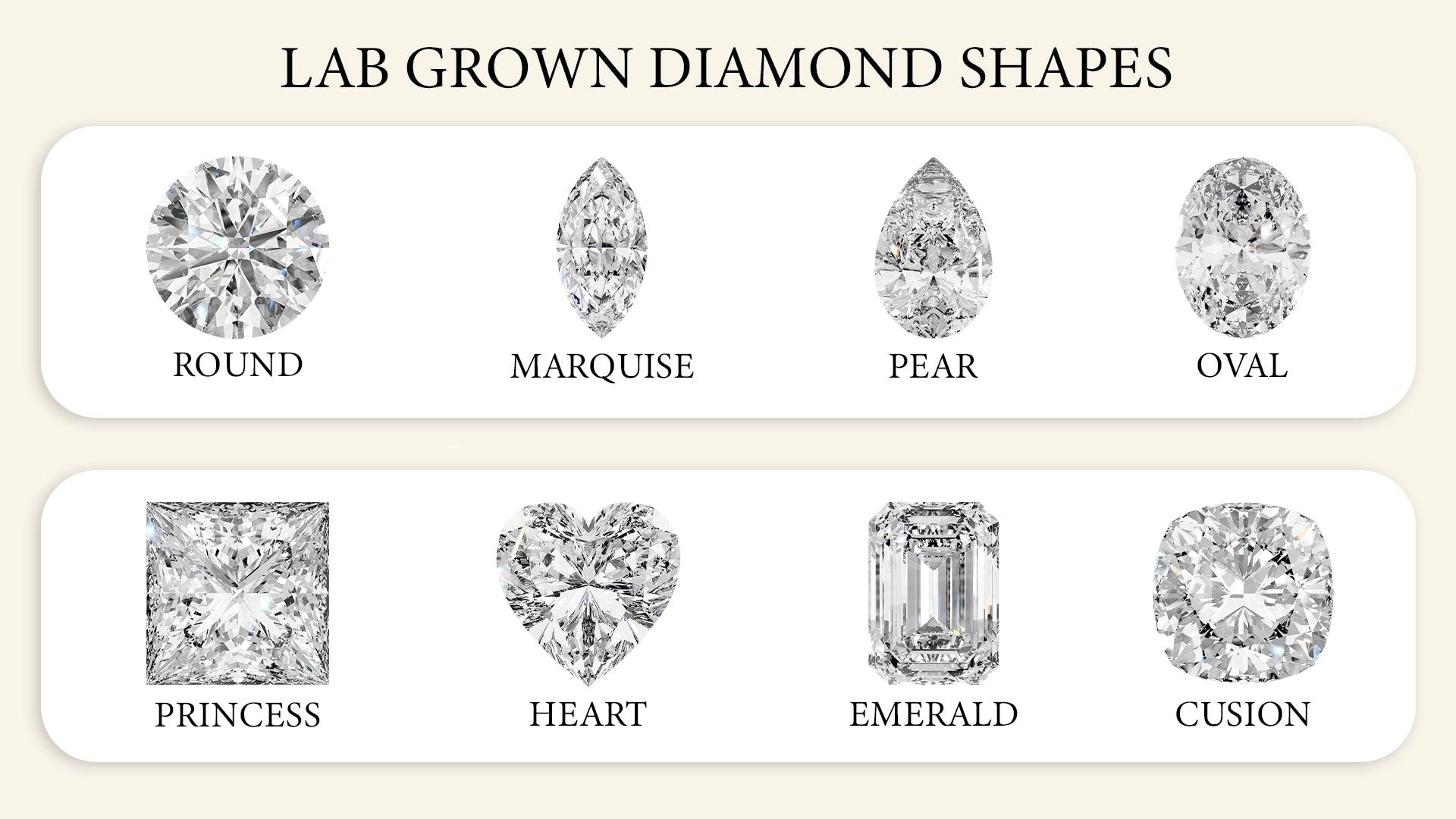
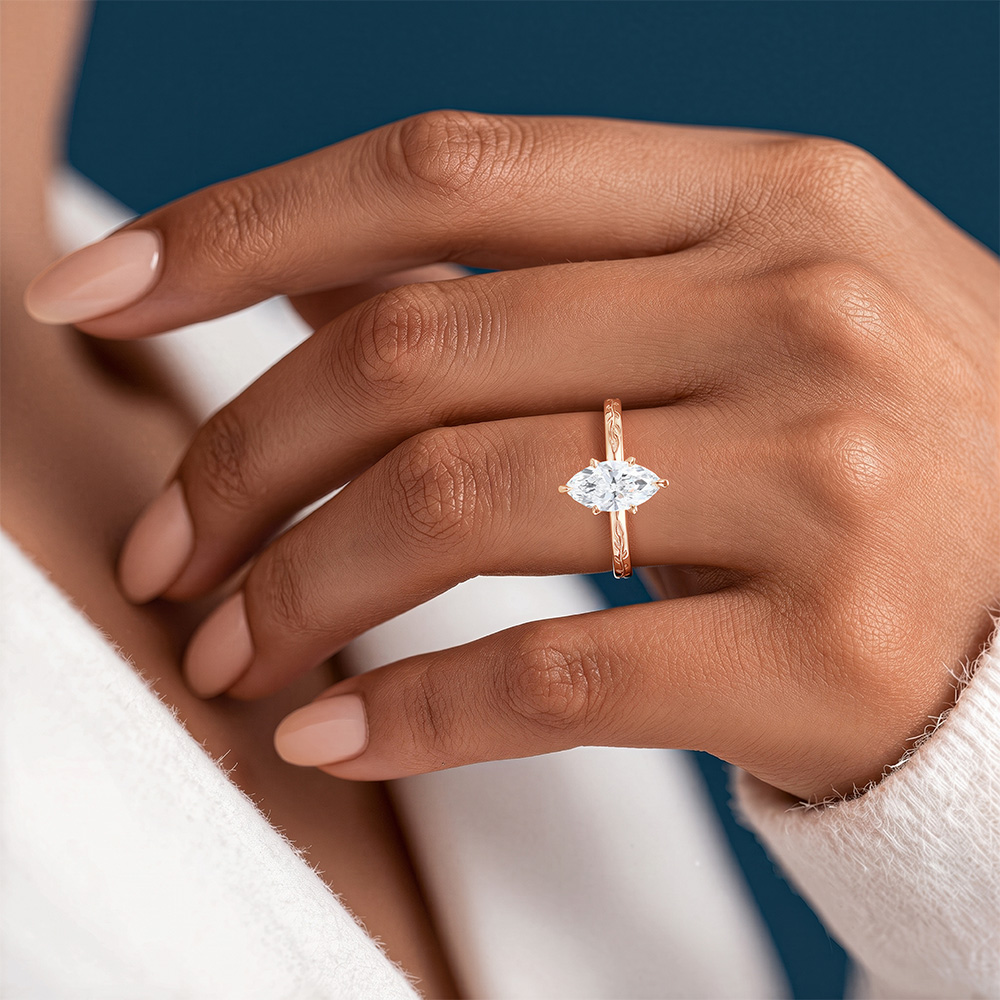
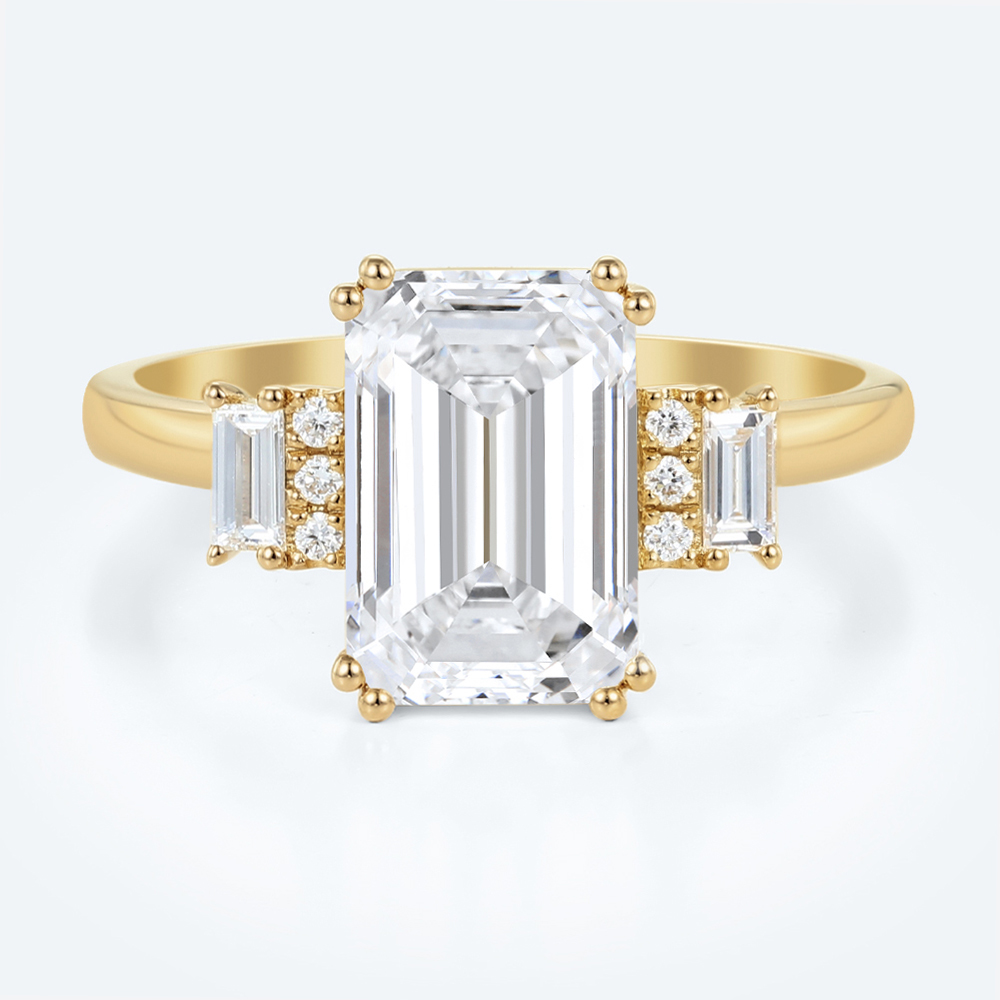
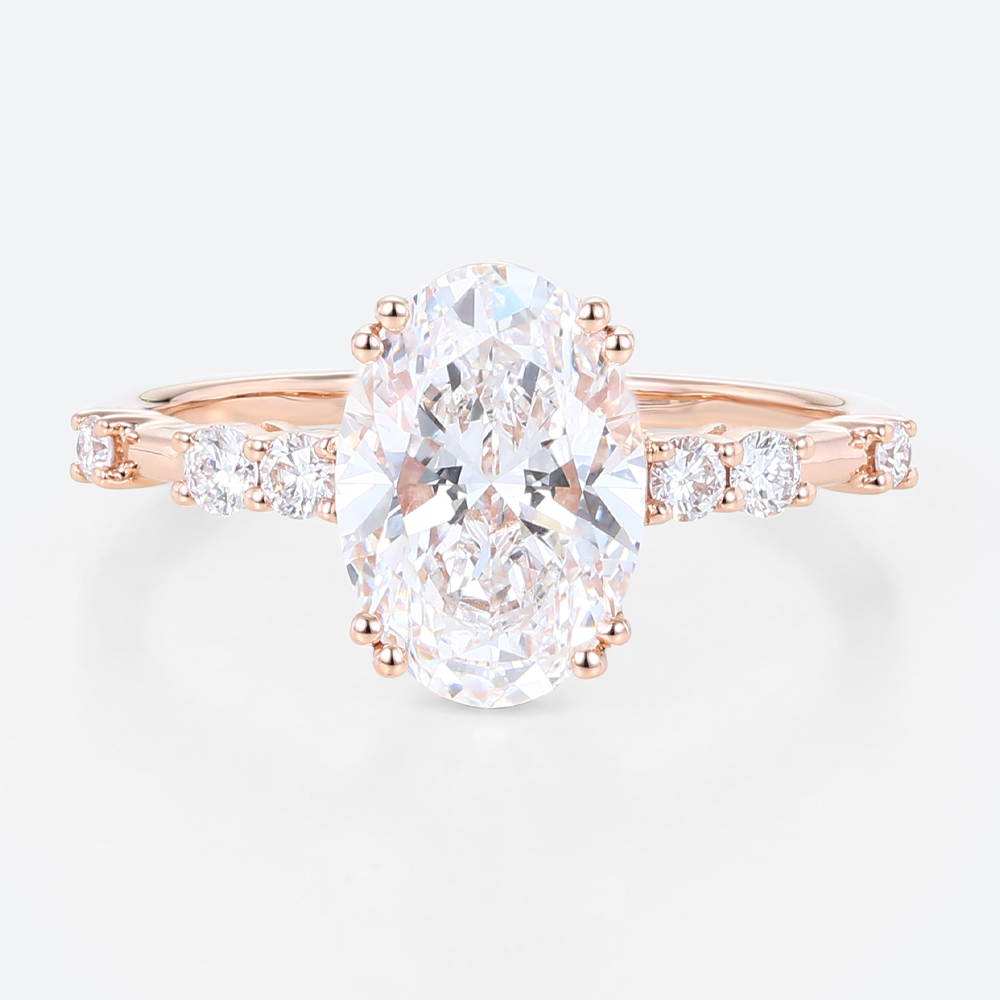
- The Optical Winners (Elongated Shapes): Diamonds with elongated silhouettes—such as Oval, Marquise, Pear, and Emerald cuts—create a brilliant optical illusion. Because they stretch along the finger, they present a significantly larger face-up surface area than a round diamond of identical weight. A 1.00-carat marquise cut, for example, can appear up to 20% larger than a 1.00-carat round brilliant.
- The Optical Losers (Deep Shapes): Shapes that are perfectly square or have steep, step-cut facets—like Princess, Asscher, and Cushion cuts—require a lot of physical depth to achieve their unique look. Because so much weight is packed into their bottom halves, they consistently look smaller face-up than round or elongated diamonds of the same weight.
Factor 3: Girdle Thickness (The Invisible Weight Gain)
Ideally, the girdle should be a thin, protective ribbon.
However, some diamonds have "Very Thick" or "Extremely Thick" girdles. This is essentially a heavy, hidden belt wrapped around the diamond’s waist. It adds serious numbers to the carat scale (and your invoice), but contributes absolutely zero value to the visual size or beauty of the stone.
IV. The Reality Check: Carat Weight vs. Millimeter (mm) Reference Table
To make your shopping experience foolproof, let’s look at how diamond carat weight vs size translates into real-world measurements.
When analyzing a grading report, look past the carat weight and instantly check the Measurements line. The table below illustrates the standard millimeter expectations for various shapes at popular carat weights:
| Diamond Shape | 0.50 Carat Dimensions (mm) | 1.00 Carat Dimensions (mm) | 1.50 Carat Dimensions (mm) | Visual "Bigness" Rating |
| Marquise Cut | 8.5 × 4.2 | 10.0 × 5.0 | 11.5 × 5.7 | 👑 The Ultimate Champion (Looks massive) |
| Oval Cut | 6.0 × 4.0 | 7.7 × 5.7 | 8.5 × 6.5 | ✨ Excellent Stretch (Highly flattering) |
| Pear Cut | 7.0 × 4.5 | 8.5 × 5.5 | 9.5 × 6.0 | 💎 High Impact (Elongated elegance) |
| Round Brilliant | 5.1 × 5.1 | 6.5 × 6.5 | 7.4 × 7.4 | ⚖️ The Baseline Standard |
| Princess Cut | 4.4 × 4.4 | 5.5 × 5.5 | 6.4 × 6.4 | 📉 Visually Compact (Looks smaller) |
V. Insiders’ Shopping Guide: How to Smartly Play the "Size vs. Carat" Game
Equipped with the science of diamond geometry, you are no longer a passive retail consumer; you are an informed investor. When you enter a jewelry boutique or browse online, use these three practical strategies to outsmart the carat pricing scale and maximize your visual impact.
Strategy 1: Buy "Under the Wire" (The Magic Sizes Secret)
In the international diamond trade, prices do not climb on a smooth, linear curve. Instead, they jump exponentially at emotional milestones known as "Magic Sizes"—such as 0.50ct, 0.70ct, 1.00ct, 1.50ct, and 2.00ct.
The public desperately wants to say, "I have a full one-carat diamond." Because of this psychological demand, a 1.00-carat diamond carries a massive pricing premium.
The Smart Move: Look for diamonds weighing 0.90 to 0.96 carats, or 1.40 to 1.45 carats.
- The Reality Check: A well-cut 0.95-carat round diamond measures roughly 6.4mm, while a 1.00-carat diamond measures 6.5mm. The 0.1mm difference is completely indistinguishable to the naked human eye without a magnifying loupe. However, choosing the 0.95-carat stone can easily save you 20% to 30% of your total budget.
Strategy 2: Never Compromise on the Cut Grade
If you are trying to decide between a larger carat weight with a mediocre cut, or a slightly smaller carat weight with an Excellent/Ideal cut, always choose the superior cut.
A stone with a flawless, top-tier cut ensures that every fraction of a milligram is distributed across the top surface area rather than being buried in a thick waist or a bottom-heavy pavilion. Furthermore, a diamond that flashes intense fire and brilliance naturally tricks the human brain into perceiving it as larger than a dull, lifeless stone of the exact same size.
Strategy 3: Use Setting Sorcery to Amplify Visual Scale
You don't need to pay tens of thousands of dollars for a massive center stone when intelligent bench jewelry craftsmanship can create that illusion for you.
- The Halo Setting Effect: Surrounding your center diamond with a delicate border of micro-pavé diamonds can make a 1.00-carat stone look like a 2.00-carat masterpiece from a standard viewing distance.
- Bezel and Bubble Enclosures: Encasing the diamond's perimeter in a polished, reflective precious metal rim (like platinum or yellow gold) seamlessly expands the optical boundary of the stone.
- Tapered or Ultra-Slim Bands: When a ring’s band narrows significantly as it approaches the center gemstone, it creates a powerful architectural contrast. The slenderness of the band automatically forces the eye to perceive the center stone as beautifully grand.
Conclusion: Beauty is Judged by the Eyes, Not the Scale
At the end of the day, no one walks up to your hand with a digital carat scale in their pocket. When friends admire your engagement ring, they aren't calculating its microscopic mass in milligrams—they are reacting to its physical presence, its radiating sparkle, and how harmoniously it sits on your finger.
The ultimate truth of diamond carat weight vs size is that carat is a commercial metric meant for bookkeeping, while dimensions and cut quality are the architectural truths that govern genuine visual beauty.
When you prioritize an impeccable cut grade, explore elongated shapes, and buy just shy of the major weight milestones, you turn the complex matrix of diamond size vs carat into your ultimate financial advantage. Don't buy a diamond that is simply "heavy on paper." Choose a diamond that is brilliantly proportioned, expertly shaped, and undeniably breathtaking to watch every single day.