











I. The Clever Way to Double Your Diamond's Visual Impact
When searching for the dream engagement ring or a standout lifestyle piece, most buyers share a common, instinctive goal: they want a stone that commands attention and looks breathtakingly grand on the hand. For decades, traditional jewelry marketing has trained consumers to believe that the only path to a larger visual presence is to increase the carat weight, a route that exponentially drains your banking budget.
But what if you could outsmart the pricing scale entirely? What if you could make a 1.00-carat diamond look exactly like a 1.50-carat gem without spending an extra dollar on weight?
Welcome to one of the most powerful optical secrets of the luxury jewelry world. The physical reality of gem cutting means that two diamonds with the exact same weight on a digital scale can occupy vastly different amounts of visual space once set into a ring. Choosing the right silhouette is the ultimate hack for budget-conscious luxury buyers.
If you want to stretch your investment to its absolute limit, mastering ring shapes that look biggest is the most essential skill you can possess. In this expert educational guide, we will break down the precise optical physics behind stone dimensions, analyze the reigning champions of finger-elongating silhouettes, and show you exactly which diamond shapes that look bigger so you can claim the maximum visual real estate for your hand.
II. The Science of Visual Spread: Why Shape Dictates Scale
To understand why certain ring styles possess such incredible optical dominance, we must separate the concept of mass from the concept of geometry. When you purchase a diamond, you are paying for its weight, but when you look at it on your finger, your eye is only measuring its surface.
The Face-Up Surface Area (The Real Footprint)
When a gemstone is securely mounted into a ring setting, its entire lower half—the cone-shaped pavilion—is completely buried and hidden within the metal basket or prongs. Your eye never sees the bottom of the stone. Therefore, the human brain judges the “bigness” of a diamond entirely by its face-up surface area (length × width in millimeters).
Think of it like buying a house based on its square footage rather than its total vertical height. If two gemstones weigh exactly 0.2 grams (1.00 carat), the stone that spreads its mass out horizontally will always appear vastly superior in size to the stone that packs its mass vertically.
The Trapped Weight Phenomenon
Why do some shapes hide their mass? It all comes down to the strict physics of light reflection. To achieve the iconic sparkle that buyers crave, certain geometric cuts—such as classic square or rounded brilliant cuts—require a very thick, deep profile to bounce light back to your eye. The cutter is forced to leave a massive chunk of the diamond’s actual weight hidden deep in the basement of the setting.
Conversely, fancy elongated shapes allow the cutter to distribute that exact same amount of raw material across a wider, longer surface plane. By “taming the depth” and widening the top table, these master cuts maximize the physical millimeter spread, turning hidden mass into visible luxury.
III. The Elongated Elite: Diamond Shapes That Look Bigger by Design
If your goal is to claim the maximum amount of real estate on your hand, you need to look toward fancy elongated silhouettes. These geometric shapes utilize a clever optical trick: they distribute their mass along the length of your finger, creating a powerful illusion of grand scale.
The Marquise Cut: The Reigning Champion of Surface Spread
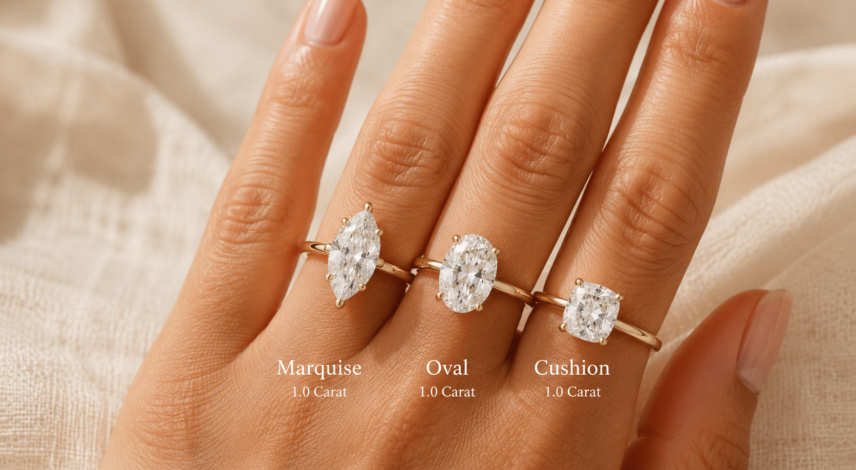
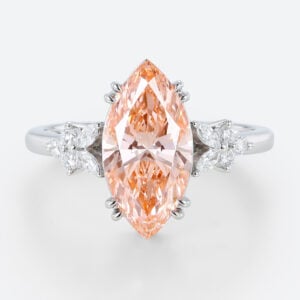
When it comes to ring shapes that look biggest, the Marquise cut sits securely on the throne. Featuring a sleek, football-shaped silhouette with dramatic pointed ends, the Marquise boasts the largest face-up surface area of any diamond shape per carat weight.
The Illusion: A 1.00-carat Marquise diamond can appear up to 20% to 25% larger than a standard 1.00-carat round brilliant.
The Finger Effect: Because of its sharp vertical orientation, it slims and elongates your finger, providing an incredibly flattering, regal presence on the hand.
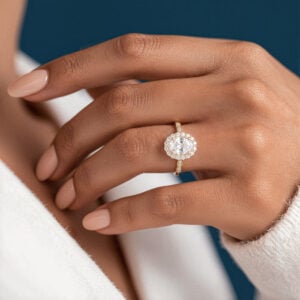
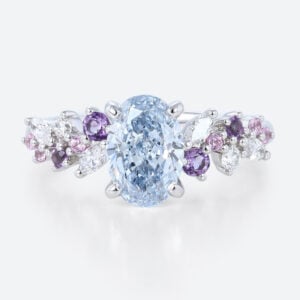
Oval diamonds have skyrocketed in popularity for a very strategic reason: they offer the breathtaking, fiery sparkle of a round brilliant diamond while secretly behaving like an elongated fancy shape.
- The Illusion: Because an oval stretches its dimensions outward, it presents a significantly larger vertical footprint. A 1.00-carat oval typically measures around 7.7mm in length, making it a spectacular choice for a diamond shapes that look bigger strategy.
- The Finger Effect: It softens the edges of your hand with its gentle curves while effortlessly creating a elongated, elegant hand profile.
The Pear and Emerald Cuts: Asymmetrical and Architectural Impact
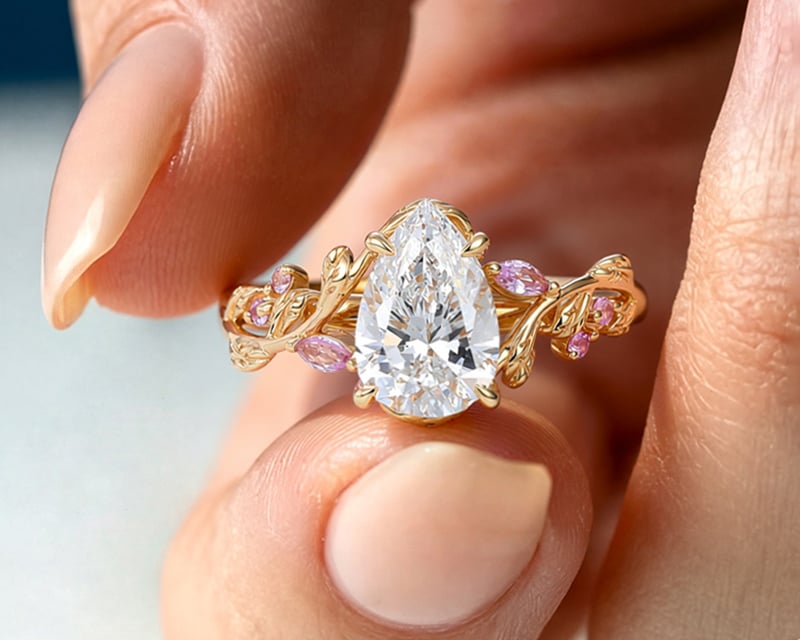
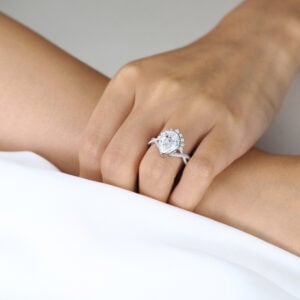
The Pear Cut: Combining the rounding of a brilliant cut with the sharp point of a Marquise, the tear-drop silhouette creates an asymmetrical weight distribution that naturally draws the eye upward, making the stone appear dramatically elongated.
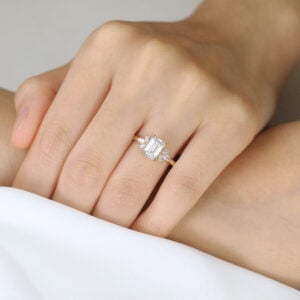
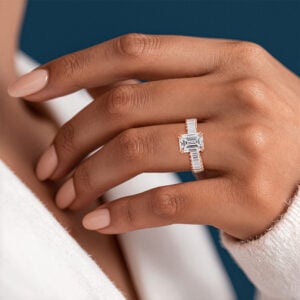
The Emerald Cut: While step-cuts do not flash the same fiery scintillation as brilliant cuts, the Emerald cut features a massive, flat top facet (the table) and a long rectangular border. This wide, open window acts like a mirror, giving the illusion of a sprawling, wide gemstone footprint.
IV. The Hidden Pitfalls: Shapes That Pack Weight and Look Smaller
To master the size game, you must also know which shapes to avoid. Some of the most stunning, romantic diamond cuts are geometrically designed to be bottom-heavy, meaning they hide their true carat weight deep within the setting.
The Princess and Cushion Cuts: Beautiful but Compact
Square silhouettes like the Princess cut, or pillowy, soft squares like the Cushion cut, require deep pavilions and thick corners to correctly bounce light.
The Reality Check: Because a massive percentage of their actual mass is buried in the hidden lower cone of the stone, a 1.00-carat Cushion or Princess cut will consistently look smaller face-up than a 1.00-carat round diamond, and vastly smaller than an oval or marquise of the exact same weight.
The Round Brilliant: The Middle Ground
The Round Brilliant is the international benchmark for sparkle, but its optical proportions are incredibly rigid. To maintain its perfect light reflection, a round diamond must follow strict depth formulas. A 1.00-carat round diamond will always measure right around 6.5mm across. It doesn’t hide weight as severely as a cushion cut, but it offers zero geometric elongation to help it look bigger than its paper weight.
V. Setting Sorcery: Amplifying Your Chosen Shape's Footprint
Once you have selected a stone shape that naturally maximizes its surface area, you can employ master bench jewelry techniques to push that visual illusion even further.
Ultra-Slim Bands
The width of your metal band directly dictates how large the center stone is perceived. A thick, heavy metal band will swallow up the visual presence of your gemstone. By pairing an elongated stone like an Oval or Marquise with an ultra-slim, tapered band, you create a powerful architectural contrast that forces the center stone to pop forward and look instantly larger.
Enhancer Bands (The One-Piece Visual Double)
If you already own a ring or want an adjustable way to expand its scale later on without replacing the main diamond, look no further than Enhancer Bands. Also known as ring guards or wraps, these are specialized, cohesive pieces designed to wrap perfectly around your existing ring. An enhancer band frames your center stone with additional metalwork or delicate pavé rows, seamlessly doubling the visual width and presence of your ring on the finger without forcing you to buy a heavier center stone.
VI. The Hand-Shape Matchmaker: Customizing the Illusion for Your Fingers
Maximizing a diamond’s visual footprint is not just about the physics of the stone; it is about how that geometry interacts with the unique architecture of your hand. A shape that looks massive on one person might look disproportionate on another. To achieve the absolute ultimate “bigness” effect, you must match the diamond silhouette to your specific hand type.
For Short Fingers: The Ultimate Elongation Hack
If your goal is to make your fingers appear longer and more slender while making the stone pop, your baseline rule is vertical extension.
The Perfect Matches: Marquise, Oval, and Pear cuts.
Why it Works: These shapes act as a physical extension of your finger’s natural line. The elongated vertical ratio draws the observer’s eye upward and downward along the hand, creating a continuous line that tricks the brain into seeing both a longer finger and a significantly grander diamond footprint.
For Wide or Plus-Size Fingers: Claiming Width with Balance
If you have wider fingers or a larger ring size, a narrow or overly petite diamond can easily get swallowed up, making the stone look smaller than its actual carat weight. You need a shape that covers horizontal real estate without looking stubby.
The Perfect Matches: Wide Ovals, Radiant cuts, or East-West settings.
Why it Works: An Oval cut with a slightly wider ratio ($1.35$ to $1.40$) or a rectangular Radiant cut spreads its brilliance across the width of your finger. It balances the proportions of your hand, ensuring that the metal of the band doesn’t dominate the view, allowing the diamond to command the spotlight.
For Slender or Long Fingers: The Structural Statement
While long fingers can wear almost any shape, a stone that is too narrow (like a very thin Marquise) can look sparse or overly fragile, failing to project a sense of luxury.
The Perfect Matches: Emerald cuts, Round Brilliants, or Princess cuts.
Why it Works: Long fingers provide the perfect canvas for architectural, symmetrical shapes. An Emerald cut utilizes its wide, reflective step-cut facets to ground the look, creating a bold, sprawling mirror-like footprint that fills the finger with elegance rather than just length.
Conclusion: Trust Your Calipers, Not Just the Scale
The ultimate takeaway when hunting for ring shapes that look biggest is to remember that carat is a measurement of gravity, but beauty is a measurement of perception. You do not need to overextend your budget on a heavier stone when intelligent geometric selection can achieve the exact same visual impact.
By focusing your search on elongated diamond shapes that look bigger—like the Marquise, Oval, or Pear—and steering away from bottom-heavy square cuts, you turn the laws of optical physics into your ultimate shopping advantage. Choose a shape that flatters your unique hand structure, spreads its mass beautifully across your finger, and commands attention through flawless proportions rather than just a number on a scale.