











When shopping for an engagement ring or a signature piece of jewelry, parsing through a grading report can feel like reading a foreign language. Between cut grades, clarity scales, and millimeter ratios, one parameter frequently stops buyers in their tracks: Fluorescence.
If you have stumbled across terms like “Faint,” “Medium,” or “Strong Blue” on a grading certificate, you might be asking yourself: Will this make my diamond glow in the dark? Is fluorescence a secret flaw? Could it turn my sparkling stone into a cloudy, milky diamond?
In the world of natural diamonds, fluorescence has sparked debates among jewelers for decades. But when it comes to lab-grown diamond fluorescence, the physics, probability, and market reality are completely different.
Whether you are eyeing a classic HPHT solitaire or a sleek CVD emerald cut, this ultimate guide will demystify diamond fluorescence, unpack how lab diamonds behave under light, and help you shop with absolute confidence.
I. What Is Diamond Fluorescence?
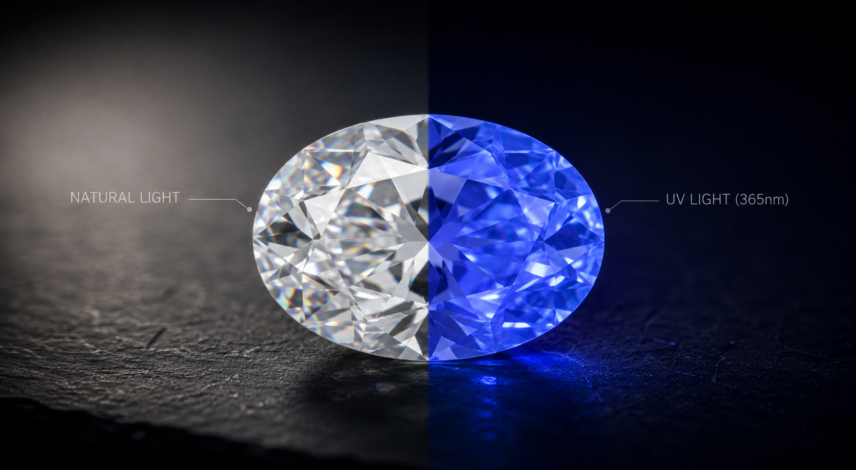
At its core, diamond fluorescence refers to a diamond’s ability to emit a soft, visible glow when exposed to long-wave ultraviolet (UV) light—the invisible rays found in natural sunlight and blacklights.
Think of it like a subtle, built-in optical reaction. When UV photons strike certain trace elements embedded inside the diamond’s crystal lattice, the stone temporarily absorbs that energy and re-emits it as visible light.
The Grading Scale: From None to Very Strong
Major gemological laboratories—such as the International Gemological Institute (IGI) and the Gemological Institute of America (GIA)—evaluate fluorescence by placing the diamond in a dark room directly beneath a standardized long-wave UV lamp.
They categorize the reaction into five distinct grades:
None: The diamond displays zero reaction; its appearance remains identical under UV and normal light.
Faint: A subtle, barely perceptible light glow under concentrated UV light.
Medium: A noticeable, clear glow when exposed to UV rays.
Strong: A bright, vivid light emission under UV illumination.
Very Strong: An intense, fluorescent glow that is unmistakable even under light outdoor UV exposure.
Key Takeaway: Fluorescence is not a permanent light source. It only activates in the presence of strong UV light. Once you step out of the UV light source, the glow disappears instantly.

II. Lab-Grown vs. Natural Diamonds: Why Fluorescence Originates Differently
To understand why lab-grown diamond fluorescence is so unique, we have to look under the hood at how these gems are created. While natural and lab-grown diamonds share identical chemical, physical, and optical properties (pure carbon crystal lattices), their growth environments leave very different microscopic footprints.
Natural Diamonds: Earth-Born Nitrogen
Over billions of years under high pressure deep within the Earth’s mantle, natural diamonds absorb microscopic impurities from surrounding rock. The most common intruder is nitrogen.
When nitrogen atoms cluster in specific geometric formations (known as N3 structural defects), they react to UV radiation by glowing blue. Roughly 25% to 30% of natural diamonds exhibit some degree of blue fluorescence.
Lab-Grown Diamonds: Controlled Science
Lab diamonds are grown in high-tech laboratories under meticulously controlled conditions over weeks rather than millennia. Because engineers control the atmospheric gases during production, unwanted impurities like nitrogen are filtered out to maximize diamond clarity and color.
Depending on the growth method, lab-grown fluorescence behaves very differently:
A. Chemical Vapor Deposition (CVD)
CVD diamonds are grown by placing a diamond “seed” in a vacuum chamber filled with carbon-rich gas (like methane).
Because the gas chamber environment is tightly regulated, CVD diamonds almost never exhibit traditional blue fluorescence.
On rare occasions, trace silicon or nitrogen added to tweak growth speeds can create a faint orange, pinkish, or reddish fluorescence under intense UV light. However, in gem-quality CVD rough used for fine jewelry, this is exceptionally rare.
B. High Pressure High Temperature (HPHT)
HPHT growth replicates the extreme heat and pressure of the Earth’s mantle using massive mechanical presses.
HPHT diamonds achieve exceptional chemical purity, meaning nitrogen impurities are practically non-existent.
As a result, the vast majority of HPHT lab-grown diamonds receive a rating of “None” for fluorescence on GIA and IGI certificates.
Note: Some HPHT stones can show a brief phosphorescence (an lingering glow after the UV light is turned off), but modern gem labs screen for this to ensure only visually inert gems make it to market.
III. Real-World Lighting Tests: How Fluorescence Behaves Indoors vs. Outdoors
Understanding the science on paper is one thing, but how does lab-grown diamond fluorescence actually affect what you see on your finger every day?
To give you a complete picture, let’s break down how a diamond behaves under three common real-world lighting environments:
Scenario 1: Indoor Lighting & Office Environments (Zero UV Light)
Most artificial light sources—such as standard LED bulbs, incandescent lamps, and office fluorescents—emit virtually zero long-wave UV light.
The Result: Whether your lab-grown diamond certificate says None, Faint, or Medium, it will look 100% identical indoors. Without UV photons to kickstart the reaction, fluorescence remains completely invisible.
Scenario 2: Direct Midday Sunlight (High UV Light Exposure)
Natural daylight is the strongest source of UV radiation you encounter daily. When you step outside into bright sunshine, the UV rays hit the diamond instantly.
Faint to Medium Blue Fluorescence: If a diamond has faint or medium blue fluorescence, the blue light emitted under sunlight acts as a natural optical illuminator. Because blue and yellow are complementary colors on the color wheel, a faint blue glow actually neutralizes subtle warm undertones (in lower color grades like J or K), making the diamond appear slightly whiter to the naked eye.
Strong Blue Fluorescence: Under intense outdoor sun, a stone with strong blue fluorescence might display a subtle bluish sheen. However, as noted earlier, strong fluorescence is exceedingly rare in gem-quality lab diamonds.
Scenario 3: Nightclub & UV Party Lights (Pure UV Environment)
If you walk into an environment illuminated purely by UV blacklights—such as a modern bowling alley, music venue, or nightclub—a diamond with strong fluorescence will illuminate with a futuristic glow.
The Reality for Lab Diamonds: Because over 95% of jewelry-grade lab diamonds are graded as None, your lab diamond will almost certainly stay sleek, brilliant, and completely inert under blacklight, reflecting light purely through its precision cut.
IV. Does Fluorescence Cause a "Milky" Diamond?
Of all the concerns surrounding diamond fluorescence, the fear of buying a milky diamond—a stone that looks hazy, cloudy, or greasy rather than crisp and sharp—is by far the most widespread.
The Myth: "Fluorescence Always Makes Diamonds Cloudy"
This myth stems entirely from the natural diamond market. In very rare cases (representing less than 0.5% of natural stones), a natural diamond with an extreme Very Strong Blue fluorescence level can experience light scattering inside its lattice. When sunlight hits the stone, this intense internal scattering makes the diamond look like it has a drop of milk inside it, dulling its fire and transparency.
However, applying this fear to lab diamonds is a fundamental misunderstanding of gem physics.
The Reality: What Actually Causes Cloudiness in Lab Diamonds?
If you ever encounter a cloudy or hazy lab diamond, fluorescence is almost never the culprit. Because lab diamonds rarely carry strong fluorescence to begin with, visual haziness is caused by growth quality issues during manufacturing:
CVD Micro-Grain Strain Lines: If a Chemical Vapor Deposition (CVD) diamond is grown too quickly to save production costs, internal atomic dislocations create faint internal strain patterns. These micro-grain lines scatter light internally, making the diamond look hazy or “asphyxiated” even if its certificate reads Fluorescence: None.
HPHT Metallic Flux Inclusions: High Pressure High Temperature (HPHT) diamonds use molten metal catalysts (like iron or nickel) during growth. If microscopic remnants of this metal flux get trapped throughout the crystal lattice, they can diminish overall optical transparency.
Expert Advice: A certificate showing Fluorescence: None does not automatically guarantee crystal clarity. Always prioritize diamonds with exceptional crystal transparency, precise cut proportions, and zero internal growth haziness.
V. Market Truths: Price Impact & Grading Standards
When navigating the diamond market, understanding how pricing mechanisms and gemological lab standards interact with fluorescence can save you money while ensuring top-tier optical performance.
The Natural Diamond "Fluorescence Discount"
In the natural diamond market, pricing is heavily influenced by consumer perception and legacy trading habits:
High Color (D-F) + Strong Blue: Typically trades at a 10% to 15% discount. Buyers worry about potential haziness, even though only a small fraction of strong blue stones actually exhibit optical cloudiness.
Lower Color (I-M) + Faint/Medium Blue: Can sometimes carry a small premium because the subtle blue glow cancels out warm tint under daylight, making the stone look whiter.
The Lab-Grown Diamond Pricing Reality
In the lab-grown diamond ecosystem, the dynamic is vastly different:
Uniform High Quality: Because diamond foundries control environmental parameters, over 95% of gem-grade lab diamonds emerge with a None fluorescence rating.
No Fluorescence Penalty: Because fluorescence is so rare in lab diamonds, there is no established “fluorescence discount tier” in the lab-grown industry. You won’t find deep price cuts on a lab diamond based on fluorescence alone—if a lab diamond is priced suspiciously low, it is almost certainly due to poor cut precision, off-color undertones (like brown or gray CVD tint), or internal strain lines.
How Top Gem Labs Grade Fluorescence (GIA vs. IGI)
Both the Gemological Institute of America (GIA) and the International Gemological Institute (IGI) follow strict spectroscopic laboratory standards when testing lab-grown diamonds:
When you inspect an official IGI or GIA grading certificate, the fluorescence result is listed clearly under the Additional Grading Information section, giving you complete verification before you buy.
VI. Actionable Buyer’s Guide: How to Pick the Perfect Lab Diamond
Now that you know the physics, how should you use this information when picking your diamond? Use these rule-of-thumb principles to make a flawless selection.
The Golden Rule: Target "None" (The Easy Default)
Since the vast majority of premium lab-grown diamonds naturally grade as None, making “None” your default filter setting keeps your shopping experience simple and worry-free.
Don't Panic Over "Faint"
If you find a lab diamond that fits your cut, carat, color, and clarity criteria perfectly—but its certificate lists Fluorescence: Faint—do not hesitate to buy it. A “Faint” rating has zero negative impact on visual transparency or light performance.
Focus on What Truly Matters for Sparkle
Instead of stressing over fluorescence, allocate your attention to the parameters that actually determine a diamond’s radiance:
Cut Grade: Look for Ideal or Excellent cut proportions. Precision faceting dictates 90%+ of a diamond’s fire and brilliance.
Optical Transparency: Ensure the diamond crystal is crisp and free of micro-grain strain patterns (common in low-tier CVD) or heavy metallic flux residue (common in low-tier HPHT).
Quick Reference: Diamond Fluorescence Cheat Sheet
| Fluorescence Grade | Visual Impact Indoors | Visual Impact Outdoors (Sunlight) | Lab Diamond Rarity | Smart Buying Advice |
| None | 100% Inert & Clear | Crisp, zero light emission | 95%+ (Industry Standard) | Top Recommendation. Pristine, worry-free choice. |
| Faint | 100% Inert & Clear | Indistinguishable from “None” | Rare (~3%-4%) | Safe to Buy. Zero visual downside; great value. |
| Medium / Strong | 100% Inert & Clear | Subtle bluish glow in rare cases | Extremely Rare (<1%) | Inspect Carefully. Request 360° video to check transparency. |
VII. Final Verdict & The LisaJewelryUS Commitment
At the end of the day, fluorescence does not matter for the vast majority of lab-grown diamond buyers. Unlike natural diamonds where fluorescence is a common variable, lab-grown diamonds are synthesized in environments designed to eliminate unwanted trace elements. As a result, almost every gem-grade lab diamond you consider will naturally feature a None fluorescence rating on its grading report.
If you ever encounter a cloudy or hazy lab diamond, remember: it’s not fluorescence—it’s growth quality.
Sparkle with Absolute Confidence at LisaJewelryUS
At LisaJewelryUS, we believe buying fine jewelry should be an empowering, transparent experience. Every lab-grown diamond in our signature engagement ring and fine jewelry collection undergoes rigorous dual-screening:
100% Certified Purity: Graded by leading laboratories (GIA & IGI) with verified None fluorescence ratings.
Hand-Selected Optical Clarity: Hand-inspected by master jewelers to ensure zero internal strain lines, zero metallic flux haze, and maximum light performance.
Explore our handcrafted Lab-Grown Diamond Engagement Rings or book a virtual consultation with our diamond experts today to design your dream custom ring!