
















What is Diamond Table and Depth Percentage? A Beginner’s Ideal Ratio Guide
by Lisa Jewelry US 0 comments
Two diamonds can share the same shape, carat weight, color, and clarity grade yet look noticeably different when viewed side by side. One may appear bright and lively, while the other looks smaller, darker, or less balanced. Often, the difference lies in how the diamond was proportioned.
Among the measurements listed on a diamond grading report, diamond depth and table percentage are two of the most frequently discussed—and misunderstood. They can offer useful clues about a diamond’s face-up appearance and potential light performance, but they should never be treated as a complete beauty score.
This beginner-friendly guide explains what table and depth percentages mean, how they work together, and why an “ideal” number is best used as a starting point rather than a guarantee.
Quick Answer: What Are Diamond Table and Depth Percentages?
- Table percentage describes the size of the diamond’s largest top facet relative to its overall width or diameter.
- Depth percentage describes the diamond’s total height—from the table to the culet—relative to its width or average diameter.
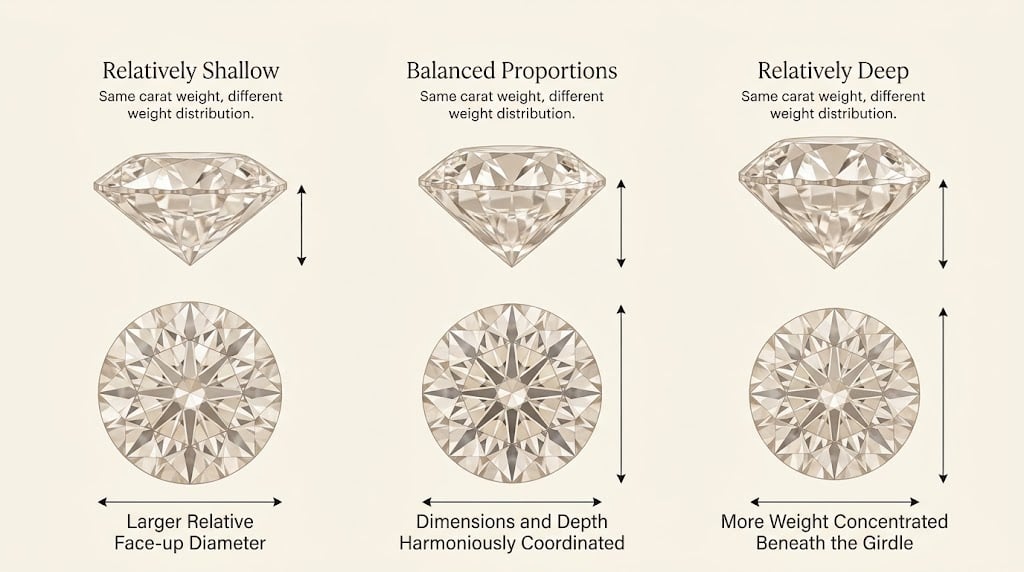
- Together, these numbers help reveal whether a diamond is relatively shallow, deep, or proportionally balanced.
However, table and depth percentages do not operate independently. Crown height, pavilion depth, facet angles, symmetry, polish, and cutting precision also influence how the diamond returns light. IGI evaluates round-brilliant cut quality using a combination of proportions, polish, symmetry, and light-performance considerations—not a single measurement.
What Is Diamond Table Percentage?
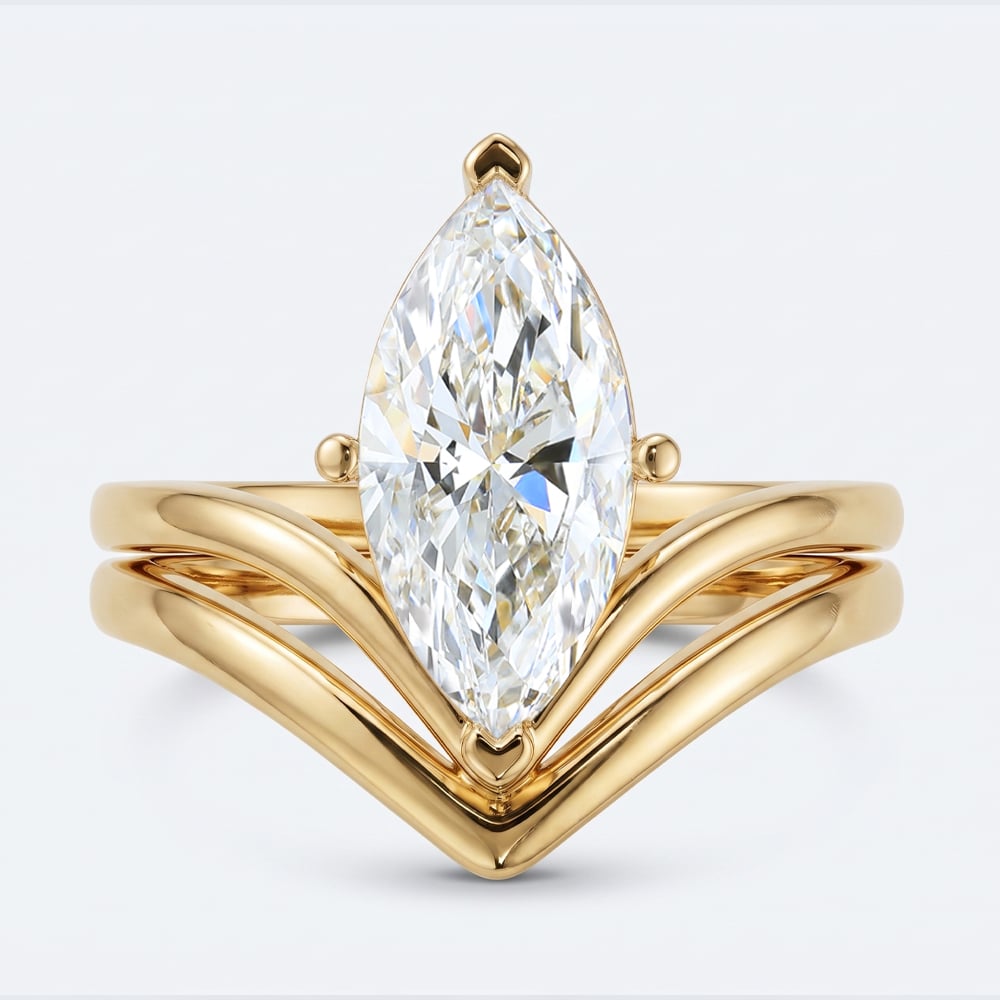
The table is the large, flat facet at the very top of a faceted diamond. When you look straight down at the stone, it is the central window through which light enters and exits.
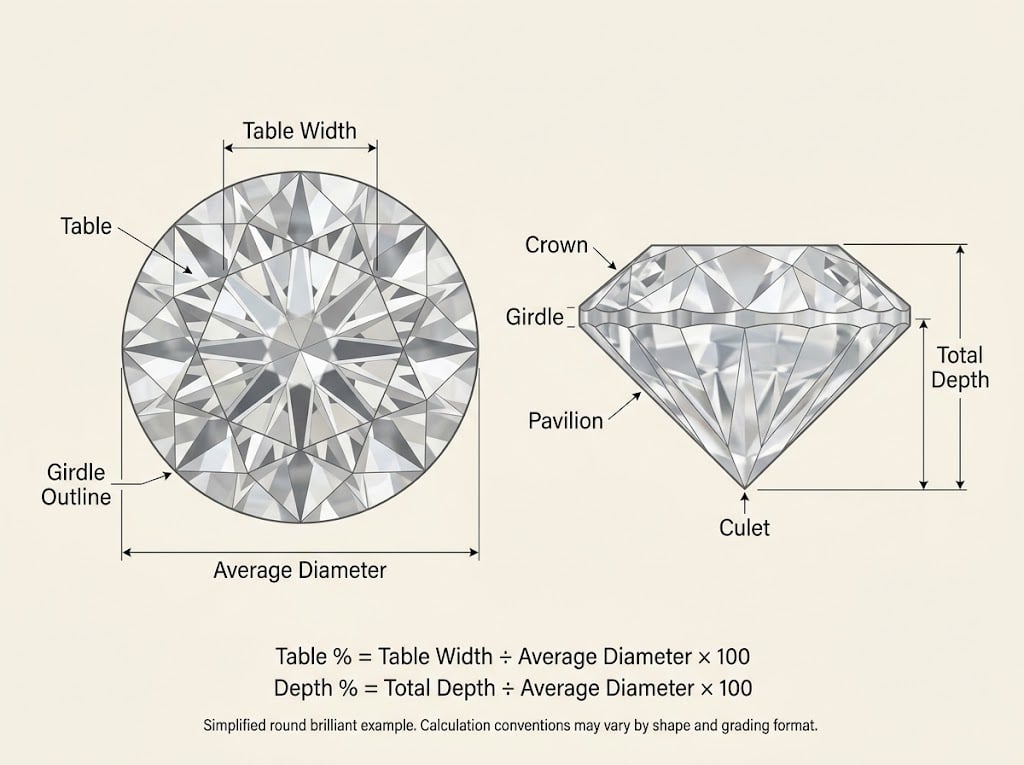
In simplified terms, table percentage compares the width of this top facet with the diamond’s overall face-up width:
Table Percentage = Table Width ÷ Diamond Width × 100
For a round diamond, the calculation is generally related to its average girdle diameter. For fancy shapes, the relevant width and reporting convention depend on the stone’s outline.
A 56% table, for example, means the table facet measures approximately 56% of the diamond’s overall width. It does not mean that 56% of the diamond’s visible surface is table, nor does it mean the stone is automatically well cut.
How Table Size Can Affect Appearance
Table size contributes to the balance between white brightness, colored fire, and the diamond’s overall facet pattern.
A relatively small table is often associated with a higher crown and may support more visible fire when the surrounding angles work well. A larger table may emphasize white brightness and create a broader central appearance. Neither result is guaranteed, because the pavilion and crown must work with the table rather than against it.
This is why choosing the “smallest possible” or “largest possible” table is not an effective buying strategy. A table percentage is meaningful only when it is considered as part of the diamond’s complete geometry.
What Is Diamond Depth Percentage?
Diamond depth is the stone’s total vertical measurement, extending from the top of the table to the lowest point of the pavilion. It is recorded in millimeters as part of the diamond’s measurements and may also appear as a percentage in the proportions section of a grading report.
In simplified form:
Depth Percentage = Total Depth ÷ Diamond Width × 100
For a round diamond, the denominator is typically its average diameter. For many fancy shapes, depth is compared with the stone’s width rather than its length.
It is important to distinguish depth in millimeters from depth percentage:
- Millimeter depth tells you the stone’s actual physical height.
- Depth percentage places that height in context by comparing it with the diamond’s width.
IGI grading reports include key measurements and proportions established through optical measuring equipment that creates a digital representation of the diamond’s geometry.
What Happens When a Diamond Is Too Shallow?
A shallow diamond may spread more of its carat weight across the face-up surface, making it appear larger for its weight. That can sound attractive, but spread alone does not guarantee beauty.
If the pavilion becomes too shallow in relation to the crown and table, some light may escape instead of returning to the viewer. The diamond may appear pale, watery, or less defined in certain lighting conditions.
What Happens When a Diamond Is Too Deep?
A deep diamond may carry more of its weight vertically below the girdle. As a result, it can face up smaller than another diamond of the same carat weight.
When depth is excessive or poorly coordinated with the other angles, the diamond may also display unwanted darkness or reduced light return. However, a depth percentage near the edge of a preferred range is not automatically a problem. The rest of the proportions—and the diamond’s actual appearance—still matter.
Why Diamond Table and Depth Percentage Must Be Read Together
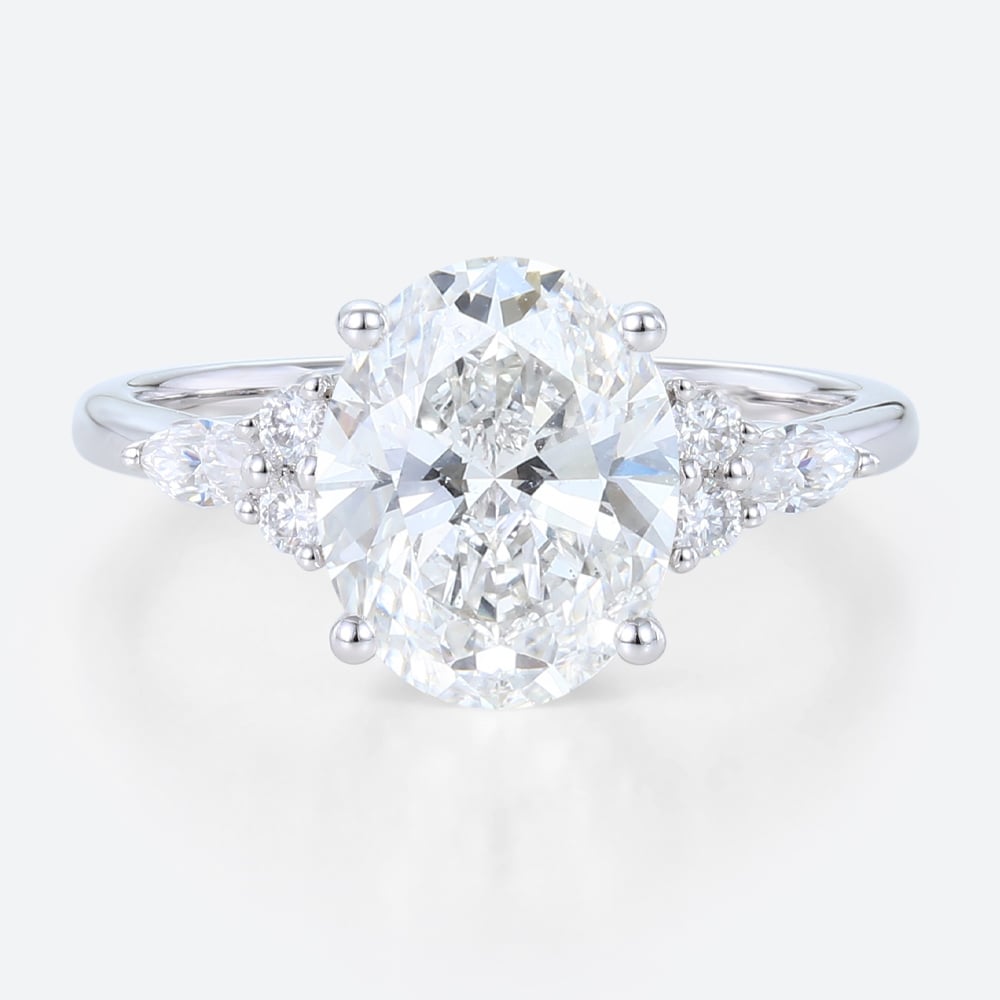
Table and depth percentages are useful, but neither number should be judged in isolation. They describe different parts of the same three-dimensional structure, and their visual effects depend on how the diamond’s crown, pavilion, girdle, and facets work together.
For example, a relatively large table does not automatically make a diamond brighter. A relatively deep diamond does not automatically have poor light performance, either. The result depends on the complete combination of proportions—not simply whether one number falls inside a popular online range.
A helpful way to understand this relationship is to compare three general proportion profiles:
| Proportion Profile | Possible Face-Up Appearance | What to Check |
|---|---|---|
| Relatively shallow | May appear larger for its carat weight, but extreme shallowness can reduce contrast or light return | Look for pale, transparent, or watery areas |
| Well-balanced | Often provides a pleasing balance of brightness, fire, contrast, and face-up spread | Observe the diamond in different lighting and angles |
| Relatively deep | May appear smaller face-up because more weight is carried below the girdle | Check for persistent darkness or unnecessary hidden weight |
These are tendencies rather than guaranteed results. Two diamonds with the same table and depth percentages may still look different because their crown angles, pavilion angles, facet alignment, symmetry, and cutting style are not identical.
Face-Up Size vs. Hidden Weight
Depth percentage also helps explain why two diamonds of the same shape and carat weight may not appear equally large.
Carat measures weight, not visible dimensions. A diamond that carries more of its weight below the girdle may have a smaller face-up outline than another diamond of the same carat weight. In contrast, a shallower diamond may spread wider across the finger—but a larger-looking outline is not necessarily better if the proportions reduce visual performance.
This is why millimeter measurements deserve a place beside table and depth percentages. When comparing two diamonds, review:
- Carat weight
- Length and width in millimeters
- Total depth in millimeters
- Table percentage
- Depth percentage
- Cut grade, when applicable
- Face-up video or in-person appearance
The goal is not simply to find the largest-looking diamond. It is to find a satisfying balance between visible size, light behavior, shape, and overall design.
Is There One Ideal Diamond Table and Depth Ratio?
The short answer is no. There is no single table-and-depth combination that guarantees the best diamond in every shape, size, and cutting style.
Proportion recommendations are most useful as a screening tool. They can help you narrow a large group of diamonds, but they should not replace the laboratory cut grade or a careful visual inspection. IGI evaluates cut using multiple proportion and workmanship factors rather than treating table and depth as a complete grading formula.
This distinction is especially important because different diamond shapes use light differently.
Round Brilliant Diamonds
Round brilliants have a highly standardized facet arrangement, so table and depth ranges can be particularly helpful during the initial search.
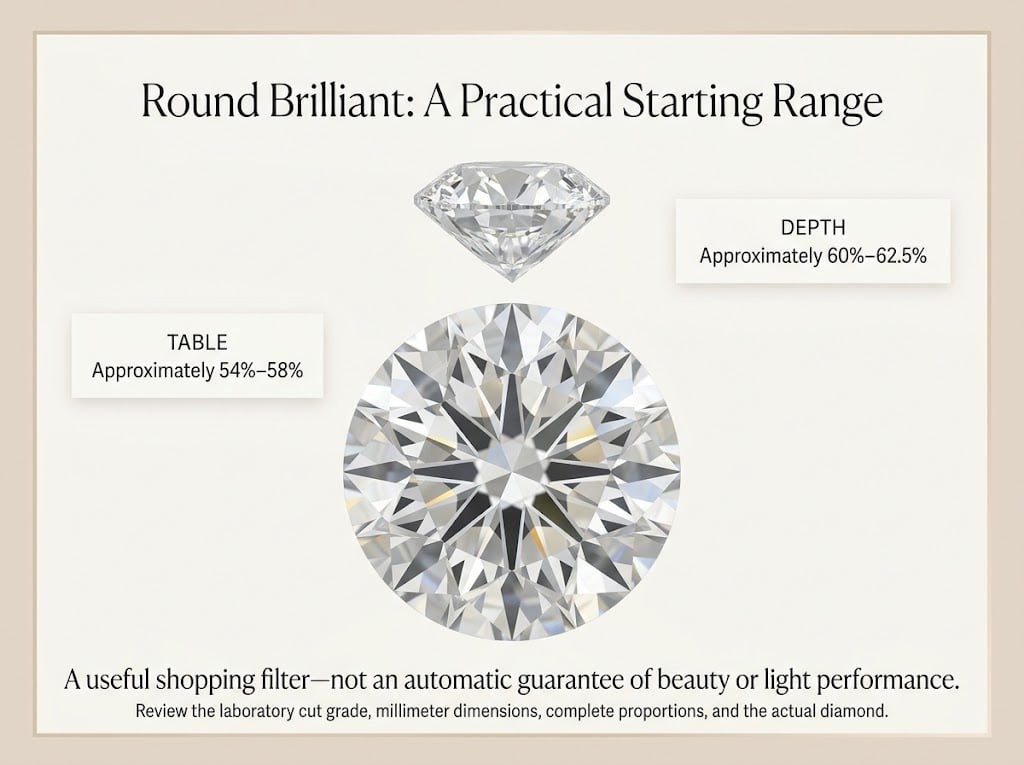
As a practical shopping starting point, many buyers look for:
- Table: approximately 54%–58%
- Depth: approximately 60%–62.5%
These figures should be treated as a focused search window—not as absolute pass-or-fail boundaries. A round diamond just outside the range may still perform beautifully, while one inside it can be less appealing if other proportions are poorly coordinated.
For round brilliants, consider the laboratory cut grade first, then use table and depth percentages to understand why two diamonds within the same grade may have slightly different visual personalities.
A smaller table is often associated with a relatively higher crown and may encourage more visible spectral color, commonly called fire. A somewhat larger table may favor a broad, bright face-up appearance. However, these effects depend on the rest of the diamond’s geometry, particularly the crown and pavilion angles.
Fancy-Shaped Diamonds
Oval, pear, marquise, cushion, princess, emerald, and Asscher-style diamonds should not be judged by round-brilliant standards.
For fancy shapes, table and depth remain valuable, but other factors may be equally—or more—important:
- Oval, pear, and marquise: bow-tie visibility, outline symmetry, and length-to-width ratio
- Cushion: facet pattern, corner shape, and whether the outline is square or elongated
- Princess: corner symmetry, depth distribution, and setting protection
- Emerald and Asscher-style: step alignment, windowing, contrast, and transparency
- All fancy shapes: actual length and width measurements for face-up coverage
IGI’s approach to fancy-shape cut evaluation reflects this broader relationship between proportions, craftsmanship, contrast, and light behavior. A single “ideal” percentage cannot describe every attractive fancy-shaped diamond.
The most useful ideal cut proportions guide, therefore, is not a rigid list of numbers. It is a decision framework: begin with shape-specific reference ranges, examine the complete grading report, and confirm that the diamond looks lively and balanced in motion.
How to Read Diamond Certificate Specs
When people search for how to read diamond certificate specs, they are usually trying to answer one practical question: Do these numbers suggest that the diamond is well cut?
Although “diamond certificate” is widely used by shoppers, diamond grading report is the more precise term. An IGI grading report records the diamond’s identification details, measurements, quality grades, and relevant proportion information. Table and depth percentages are usually shown in or near the proportions diagram.
Here is how to review those specifications in a useful order.
1. Begin with the Measurements
The measurements show the diamond’s physical dimensions in millimeters.
A round diamond may be listed in a format such as:
6.48–6.52 × 3.96 mm
The first two numbers represent the minimum and maximum diameter. The third is the diamond’s total depth.
A fancy-shaped diamond usually follows this format:
Length × Width × Depth
For example:
9.10 × 6.45 × 3.92 mm
These dimensions help you understand how large the diamond may appear from the top. When comparing diamonds of equal carat weight, the one with greater length and width may offer more visible finger coverage—but only if its proportions and light performance remain attractive.
Locate the Table and Depth Percentages
Next, find the table and depth values on the proportions diagram.
Imagine that a round brilliant is listed with:
- Table: 56%
- Depth: 61.4%
These numbers fall within a commonly preferred starting range for round brilliants. However, they should not be interpreted as proof that the diamond will be exceptional. They simply indicate that the diamond deserves further consideration.
For fancy shapes, compare the percentages only with guidelines created for that particular shape. A table percentage that looks appropriate for an emerald cut may not be appropriate for a round brilliant.
Review the Cut Grade
For round brilliant diamonds, the cut grade is generally more informative than table or depth alone because it considers a broader combination of proportions and workmanship.
If the report provides a cut grade or shape-specific cut assessment, use it as your primary filter. Then examine table, depth, symmetry, polish, and the actual diamond to understand the details behind that grade.
IGI may also provide additional light-performance information for qualifying diamonds, evaluating visual characteristics such as brightness, fire, and contrast. These assessments reinforce an important lesson: attractive light performance cannot be predicted from one percentage alone.
Check the Supporting Specifications
Several nearby details can add context:
- Polish describes the quality of the facet surfaces.
- Symmetry evaluates the precision and alignment of the diamond’s shape and facets.
- Girdle thickness indicates the width of the diamond’s outer edge.
- Culet describes the facet—or point—at the bottom of the pavilion.
- Crown and pavilion information, when provided, offers a fuller view of the diamond’s geometry.
A table and depth combination may look promising, but the complete set of specifications provides a more responsible basis for comparison.
Confirm the Diamond Visually
A grading report cannot show every aspect of a diamond’s personality. Before making a final choice, view a clear face-up video or examine the stone in person when possible.
Look for:
- Even brightness across the diamond
- Balanced light and dark contrast
- Sparkle that moves across the facets
- No large, persistently dull areas
- A pleasing and symmetrical outline
- No distracting bow tie or windowing in fancy shapes
Online videos should also be interpreted carefully. Bright studio lighting, magnification, camera reflections, and rotating platforms can influence how a diamond appears on screen.
Common Table-and-Depth Mistakes
Treating the Numbers as a Guarantee
A diamond does not become beautiful simply because its table and depth fall within an online “ideal” range. Those numbers are preliminary filters, not a replacement for cut grading and visual evaluation.
Applying Round Guidelines to Every Shape
Fancy shapes have different outlines, facet arrangements, and visual priorities. Oval and pear diamonds require bow-tie evaluation, while emerald and Asscher-style diamonds should be checked for windowing and balanced step patterns.
Assuming Shallower Always Means Larger and Better
A shallow stone may offer more face-up spread, but excessive shallowness can affect light return. Visible size should be balanced with overall optical performance.
Ignoring Millimeter Dimensions
Carat weight tells you how much a diamond weighs—not exactly how large it will look. Always compare length and width measurements when evaluating face-up size.
Buying from the Report Alone
Two diamonds with similar specifications may look noticeably different in motion. The report narrows the search; the actual diamond completes the decision.
Final Thoughts: Use Proportions as a Guide, Not a Verdict
Understanding diamond depth and table percentage makes it easier to compare diamonds with confidence. Table percentage describes the relative size of the top facet, while depth percentage shows how the diamond’s height relates to its face-up width or diameter.
Neither number determines beauty by itself.
A thoughtful buying process begins with shape-specific proportions, laboratory grading information, and millimeter measurements. It then considers light performance, outline, facet pattern, and personal preference. The best diamond is not necessarily the one with the most “perfect-looking” percentages—it is the one whose proportions create a beautiful result in the actual stone.
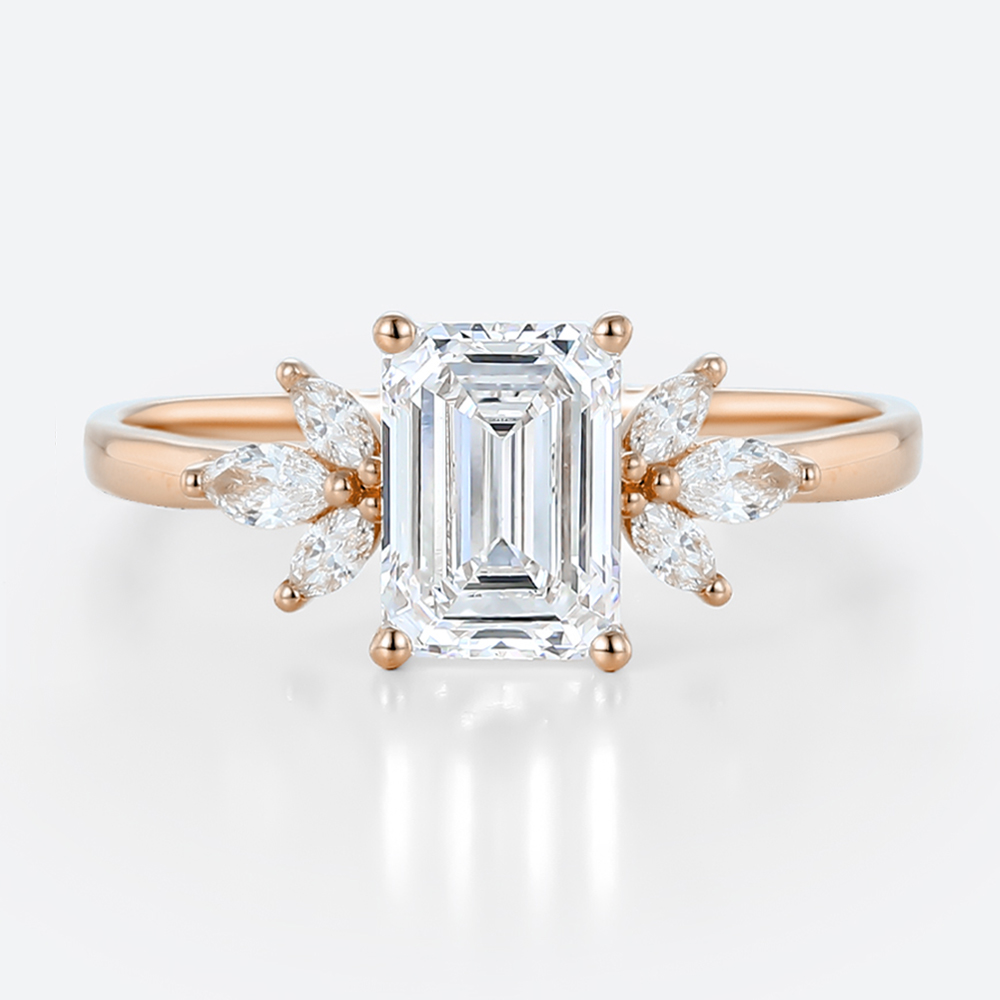
When exploring a LisaJewelryUS engagement ring, use the grading report to understand the diamond, then let its appearance and the finished ring design guide your final choice.
Frequently Asked Questions
A practical starting range is approximately 54%–58% table and 60%–62.5% depth. Use these figures with the cut grade and visual appearance.
No. Sparkle also depends on crown and pavilion geometry, facet alignment, symmetry, polish, contrast, and lighting.
No. A shallower diamond may look larger, but excessive shallowness can reduce balanced light return.
No. Oval, pear, cushion, emerald, and other shapes require shape-specific evaluation and visual checks.
The same proportion principles apply. “Lab-grown” describes the diamond’s origin, while table, depth, and cut describe its physical design.
They are generally displayed in the proportions section or diagram, near measurements and details such as the girdle and culet.