











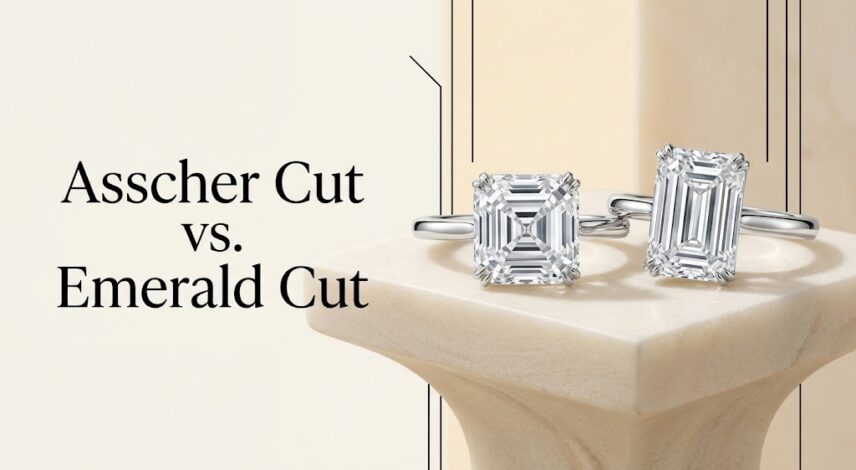
Asscher and emerald-cut diamonds share an unmistakable visual language. Instead of relying on the rapid, splintered sparkle associated with many brilliant cuts, they use long step facets to produce broad flashes, dramatic contrast, and an architectural sense of depth.
Yet the two shapes do not create the same effect.
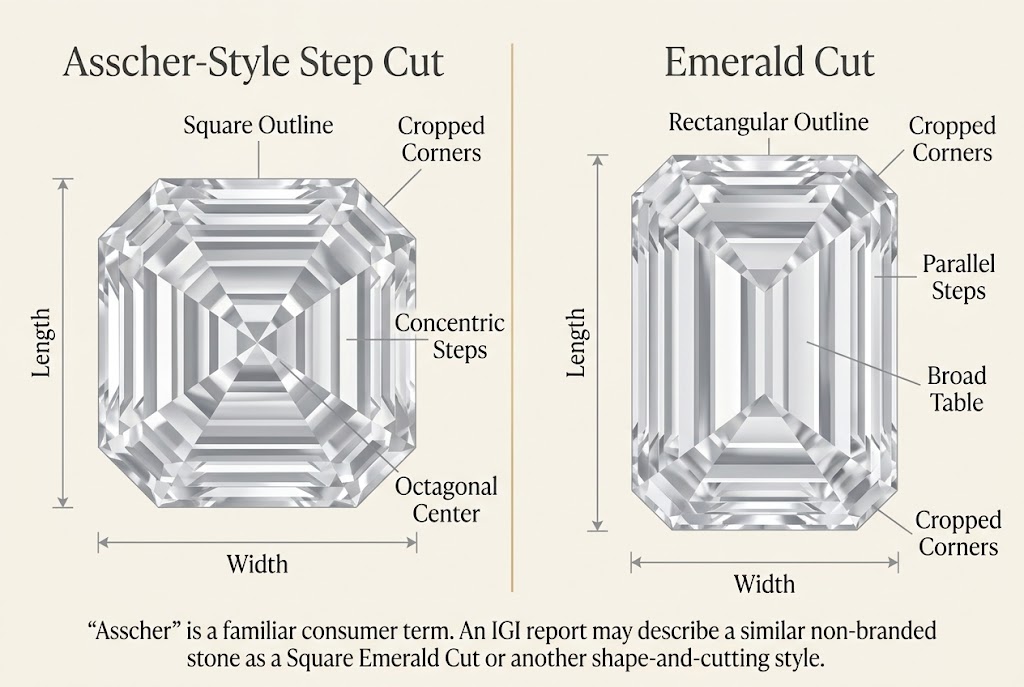
An Asscher-style diamond is square or nearly square, with cropped corners and concentric facets that seem to draw the eye inward. An emerald-cut diamond stretches those steps across a rectangular outline, producing a longer and more linear appearance.
So, in the Asscher vs. emerald cut comparison, which one offers better brilliance, greater visual size, and the right character for an Art Deco engagement ring? The answer depends not only on shape, but also on proportions, clarity, light return, and the individual diamond’s facet pattern.
Quick Answer: Asscher or Emerald Cut?
Choose an Asscher-style diamond if you prefer square geometry, concentric depth, and a strong vintage personality. Choose an emerald-cut diamond if you want an elongated silhouette, greater north-to-south finger coverage, and broad linear flashes.
In simple terms:
- Asscher: Square, architectural, hypnotic and distinctly vintage
- Emerald: Elongated, elegant, linear and understated
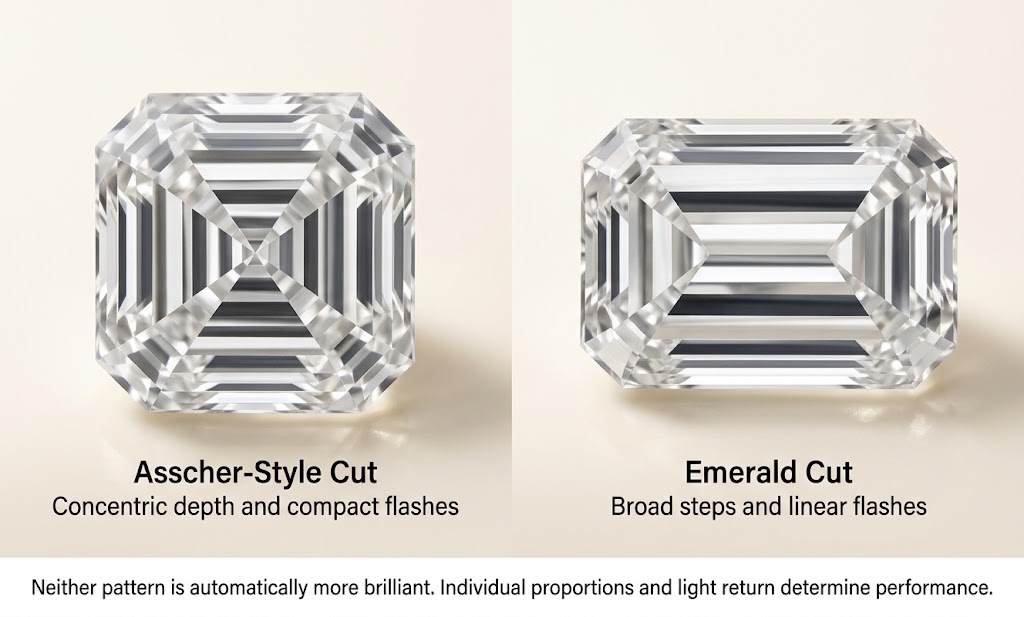
Neither shape is automatically more brilliant or better cut. Step-cut beauty depends on how evenly the facets reflect light, how the proportions work together, and whether the pattern remains lively as the diamond moves.
Asscher vs. Emerald Cut at a Glance
| Feature | Asscher-Style Diamond | Emerald-Cut Diamond |
|---|---|---|
| Outline | Square or nearly square with cropped corners | Rectangular with cropped corners |
| Facet impression | Concentric and octagonal | Long and parallel |
| Light pattern | Compact, pulsing flashes | Broad, linear flashes |
| Face-up appearance | Deep and architectural | Long and open |
| Finger coverage | Concentrated around the center | Greater north-to-south length |
| Same-carat appearance | May look smaller because of greater depth | Often appears larger face-up |
| Style association | Strong Art Deco personality | Art Deco, classic or minimalist |
| Best for | Square vintage geometry | Sleek elongated elegance |
These are general tendencies, not guarantees. A well-spread Asscher may appear larger than a deeply cut emerald, while two diamonds with identical carat weights and grading details may still reflect light very differently.
Understanding Step Cuts, Asschers, and Emerald Cuts
Before comparing the two shapes, it helps to understand what makes a step cut different from a brilliant cut.
What Is a Step-Cut Diamond?
Step cuts use long, usually four-sided facets arranged in parallel rows. These facets descend from the outer edge toward the center like a series of steps.
Brilliant cuts typically rely on more triangular and kite-shaped facets to create frequent points of sparkle. Step cuts produce fewer rapid flashes, but the flashes they create are often larger, broader, and more structured.
This difference does not mean that step cuts are less beautiful or poorly performing. They simply express light differently.
Step cuts do not compete through constant glitter. Their beauty comes from broad mirrors, geometric repetition, and the movement between light and shadow.
This is why a vintage step cut diamond may feel calm and understated in one lighting environment, then become dramatically reflective as the wearer moves their hand.
What Is an Asscher Cut?
An Asscher-style diamond is generally square or nearly square, with four cropped corners that create an eight-sided face-up outline. Its step facets form a concentric pattern, leading the eye from the outer edge toward the center.
The original Asscher Cut was introduced by Joseph Asscher in 1902 and later became closely associated with the geometric jewelry of the Art Deco era. Modern square step cuts may preserve this vintage character while using updated cutting precision and contemporary settings.
However, not every square step-cut diamond is a branded Royal Asscher Cut. On an IGI report, an Asscher-like stone may be described as a Square Emerald Cut or another shape-and-cutting-style term that reflects its actual structure.
This distinction matters when comparing diamonds online. “Asscher” may be used as a familiar consumer term, while the independent grading report may use more technical wording.
Asscher-style diamonds are also often deeper than emerald cuts. That additional depth can enhance the inward, layered appearance of the facets, but it may place more carat weight below the face-up surface.
What Is an Emerald Cut?
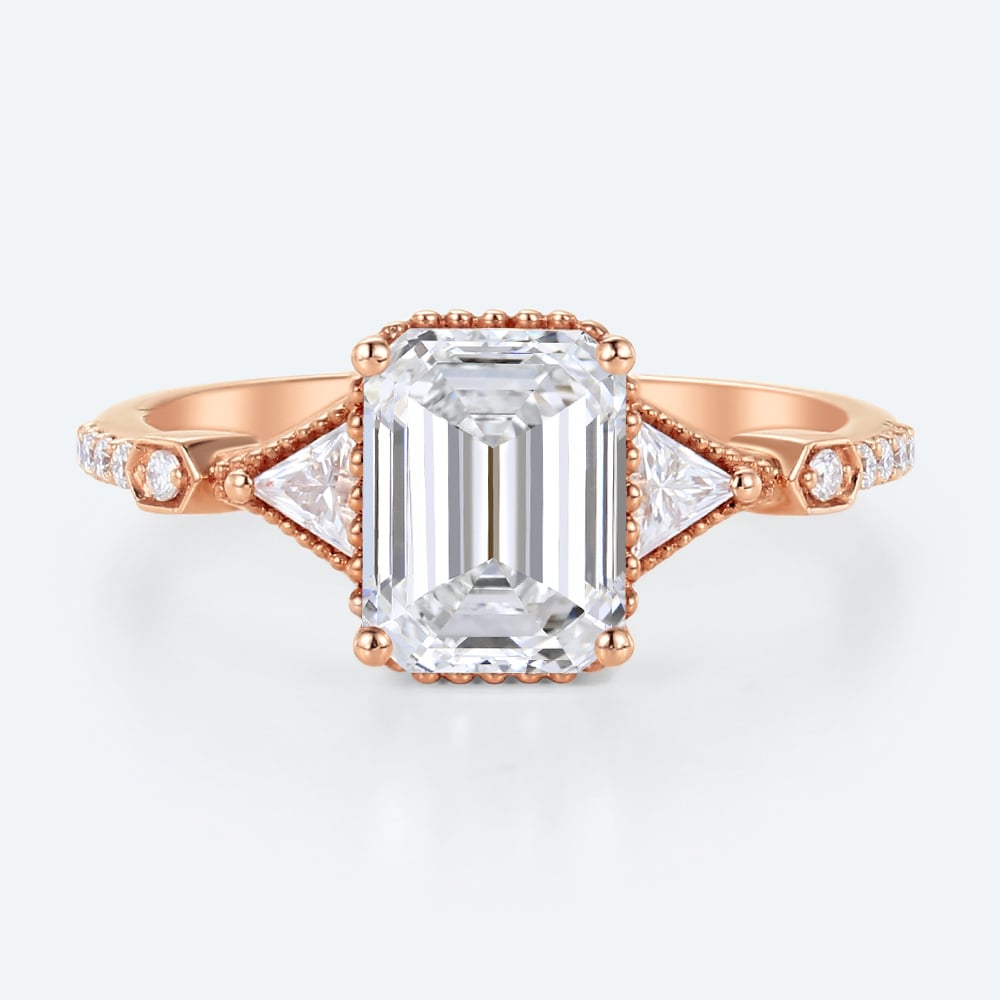
An emerald-cut diamond has a rectangular outline, four cropped corners, and long step facets running parallel to its sides.
Where an Asscher creates a compact, inward-looking pattern, an emerald cut extends its reflections across a longer surface. Its broad table and linear facets can make the diamond appear open, elegant, and visually calm.
Emerald cuts are highly versatile. In a platinum setting with baguette side stones, the shape can feel distinctly Art Deco. In a simple yellow-gold solitaire, it may look modern and minimalist. A three-stone setting can emphasize its symmetry, while an east-west bezel can transform it into a contemporary statement ring.
The length-to-width ratio plays a major role in the final appearance. A broader emerald cut feels more substantial and balanced, while a slender emerald creates a stronger vertical line along the finger.
Asscher vs. Emerald Brilliance: How Do They Reflect Light?
“Which one sparkles more?” is one of the most common questions about these two shapes, but sparkle alone does not fully describe step-cut performance.
An Asscher-style diamond generally produces more compact flashes arranged around its octagonal center. As the diamond moves, the steps may appear to light up in sequence, creating a deep, almost hypnotic corridor effect. This is often described as a “hall of mirrors.”
An emerald cut produces longer flashes that travel across its rectangular outline. Its reflections may feel broader and more fluid, with alternating bands of light and dark creating a clean, linear rhythm.
The visual distinction can be summarized as:
- Asscher: Concentric depth and compact flashes
- Emerald: Linear movement and broad flashes
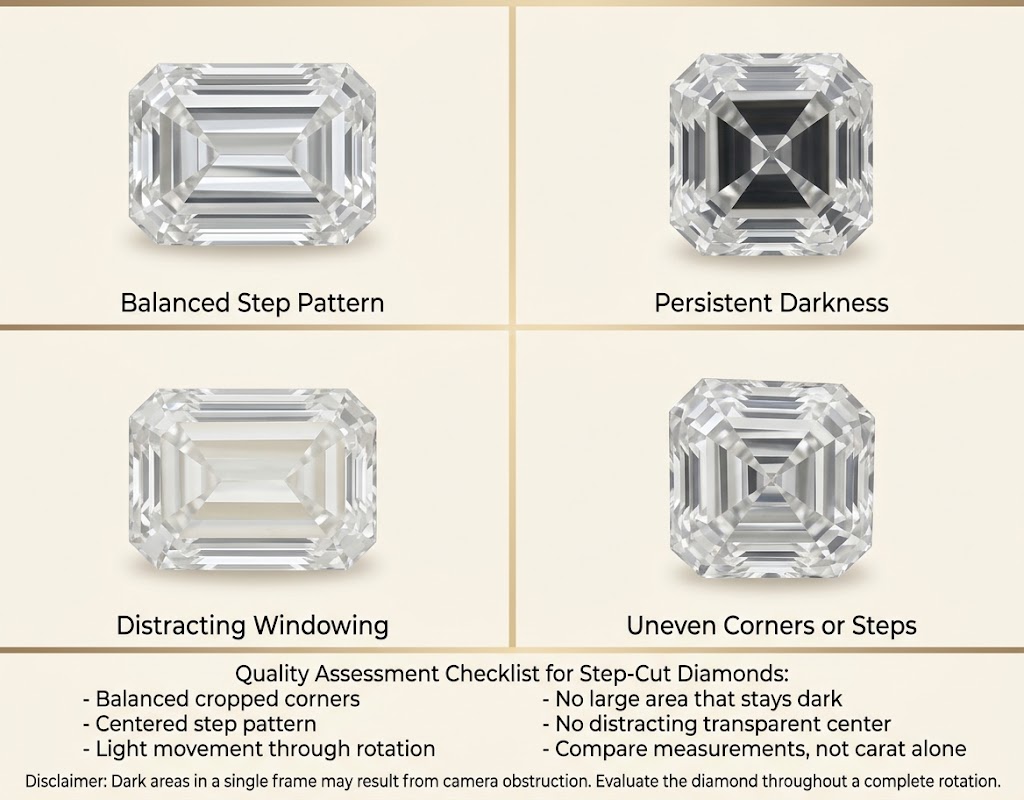
Neither pattern is inherently brighter. An attractive example of either shape should show balanced light return, distinct step definition, and movement throughout the stone. Large areas that remain persistently dark or overly transparent may distract from the intended pattern.
Cut quality therefore matters more than the shape name. An expertly proportioned emerald cut may look livelier than a poorly balanced Asscher, while a beautifully cut Asscher may show greater depth and movement than an emerald with weak or uneven reflections.
Whenever possible, compare videos rather than relying on a single still image. Step cuts reveal their character through movement, and a photograph may capture only one moment of brightness or darkness.
Which Cut Looks Larger on the Hand?
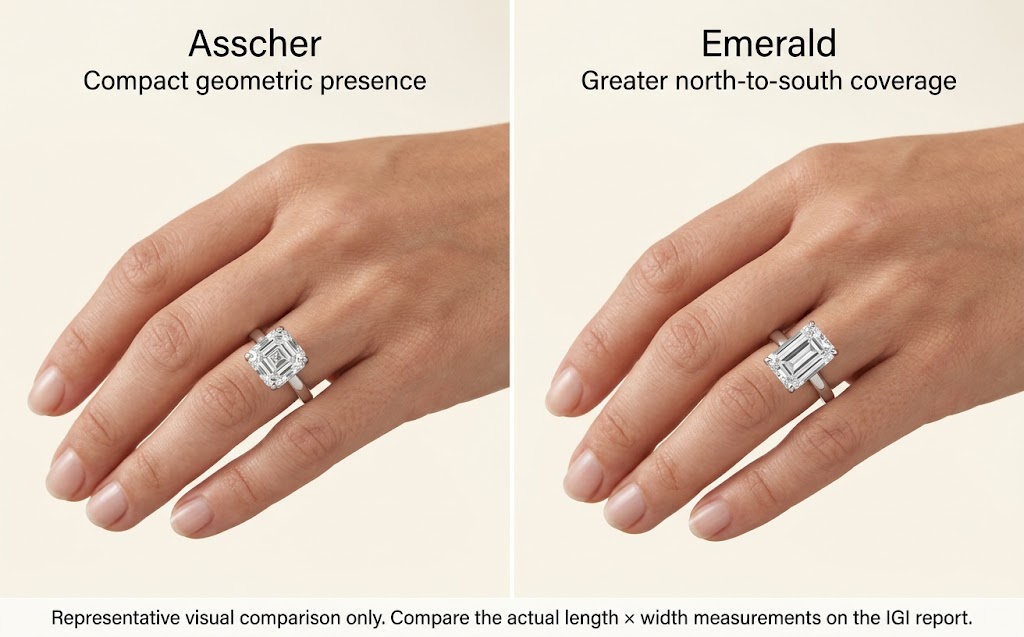
Carat measures weight, not visible size. Because Asscher-style diamonds are often relatively deep, more of their weight may sit below the girdle. Emerald cuts usually distribute their weight across a longer outline and may therefore appear larger from the top at the same carat weight.
This is a general tendency rather than a rule. When comparing two diamonds, review the length × width measurements on their IGI reports instead of relying on carat weight alone.
The shapes also create different effects on the hand:
- An Asscher concentrates its geometry around the center of the finger, creating a balanced, architectural presence.
- An emerald cut extends farther along the finger, creating more north-to-south coverage and a stronger sense of length.
You do not need a particular finger shape for either diamond. Band width, setting design, diamond proportions, and personal preference matter more than a universal hand-shape rule.
Clarity and Color: Are Step Cuts Less Forgiving?
The large table and open facets of a step cut may make certain inclusions easier to see than they would be in a brilliant cut with a busier sparkle pattern.
However, this does not mean every Asscher or emerald-cut diamond requires a VS1 clarity grade or higher. An eye-clean VS2 may offer excellent value, depending on the inclusion’s size, position, color, and nature.
Pay particular attention to:
- Dark inclusions beneath the table;
- Inclusions reflected repeatedly through the steps;
- Features near cropped corners or the girdle;
- Marks visible without magnification.
Color may also appear more noticeable through broad, open facets. Buyers who prefer an icy look may prioritize a higher color grade, while warmer diamonds can pair beautifully with yellow or rose gold.
Evaluate the finished appearance rather than choosing a grade from a chart alone.
Proportions: Look Beyond a Single Ratio
An Asscher-style diamond generally looks square at a length-to-width ratio of approximately 1.00:1 to 1.05:1. As the ratio increases, the outline begins to appear more rectangular.
Emerald cuts offer more variation:
- A broader emerald feels substantial and balanced;
- A moderately elongated emerald creates a classic rectangular look;
- A slender emerald emphasizes length and drama.
There is no single ideal ratio for every shopper. Ratio describes the outline, but it cannot show whether the diamond has attractive light return.
When viewing photos and videos, check that:
- The cropped corners appear balanced;
- The steps are centered and symmetrical;
- Light moves across the stone as it turns;
- No large area remains persistently dark;
- The center does not look overly transparent or empty.
A single dark frame is not enough to reject a diamond. Some darkness may result from the camera or viewer blocking the light, so evaluate the stone throughout a complete rotation.
Which Cut Is Better for an Art Deco Engagement Ring?
Both shapes work beautifully in an Art Deco engagement ring, but they express the style differently.Both shapes work beautifully in an Art Deco engagement ring, but they express the style differently.
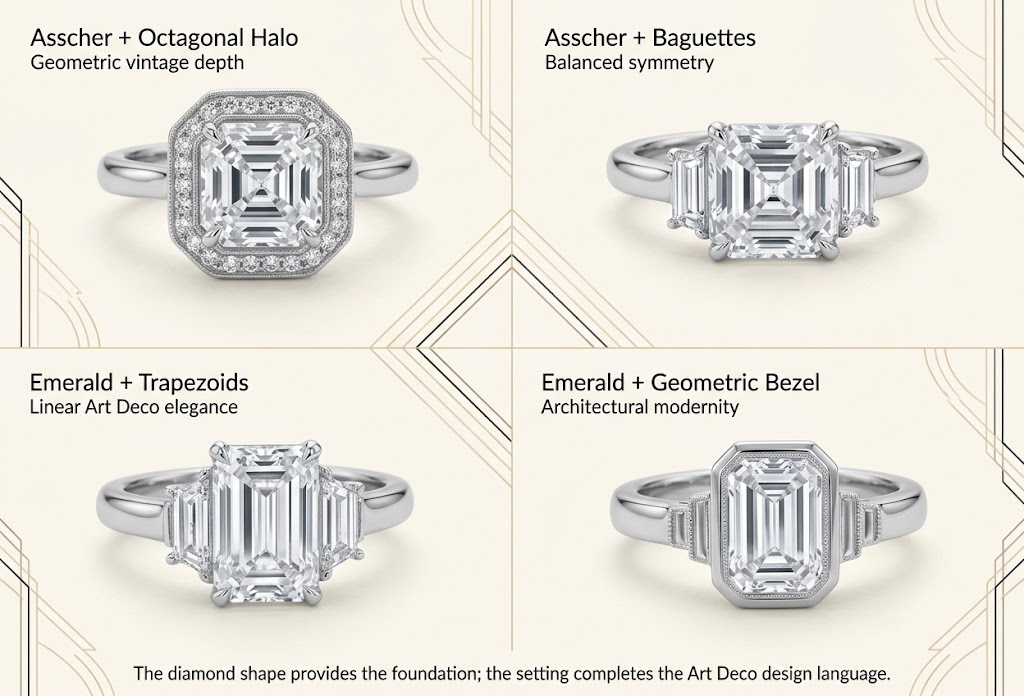
An Asscher’s square outline and octagonal center naturally complement:
- Geometric halos;
- Symmetrical baguette side stones;
- Milgrain borders;
- Engraved platinum details;
- Calibrated colored-gemstone accents.
An emerald cut creates a longer and more linear interpretation of Art Deco design. It pairs especially well with trapezoid side stones, stepped shoulders, baguettes, target halos, and architectural bezels.
Neither shape has to look vintage. A simple solitaire, east-west bezel, or polished yellow-gold band can make either diamond feel distinctly contemporary.
LisaJewelryUS Expert Note: A diamond shape does not make a ring Art Deco by itself. The setting, metal, side stones, symmetry, and decorative details create the finished design language.
Asscher or Emerald Cut: Which Should You Choose?
Choose an Asscher-Style Diamond If You Want…
- Square or nearly square geometry;
- Concentric visual depth;
- A strong vintage personality;
- A compact, architectural center stone;
- A distinctive alternative to a square brilliant.
Choose an Emerald-Cut Diamond If You Want…
- An elongated rectangular outline;
- Broad, linear flashes;
- More north-to-south finger coverage;
- A shape that transitions easily between vintage and modern settings;
- Elegant pairing with baguette or trapezoid side stones.
Whichever shape you prefer, compare actual diamonds rather than shape illustrations alone. Two step cuts with similar grades can display very different patterns in motion.
Final Verdict: Concentric Depth or Linear Elegance?
The Asscher cut offers square geometry, concentric depth, and a strong vintage identity. The emerald cut provides elongated elegance, broad flashes, and greater visual coverage.
Neither is automatically more brilliant. The better choice is the diamond whose steps remain balanced and lively—and whose silhouette feels right on your hand.
Frequently Asked Questions
The terms are often used interchangeably by shoppers, but an IGI report may describe an Asscher-like diamond as a Square Emerald Cut or another shape-and-cutting style. A branded Royal Asscher Cut has its own specific design.
An emerald cut often appears larger at the same carat weight because of its longer face-up outline. Asschers may carry more weight in their depth. Always compare the actual millimeter measurements.
Neither automatically sparkles more. Asschers produce compact, concentric flashes, while emerald cuts show broader linear reflections. The individual diamond’s proportions, symmetry, and light return determine how lively it appears.
Their broad, open facets may make some inclusions easier to see. Rather than requiring a specific clarity grade, look for an eye-clean diamond and consider the inclusion’s position, color, and visibility.
Yes. Its square, octagonal geometry works especially well with symmetrical halos, baguettes, milgrain, and engraved details. Emerald cuts are equally suitable for a more elongated, linear interpretation of Art Deco style.
Yes. Lab-grown describes the diamond’s origin, while Asscher-style and emerald cut describe its shape and faceting. Apply the same standards for proportions, clarity, light performance, and IGI documentation.