












Cubic Zirconia vs. Moissanite vs. Lab Grown Diamond: The Ultimate Matrix
by Lisa Jewelry US 0 comments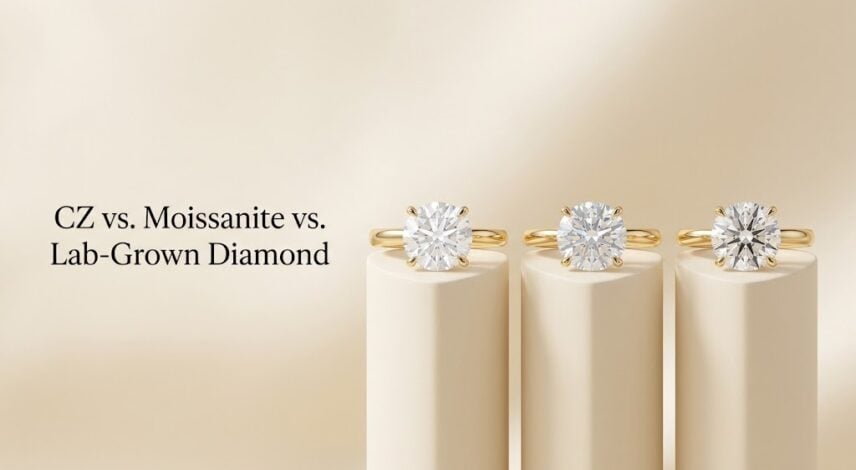
Cubic zirconia, moissanite, and lab-grown diamonds may all appear bright and colorless in a jewelry photo, but they are not interchangeable stones.
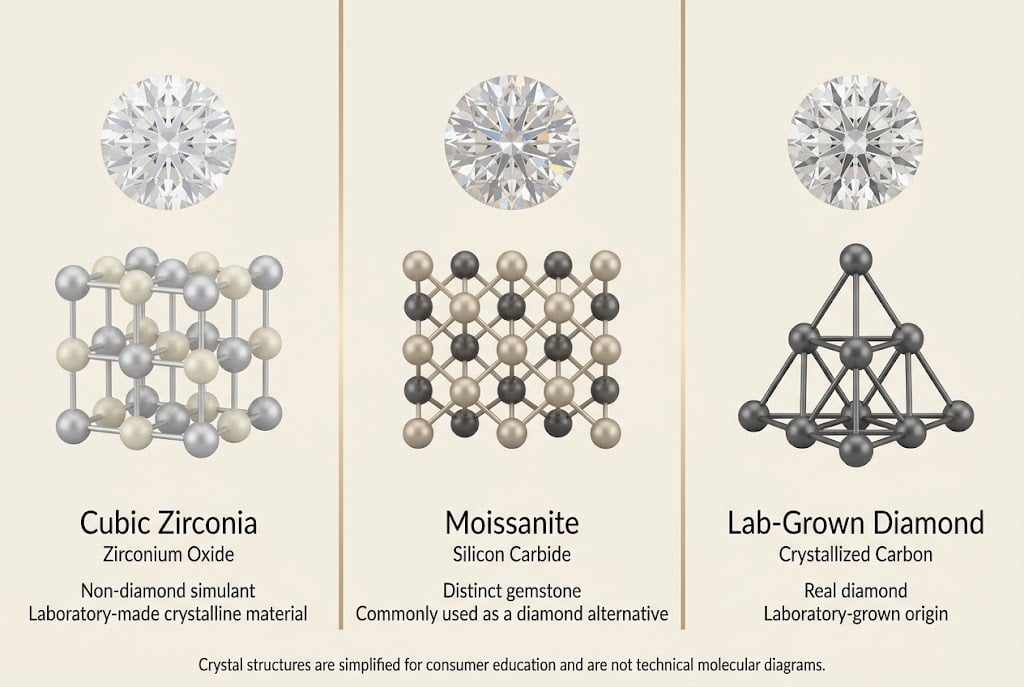
Cubic zirconia is an affordable diamond simulant made from zirconium oxide. Moissanite is a distinct silicon-carbide gemstone known for its intense rainbow fire and durability. A lab-grown diamond, meanwhile, consists of crystallized carbon and has essentially the same chemical, physical, and optical properties as a natural diamond.
Understanding these differences matters when choosing an engagement ring, travel ring, or everyday jewelry. The right stone depends on whether your priority is price, colorful sparkle, long-term wear, or genuine diamond identity.
In this cubic zirconia vs. moissanite vs. lab diamond comparison, we will look beyond surface appearance to explain what each material actually offers.
Quick Answer: CZ, Moissanite, or Lab-Grown Diamond?
Choose cubic zirconia for affordable fashion or temporary jewelry. Choose moissanite if you want a durable non-diamond gemstone with pronounced rainbow fire. Choose a lab-grown diamond if you want a real diamond with diamond grading and documentation.
In short:
- Cubic zirconia: Best for the lowest budget, travel rings, or occasional wear
- Moissanite: Best for durable, non-diamond everyday jewelry
- Lab-grown diamond: Best for genuine diamond properties and an IGI grading report
There is no single winner for every shopper. Each stone serves a different purpose, and each can be a reasonable choice when its identity and limitations are clearly understood.
The Ultimate Comparison Matrix
The chart below summarizes the most important differences among the three materials.
| Feature | Cubic Zirconia | Moissanite | Lab-Grown Diamond |
|---|---|---|---|
| Material | Zirconium oxide | Silicon carbide | Crystallized carbon |
| Is it a diamond? | No | No | Yes |
| Category | Diamond simulant | Distinct gemstone often used as a diamond simulant | Laboratory-grown diamond |
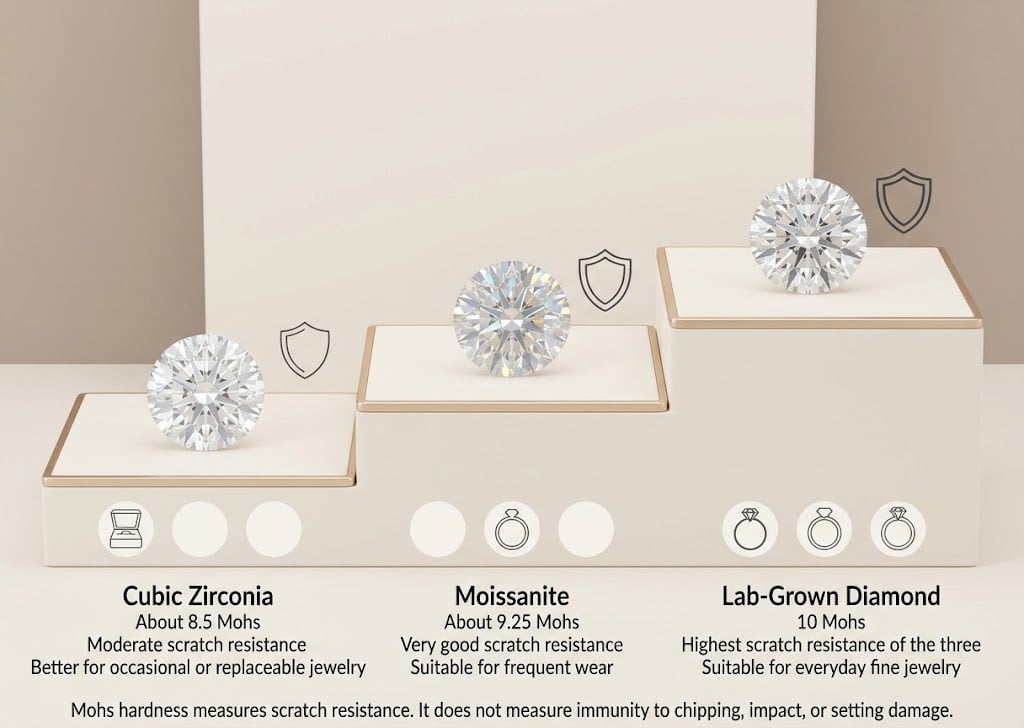
| Mohs hardness | About 8.5 | About 9.25 | 10 |
| Refraction | Singly refractive | Doubly refractive | Singly refractive |
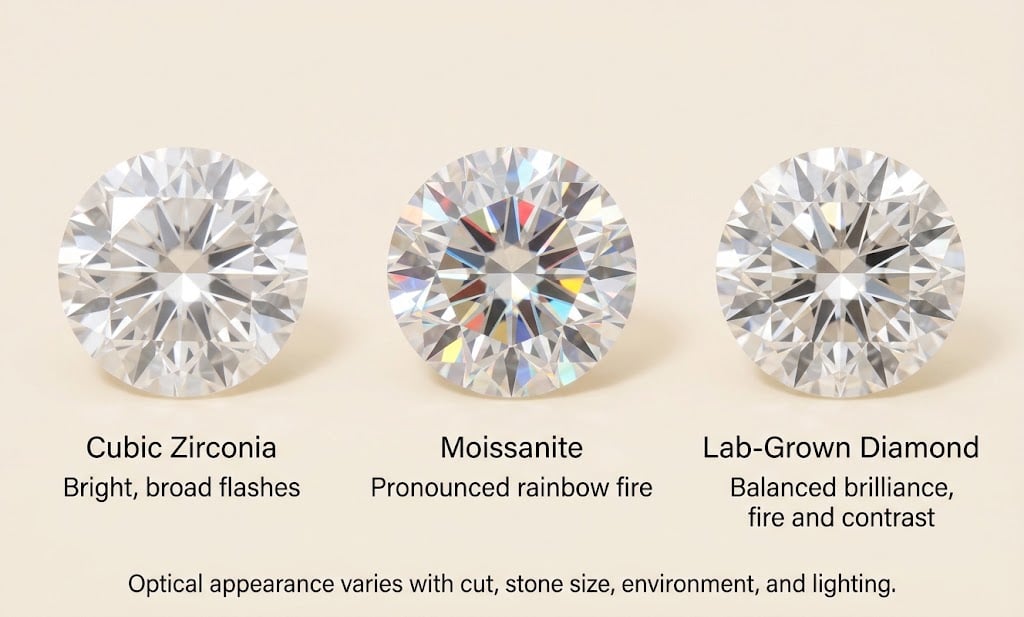
| Light style | Bright, broad flashes | Strong rainbow fire | Balanced brilliance, fire, and contrast |
| Everyday-wear durability | Moderate | Very good | Excellent scratch resistance |
| Documentation | Usually seller documentation | Varies by seller | May include an IGI diamond report |
| Relative price | Lowest | Middle | Generally highest of the three |
| Common uses | Fashion jewelry, travel rings, temporary rings | Daily-wear non-diamond jewelry | Fine jewelry and engagement rings |
These are general gemological comparisons. The durability and appearance of a finished ring also depend on the stone’s cut, setting, craftsmanship, maintenance, and how the jewelry is worn.
Lisa Jewelry Expert Note: Mohs hardness measures resistance to scratching. It does not mean that a gemstone is immune to chipping, impact, or damage.
First, Understand What Each Stone Really Is
The most important difference among these three options is not price or sparkle. It is material identity.
What Is Cubic Zirconia?
Cubic zirconia, usually abbreviated as CZ, is a laboratory-made crystalline material composed primarily of zirconium oxide.
It is not a diamond and does not contain crystallized carbon. Instead, it is designed to create a bright, colorless appearance similar enough to diamond for use in jewelry.
CZ should not be described as glass. Although it is inexpensive compared with moissanite and diamond, it is a manufactured crystalline material with its own physical and optical properties.
Its affordability makes it popular for:
- Fashion jewelry;
- Travel or vacation rings;
- Temporary engagement rings;
- Large statement pieces;
- Testing a stone size or shape before purchasing fine jewelry.
A colorless CZ may look bright and attractive when new. However, its lower scratch resistance means that frequent wear may eventually create small surface abrasions that reduce the crispness of its reflections.
This does not make CZ a “bad” stone. It simply means it is generally better suited to jewelry where affordability and visual impact matter more than decades of daily wear.
What Is Moissanite?
Moissanite is composed of silicon carbide. Natural moissanite is extremely rare, so the gem-quality material used in modern jewelry is generally created in a laboratory.
Although moissanite may be used as a diamond alternative, it is not a type of diamond. It is a distinct gemstone with its own appearance and optical behavior.
One of its most recognizable characteristics is strong dispersion, commonly called fire. When white light enters the stone, it separates into flashes of spectral color. Moissanite typically shows more visible rainbow fire than diamond, particularly in larger sizes and under direct lighting.
Moissanite is also doubly refractive. In some cuts and viewing angles, this optical property can cause facet junctions to appear slightly doubled. The effect may be difficult to notice in a small stone but more visible in certain larger cuts.
With a Mohs hardness of approximately 9.25, moissanite offers very good scratch resistance. This makes it one of the most durable common non-diamond options for an engagement ring or other jewelry intended for frequent wear.
Choose moissanite because you enjoy its fire, durability, and identity—not because it is expected to imitate a diamond perfectly.
What Is a Lab-Grown Diamond?
A lab-grown diamond is a real diamond produced in a controlled laboratory environment rather than formed underground.
It consists of crystallized carbon and has essentially the same chemical, physical, and optical properties as a natural diamond. The main distinction is its origin.
Lab-grown diamonds are typically created using one of two growth methods:
- CVD: Chemical Vapor Deposition
- HPHT: High Pressure High Temperature
The growth method does not automatically determine whether the finished diamond is beautiful. Cut, color, clarity, transparency, proportions, and overall light performance remain more important when comparing individual stones.
IGI can examine a lab-grown diamond to confirm its laboratory origin, evaluate its characteristics, disclose relevant post-growth treatments, and document its grading information.
An IGI lab-grown diamond report may include:
- Shape and cutting style;
- Carat weight;
- Measurements;
- Color grade;
- Clarity grade;
- Polish;
- Symmetry;
- Fluorescence;
- Laboratory-growth information;
- Report number and identifying details.
The report provides valuable documentation, but it should be considered together with high-resolution photos and videos. Two lab-grown diamonds with similar grades can still look different because of their proportions and facet patterns.
A “Fake vs. Real Diamond Comparison” Needs Better Labels
“Fake diamond” is a common search phrase, but it is not the most accurate way to describe every diamond-looking stone.
The clearer categories are:
- Cubic zirconia: A non-diamond simulant
- Moissanite: A distinct gemstone that may be used as a diamond simulant
- Lab-grown diamond: A real diamond with laboratory origin
- Natural diamond: A real diamond formed through natural geological processes
A CZ or moissanite is not deceptive when its identity is clearly disclosed. The problem begins only when one material is intentionally represented as another.
For the same reason, a lab-grown diamond should not be marketed simply as a “diamond” without disclosing its laboratory origin. Clear labeling allows consumers to compare materials based on what they actually are.
Lisa Jewelry Expert Note: A lab-grown diamond is not a simulant. Moissanite and CZ resemble diamond, while a lab-grown diamond possesses the defining properties of diamond.

Which One Looks Most Like a Diamond?
The answer depends on what you mean by “looks like a diamond.”
If you mean sharing the actual optical behavior of diamond, then a lab-grown diamond is the straightforward answer—because it is diamond. If you mean creating a similar colorless, sparkling appearance at a lower cost, CZ and moissanite can both serve that role, but in different ways.
Cubic Zirconia: Bright and Uniform
A well-cut colorless CZ can look bright, clean, and impressive, especially in photographs or under controlled jewelry-store lighting.
Its flashes may appear broader and its appearance more uniformly white than that of a diamond. In larger sizes, some shoppers may notice a smoother or less sharply contrasted look.
A new CZ can be visually convincing at normal viewing distance. Over time, however, surface wear and residue may reduce its crispness. Cleaning can remove oil and dirt, but it cannot reverse permanent surface abrasion.
Moissanite: Strong Rainbow Fire
Moissanite is known for producing pronounced flashes of spectral color. Under sunlight, spotlights, or other direct illumination, it may show visible red, orange, green, and blue fire.
Some shoppers love this lively appearance. Others prefer the balance of white brightness, colored fire, and dark contrast typically associated with diamond.
The difference may become more noticeable as the stone size increases. Cut style also matters: certain faceting patterns can reduce or emphasize the rainbow effect.
Moissanite should therefore be evaluated as its own gemstone rather than judged only by how closely it copies a diamond.
Lab-Grown Diamond: Diamond Light Performance
A lab-grown diamond displays the optical behavior of diamond, including:
- Brilliance, or reflected white light;
- Fire, or flashes of spectral color;
- Scintillation, or the light-and-dark sparkle seen during movement;
- Contrast, which gives the facet pattern definition.
However, the words “lab-grown diamond” do not guarantee exceptional sparkle. A poorly proportioned lab-grown diamond may appear less lively than a well-cut moissanite.
When selecting a lab diamond, prioritize the finished stone’s cut quality and visual performance rather than assuming that origin alone determines beauty.
Durability: Which Stone Is Best for Everyday Wear?
If you are choosing a center stone for an engagement ring, durability matters as much as appearance. Rings are exposed to countertops, door handles, cleaning products, skin oils, and accidental impact more often than earrings or necklaces.
However, durability is not measured by a single number.
The Mohs scale describes a material’s resistance to scratching. It does not measure how easily a stone may chip, fracture, or become loose in its setting. Cut, craftsmanship, exposed edges, and daily wearing habits all affect how well a piece of jewelry holds up over time.
Lab-Grown Diamond: Highest Scratch Resistance
Like a natural diamond, a lab-grown diamond ranks 10 on the Mohs scale. It offers the greatest scratch resistance among the three materials and is well suited to an engagement ring intended for long-term daily wear.
That does not make it indestructible. A diamond can still chip when a vulnerable edge, corner, or girdle receives a sufficiently strong impact. Shapes with points—such as pear, marquise, and princess cuts—benefit from protective prongs or bezel-style settings.
Regular inspections remain important, particularly for rings with thin prongs, pavé diamonds, or elevated center settings.
Moissanite: A Durable Non-Diamond Alternative
With a Mohs hardness of approximately 9.25, moissanite offers excellent scratch resistance for everyday jewelry.
For shoppers researching the best diamond alternative durability, moissanite is generally the strongest common non-diamond option among these three materials. It can withstand regular wear better than CZ while providing a bright, highly dispersive appearance.
Moissanite can still collect oils and residue, and it is not immune to damage. A secure setting, appropriate cleaning, and sensible wearing habits are still necessary.
Cubic Zirconia: Better for Occasional or Replaceable Jewelry
CZ ranks approximately 8.5 on the Mohs scale. That is hard enough for use in jewelry, but its surface is more likely to develop fine scratches and abrasions than moissanite or diamond during frequent ring wear.
As those marks accumulate, reflections may become less crisp. This can make a well-worn CZ appear duller even after it has been cleaned.
For that reason, CZ is often better suited to:
- Travel rings;
- Fashion jewelry;
- Occasional-wear pieces;
- Temporary engagement rings;
- Jewelry where replacing the stone would be acceptable.
A CZ ring can still last with thoughtful care, but it should not be expected to age exactly like moissanite or diamond.
Price, Size, and Long-Term Appearance
Cubic zirconia is generally the lowest-cost option, allowing shoppers to choose a larger-looking center stone without a substantial price increase.
Moissanite usually falls between CZ and lab-grown diamond. Its combination of size, fire, and durability makes it appealing to buyers who want a long-lasting non-diamond center stone.
Lab-grown diamond is generally the highest-priced of the three, although its cost varies considerably with carat weight, cut, color, clarity, shape, and market conditions.
When comparing size, do not rely on carat weight alone. Different materials have different densities, so identical carat weights may not produce identical face-up dimensions. Compare the stone’s measurements in millimeters and how it looks in the intended setting.
Long-term appearance should also be considered:
- CZ may show surface abrasion sooner with frequent wear.
- Moissanite usually maintains its crispness well but requires cleaning to remove buildup.
- Lab-grown diamond provides the strongest scratch resistance but still needs regular cleaning and setting inspections.
None of these materials is completely maintenance-free.
Which One Should You Choose?
The right stone depends on what you expect from the finished jewelry. Instead of asking which material is universally best, identify the quality that matters most to you.
Choose Cubic Zirconia If…
CZ may be the right choice if:
- Keeping the cost as low as possible is your priority;
- You need a travel or backup engagement ring;
- The jewelry will be worn occasionally;
- You want to experiment with a larger size or unfamiliar shape;
- Replacing the center stone later would not be a concern.
CZ offers immediate visual impact at an accessible price, but it is not the strongest choice for decades of uninterrupted daily wear.
Choose Moissanite If…
Moissanite may be right for you if:
- You want a durable non-diamond gemstone;
- You enjoy visible rainbow fire;
- The ring will be worn frequently;
- You want a larger center stone within a moderate budget;
- Diamond identity is not essential to you.
Choose moissanite because you appreciate its distinctive appearance—not because someone promises it will look identical to a diamond in every light.
Choose a Lab-Grown Diamond If…
A lab-grown diamond may be the best choice if:
- You want the center stone to be a real diamond;
- You prefer diamond’s balance of brilliance, fire, and contrast;
- Scratch resistance is an important consideration;
- You want the 4Cs documented in an IGI report;
- The piece is intended as long-term fine jewelry;
- You want a diamond with laboratory rather than mined origin.
Lab-grown diamonds can offer greater access to preferred shapes, sizes, and grades, but each stone should still be evaluated individually.
How to Verify What You Are Buying
Clear disclosure is essential when purchasing any diamond-looking stone. The product description and sales documentation should state whether the center stone is cubic zirconia, moissanite, a lab-grown diamond, or a natural diamond.
For Cubic Zirconia and Moissanite
Ask the seller to identify the material clearly. Descriptions such as “diamond alternative,” “diamond-like stone,” or “created stone” are not specific enough by themselves.
Seller or manufacturer documents may describe the stone, but they should not be presented as the equivalent of a diamond grading report.
For a Lab-Grown Diamond
When a lab-grown diamond has an IGI report, check:
- The report number;
- Laboratory-grown disclosure;
- Growth method information, when provided;
- Carat weight;
- Measurements;
- Color and clarity grades;
- Polish and symmetry;
- Fluorescence;
- Any disclosed post-growth treatment.
Confirm that the report details correspond with the diamond being sold. A report helps document identity and quality characteristics, but photos and videos remain important for judging beauty.
Avoid Unreliable At-Home Tests
Do not rely on fog, water, newspaper, or scratch tests to identify a stone. These methods can be inconclusive, and scratching a gemstone is never an appropriate identification method.
Some basic thermal diamond testers may respond to moissanite because of its thermal conductivity. Professional identification may require instruments capable of evaluating additional electrical and optical properties.
Lisa Jewelry Expert Note: A tester result alone is not a grading report. For a significant jewelry purchase, rely on clear disclosure, reliable documentation, and professional gemological evaluation.
Final Verdict: Which Stone Wins?
There is no single winner in the cubic zirconia vs. moissanite vs. lab diamond comparison.
Cubic zirconia is the most affordable choice for fashion, travel, or temporary jewelry. Moissanite is the most durable common non-diamond option of the three and is ideal for shoppers who enjoy strong rainbow fire. A lab-grown diamond is the choice for someone who wants real diamond properties, long-term scratch resistance, and an IGI grading report.
The best stone is the one whose identity, appearance, durability, and price match how the jewelry will actually be worn.
Frequently Asked Questions
No. A lab-grown diamond consists of crystallized carbon and has essentially the same chemical, physical, and optical properties as a natural diamond. Its distinguishing characteristic is its laboratory origin.
Yes, generally. Moissanite ranks approximately 9.25 on the Mohs scale, while CZ ranks about 8.5. Moissanite is therefore more resistant to scratching and usually better suited to frequent ring wear.
Dirt and oil can temporarily dull CZ and may be removed through cleaning. With frequent wear, however, surface scratches and abrasions can reduce its crispness in a way that cleaning alone cannot reverse.
Some basic thermal testers may respond to moissanite as though it were diamond. Professional identification uses additional properties and more advanced instruments rather than relying on one thermal reading.
Moissanite generally produces the strongest rainbow fire. A lab-grown diamond offers diamond’s balance of brilliance, fire, scintillation, and contrast. CZ can appear bright but may display broader, less sharply defined reflections.
Choose a lab-grown diamond for real diamond identity, moissanite for a durable non-diamond center stone, or CZ for an affordable temporary or occasional-wear ring. The best choice depends on your priorities and lifestyle.
An IGI diamond grading report is intended to document a diamond’s identity and quality characteristics. CZ and moissanite may have seller or gemstone documentation, but it should not be represented as an equivalent diamond grading report.