





















Ring Sizing Beads vs. Sizing Bars: The Invisible Fix for Spinning Rings
by Lisa Jewelry US 0 comments
You adjust your engagement ring so the diamond sits perfectly on top of your finger. A few minutes later, it has turned sideways again—or worse, the center stone is facing your palm.
If this sounds familiar, you may assume the ring simply needs to be made smaller. However, a spinning ring is not always the same as an incorrectly sized ring. Finger shape, knuckle size, setting height, band width, and the weight distribution of the design can all influence how securely a ring stays centered.
Fortunately, permanent resizing is not the only option. Ring sizing beads, sizing bars, spring inserts, and temporary ring guards can all help stabilize a loose or top-heavy engagement ring. The best solution depends on why the ring is moving in the first place.
Quick Answer: Sizing Beads or a Sizing Bar?
Sizing beads are generally best for a ring that is only slightly loose or needs a little extra resistance to keep a top-heavy setting upright. They create two small contact points inside the lower part of the band.
A sizing bar or insert provides a broader contact area. Depending on the design, it may be more suitable for someone with a noticeable difference between the size of the knuckle and the base of the finger.
As a quick starting point:
- Slight looseness or mild spinning: Try sizing beads.
- Sensitive to pressure points: Ask about a flat or tapered insert.
- Large knuckles: Consider a spring insert or fold-over sizing bar.
- Ring consistently feels too large: Evaluate professional resizing.
- Temporary or seasonal looseness: Use a removable ring guard.
These are general guidelines. A qualified jeweler should inspect the ring and evaluate how it fits on your finger before making a permanent alteration.
Why Does Your Engagement Ring Keep Spinning?
Before deciding how to stop a ring from spinning, it helps to identify the cause. Two rings that appear equally loose may require very different solutions.
The Ring Is Slightly Too Large
A ring that is genuinely too large usually does more than rotate. It may slide up and down the finger, move over the knuckle with very little resistance, or feel as though it could slip off when your hand is pointed downward.
If the size difference is minor, an internal sizing aid may be enough. If the ring is substantially too large throughout the year, resizing the shank may provide a more secure long-term fit.
Your Knuckle Is Wider Than the Base of Your Finger
Some people need a larger ring size simply to get the ring over the knuckle. Once the ring reaches the narrower base of the finger, however, extra space allows it to turn.
This does not necessarily mean the original size was chosen incorrectly. It may mean that a standard circular ring cannot closely fit both parts of the finger at the same time.
Internal adjustments can help fill some of the space at the base of the finger without preventing the ring from passing over the knuckle. GIA notes that small metal beads may be added inside a ring to improve the fit and help prevent turning, particularly when the wearer has larger knuckles.
The Setting Is Top-Heavy
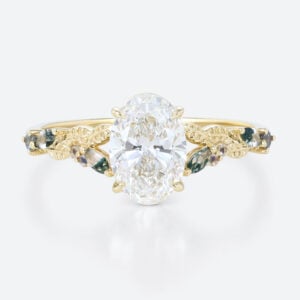
A large center diamond does not automatically cause a ring to spin. However, a heavier or higher setting paired with a slim shank may be more likely to rotate.
This can be especially noticeable with:
- High-profile center settings;
- Large oval, pear, emerald, or radiant center stones;
- Halos and substantial side-stone arrangements;
- Very thin or rounded bands;
- Designs with most of their metal and gemstone weight above the finger.
In these cases, the ring may be close to the correct size but still lack enough support at the bottom of the finger to keep the center stone upright.
Your Finger Size Changes During the Day
Finger circumference is not completely constant. Temperature, humidity, activity, and the time of day may influence how a ring feels. A ring that feels secure on a warm afternoon may rotate more freely on a cold morning.
This is why it is usually better to evaluate fit under normal conditions rather than making a permanent decision based on one unusually hot or cold day.
Your Wedding Band Is Affecting the Fit
An engagement ring may also behave differently when worn beside a wedding band. The second ring can make the overall stack feel tighter, but it may also push against the engagement ring’s basket, prongs, or side details.
Before adding sizing beads or resizing the ring, test it both alone and with the wedding band you plan to wear regularly.
What Are Ring Sizing Beads?
Ring sizing beads—sometimes called sizing balls, sizing bumps, or speed bumps—are small, rounded pieces of metal added to the inside of the ring’s lower shank.
They are commonly positioned as a pair. If the center stone represents the 12 o’clock position, the beads may sit near the 5 o’clock and 7 o’clock areas inside the band.
The beads are usually made from a metal compatible with the ring. Their size, shape, spacing, and method of installation should be selected according to the band and the wearer rather than treated as a one-size-fits-all modification.
How Do Sizing Beads Work?
Sizing beads do not reduce the full circumference of the ring in the same way as traditional resizing. Instead, they occupy a small amount of interior space and create two gentle contact points against the finger.
These contact points may:
- Reduce empty space at the base of the finger;
- Add resistance against side-to-side movement;
- Help a large or high-set diamond remain upright;
- Allow the ring to retain enough room to pass over a wider knuckle.
The American Gem Society includes beads, bumps, bars, and other internal additions among the methods used to adjust fit and keep a ring from rolling. Its professional guidance also emphasizes recording the size and placement of these additions, reinforcing that they should be customized to the individual ring.
When Are Sizing Beads a Good Choice?
Sizing beads may be worth considering when:
- The ring is only slightly loose;
- It fits over the knuckle but rotates at the base;
- A top-heavy setting tilts to one side;
- The shank has details that make conventional resizing more complicated;
- You want to try a relatively small internal alteration first.
They can be particularly useful for rings with ornate engraving, pavé details, or other design elements that should be assessed carefully before the shank is cut.
Are Sizing Beads Comfortable?
Comfort varies from person to person. Some wearers barely notice the beads, while others are sensitive to the two raised contact points.
The experience depends on:
- The diameter and shape of the beads;
- Their placement inside the band;
- The width of the ring;
- The shape of the finger;
- Daily or seasonal swelling;
- The wearer’s sensitivity to pressure.
Sizing beads that are too large may feel intrusive, while beads that are too small may not provide enough stability. If possible, ask the jeweler whether you can try on a sample ring with sizing beads before committing to the modification.
What Is a Ring Sizing Bar?
The term sizing bar requires a little clarification because it is not always used in exactly the same way.
In many consumer jewelry guides, a sizing bar refers to a U-shaped fold-over device installed inside the bottom of a ring. In other jewelry consultations, the word “bar” may be used more loosely for fixed, tapered, or flexible interior inserts.
Always ask the jeweler to show you the exact mechanism being recommended.
Fixed or Tapered Interior Insert
A fixed or tapered insert is a broader piece of metal attached inside the lower portion of the band. Instead of creating two small contact points like sizing beads, it provides support across a wider area.
This may appeal to someone who dislikes the feeling of individual beads. It may also help distribute pressure more evenly, although comfort still depends on the shape and construction of the insert.
Because the insert occupies more interior space, the jeweler must confirm that the band is wide and strong enough to accommodate it.
Spring Insert
A spring insert is a flexible, horseshoe-shaped strip of metal that lines much of the inside bottom of the ring. It opens slightly as the ring passes over the knuckle and then returns inward to create a closer fit at the base of the finger.
This can be helpful when there is a meaningful difference between knuckle size and finger-base size. It creates a broader contact surface than sizing beads and may feel smoother for some wearers.
Jewelers Mutual describes a spring insert as a flexible interior strip that can help make a ring fit more closely while still allowing it to pass over the knuckle.
Fold-Over Sizing Bar
A fold-over sizing bar is a more mechanical solution. It generally consists of a U-shaped bar installed across the lower inside of the ring, with a hinge on one side and a latch on the other.
The wearer opens the mechanism, places the ring over the knuckle, and closes the bar so the ring fits more securely at the base of the finger. This design can accommodate a larger difference between the knuckle and the finger base than small sizing beads may be able to address.
Because it contains moving components, a fold-over bar is more complex than a pair of beads. The jeweler should evaluate available space, band thickness, metal, comfort, and the long-term maintenance of the hinge and latch.
Ring Sizing Beads vs. Sizing Bars
Neither option is automatically better. The most suitable choice depends on the ring, the finger, and the amount of correction required.
| Feature | Sizing Beads | Fixed or Tapered Insert | Spring or Fold-Over Bar |
|---|---|---|---|
| Best for | Slight looseness and mild spinning | Broader interior support | Larger knuckles or greater size differences |
| Contact | Two small contact points | Wider, smoother surface | Flexible or adjustable surface |
| Comfort | Depends on sensitivity to the beads | May feel smoother to some wearers | May distribute pressure more broadly |
| Visibility while worn | Usually very discreet | Usually very discreet | Depends on the mechanism |
| Complexity | Relatively simple | Moderate | More complex |
| Adjustability | May be reshaped or removed professionally | Depends on construction | Often accommodates more variation |
| Top-heavy rings | Often helpful | Often helpful | Useful when knuckle fit is also a concern |
| Replacement for resizing | Only in selected cases | Only in selected cases | Only in selected cases |
Lisa Jewelry Expert Note: The goal is not simply to make the ring feel tighter. The goal is to improve stability while preserving comfort, knuckle clearance, and the structural integrity of the ring.
Which Fix Is Best for Your Spinning Ring?
A professional fitting is the most reliable way to make a final decision, but the following scenarios can help narrow the options.
Choose Sizing Beads If…
Sizing beads may be a good starting point if your ring is only slightly loose, fits over your knuckle with reasonable resistance, and mainly needs help staying centered.
They may also be suitable when the ring size is generally correct but the weight of the center setting causes it to lean. Because the adjustment is inside the shank, it normally does not change the ring’s outward appearance.
For someone searching for a discreet ring guard for a large diamond, professionally fitted sizing beads may look more refined than a visible plastic adjuster. However, the size of the diamond alone should not determine the solution.
Choose a Fixed or Tapered Insert If…
A broader insert may be preferable if you are sensitive to the two pressure points created by beads or want a smoother contact surface inside the band.
This option still requires sufficient space and metal thickness. It may not be appropriate for every thin, hollow, pavé-set, or highly detailed shank.
Consider a Spring Insert If…
A spring insert may be useful if:
- Your knuckle is noticeably wider than your finger base;
- A conventional ring size feels loose after passing the knuckle;
- You prefer support across a larger interior area;
- Your finger size changes moderately during normal wear.
The insert’s flexibility can accommodate some difference between the knuckle and finger base, but its suitability depends on the ring’s construction.
Consider a Fold-Over Sizing Bar If…
A fold-over bar may be worth discussing when the knuckle-to-finger difference is too significant for small beads.
Because the bar opens, the ring does not need to be forced over the knuckle at its final fitted circumference. Once the mechanism is closed, the ring can sit more closely around the narrower part of the finger.
Choose Traditional Resizing If…
Permanent resizing may be more appropriate if the ring is consistently too large and slides over the knuckle too easily.
A jeweler may reduce the circumference by removing a section of the shank and joining the band again. However, the feasibility of this process depends on the metal, the amount of size change, previous repairs, and whether the band contains pavé, channels, engraving, or eternity-set stones.
Temporary Ring Guards vs. Jeweler-Installed Solutions
The phrase ring guard can refer to several different products. Online, it often means a removable silicone coil, plastic insert, or clip-style adjuster. In a jewelry consultation, it may also be used more broadly for an interior fitting device.
A temporary ring guard can be useful when:
- Your fingers become looser only during cold weather;
- You are waiting for a professional appointment;
- You want to test whether reducing interior space improves stability;
- Your finger size is expected to change.
However, removable adjusters can add bulk, move out of position, collect residue, or interfere with how another ring sits beside the engagement ring. They should be removed and cleaned regularly and inspected for any signs of rubbing.
Avoid using glue, adhesive tape, string, or an unapproved metal clip as a long-term way to fix a loose engagement ring. A valuable ring should not be altered with a material that could trap residue, scratch the finish, stress the setting, or conceal an underlying fit problem.
For an engagement ring worn every day—especially one with a large center stone—a jeweler-installed solution will generally provide a cleaner and more individualized result.
What Should a Jeweler Check Before Adding Beads or a Bar?
Before recommending an adjustment, the jeweler should consider:
- Whether the ring is genuinely too large;
- How much resistance it has when crossing the knuckle;
- The difference between the knuckle and finger-base measurements;
- The height and weight distribution of the setting;
- The width and thickness of the shank;
- The condition of the prongs, stones, and existing solder joints;
- The presence of pavé, engraving, channels, or eternity details;
- Whether the ring will be worn beside a wedding band;
- Normal seasonal changes in the wearer’s finger;
- Sensitivity to raised interior components.
Bring the wedding band to the fitting if the rings will usually be worn together. The jeweler should ideally assess the engagement ring both alone and as part of the complete stack.
How Should a Properly Fitted Ring Feel?
A well-fitted ring should pass over the knuckle with light resistance and sit securely at the base of the finger. It should not slide off freely when the hand points downward, but it also should not cause pain, tingling, or deep pressure marks.
The center diamond should remain generally upright during normal activity, although a small amount of movement can be natural.
The objective is not to make the ring completely motionless. It is to create a fit that feels secure without becoming restrictive when the fingers are warm.
Final Verdict: The Best Fix Starts With the Cause
If your engagement ring keeps spinning, resist the urge to choose a solution based only on appearance or convenience.
Sizing beads are often an effective starting point for mild looseness or a top-heavy setting. A broader insert may suit someone who prefers a smoother interior surface. Spring inserts and fold-over sizing bars can help address a greater difference between the knuckle and finger base. If the entire ring is consistently too large, professional resizing may be the better long-term answer.
Before altering a valuable engagement ring, have a qualified jeweler evaluate it on your finger. The smallest suitable adjustment is often the best place to begin.
Frequently Asked Questions
Sizing beads can help reduce spinning when the ring is only slightly loose, the wearer has a larger knuckle, or the center setting needs additional support. They cannot guarantee that every ring will remain completely stationary.
If the ring is significantly too large or the setting is extremely unbalanced, a broader insert, sizing bar, shank modification, or professional resizing may be more suitable.
Some wearers hardly notice properly shaped sizing beads, while others feel the two raised contact points immediately. Comfort depends on the beads’ size and placement, the shape of the finger, the width of the band, and normal finger swelling.
If you are sensitive to internal pressure, ask about trying a sample ring or using a broader insert instead.
A flat, tapered, or flexible insert may feel smoother to some wearers because it distributes contact across a larger area. A hinged fold-over sizing bar may also reduce the need to squeeze a closely fitted ring over a large knuckle.
However, no sizing aid is universally more comfortable. The mechanism must be matched to the ring and the wearer.
The best ring guard for a large diamond depends on why the ring is spinning.
If the ring size is generally correct but the setting is top-heavy, sizing beads or a fixed interior insert may provide enough stability. If the wearer has a large knuckle, a spring insert or fold-over bar may work better. If the entire ring is too large, professional resizing should be considered.
Diamond carat weight alone is not enough to choose a solution. Setting height, shank width, weight distribution, finger shape, and everyday fit all matter.
Consider sizing beads when the looseness is minor, the ring must pass over a wider knuckle, or the shank has details that make immediate resizing less desirable.
Consider resizing when the ring is consistently too large, slides over the knuckle too easily, or remains insecure despite an internal fitting aid.
Rings with pavé diamonds, eternity details, engraving, previous repairs, or unusual metals require an individual structural assessment before either option is selected.