




















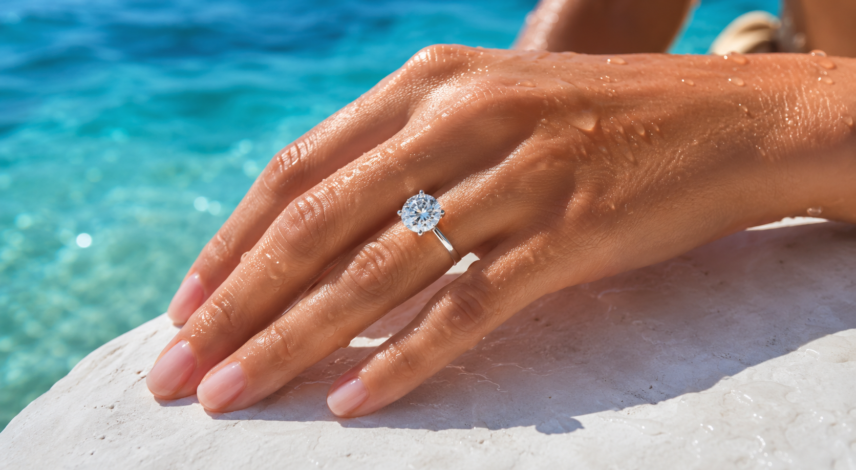
I. The Summer Sparkle Dilemma
Summer is the ultimate season for outdoor adventure, tropical getaways, and staying active. Whether you are swimming in a crystal-clear resort pool, lounging on a sun-drenched beach, or hitting the weights at the gym, your engagement ring is likely the one accessory you never want to take off. It is a symbol of love, commitment, and personal style that feels natural to wear every single day.
However, warm-weather activities introduce a hidden minefield for fine jewelry. Many ring owners operate under a common misconception: because diamonds are the hardest natural material on Earth (scoring a perfect 10 on the Mohs hardness scale), their ring must be virtually indestructible.
While your diamond can easily resist scratches, your ring is much more than just the center stone. The delicate gold or platinum prongs holding your diamond, the micro-pave accent stones lining the band, and even the precious metal framework itself are remarkably vulnerable to everyday summer elements. Chlorine, ocean temperatures, sand, and heavy gym equipment can quickly compromise the structural integrity of your piece, turning a beloved heirloom into a costly loss.
This guide breaks down the hidden risks of wearing your ring during summer activities and answers the most critical questions about summer jewelry care. Understanding when to take off engagement ring settings will help you protect your investment so your diamond shines brilliant for a lifetime.
II. The Pool & Hot Tub: Chlorine and Chemical Corrosion
When relaxing poolside on a warm day, taking a dip with your ring on seems completely harmless. After all, water itself doesn’t hurt a diamond. The real danger lies in what is dissolved inside that water: chlorine and harsh cleaning chemicals.
How Chlorine Attacks Precious Metal Alloys
While pure gold (24K) is chemically inert, it is far too soft to hold a diamond securely. To create durable jewelry, goldsmiths alloy pure gold with other metals like copper, silver, nickel, and zinc to produce 14K or 18K white, yellow, and rose gold.
When you submerge your ring in chlorinated pool water or a heated hot tub, the chlorine triggers a harsh chemical reaction known as stress corrosion cracking. The chlorine selectively attacks and leaches out the secondary alloy metals inside the gold structure. Over time, this process creates microscopic cavities—or pitting—deep within the metal.
Gemological Warning: Repeated chlorine exposure fundamentally alters the molecular structure of 14K and 18K gold settings. It makes metal prongs brittle and prone to snapping under minimal pressure, which is one of the leading causes of lost center stones in chlorinated water.
The Film Effect: Blocked Light and Dull Sparkle
Beyond chemical damage to the setting, pools are full of sunscreens, tanning oils, body lotions, and water-softening agents. Diamonds have an organic property known as being lipophilic—meaning they naturally attract fats and oils while repelling water.
As you swim, the oils and chemicals floating in the pool instantly stick to the underside and pavilion facets of your diamond. This forms a stubborn, cloudy residue that blocks light from entering the gem, turning a high-voltage, brilliant stone into a dull, lifeless piece of glass in a matter of minutes.
III. The Beach: Cold Shrinkage and Nature’s Traps
A day at the beach presents a dual threat to fine jewelry: physical loss due to physiological changes, and mechanical wear from natural elements. If you are asking whether you should wear your piece into the surf, the short answer is a definitive no.
The Cold Water Shrink Effect
One of the most dangerous traps for ring loss in the ocean is the body’s natural physiological reaction to cold water. Ocean temperatures are significantly cooler than your normal body temperature. When you wade or swim in the ocean, the blood vessels in your hands rapidly constrict to conserve core body heat.
This sudden constriction causes your fingers to shrink instantly—often by half a size to a full ring size. A ring that felt comfortably snug on dry land can become loose within seconds of entering the water.
Ocean Waves and Natural Lubricants
To make matters worse, seawater acts as a natural lubricant. Combined with the slick residue of water-resistant sunscreen on your skin, the friction keeping your ring in place vanishes.
When you add the pulling force of ocean waves and undercurrents, a loose ring can easily slide off your finger without you even noticing. Once a diamond ring slips off in the ocean, recovering it from shifting sands and murky water is nearly impossible.
Sand: Micro-Abrasions on Precious Metals
Even if you stay on the shore, the sand itself poses a long-term threat to your setting’s finish. Beach sand is composed largely of quartz particles, which carry a Mohs hardness rating of 7.
While quartz sand cannot scratch a diamond, it is significantly harder than gold and platinum (which sit between 2.5 and 4.5 on the hardness scale). Fine sand acts like coarse sandpaper against your ring:
Micro-Scratching: Rubbing against sand strips away high-polish finishes and creates a dull patina of tiny scratches across the band.
Prong Abrasion: Sand grains can wedge themselves underneath low-profile prongs or inside pave channels, slowly wearing down the metal points that keep smaller diamonds locked in place.
IV. The Gym: Heavy Steel and Structural Deformations
It is common to see people wearing fine jewelry while working out, but high-impact exercise and weightlifting are among the fastest ways to cause catastrophic physical damage to a fine ring. The core risk in a gym environment is not chemical exposure, but heavy mechanical pressure and hard-surface impact.
Metal on Metal: The Pressure of Free Weights
Gym equipment—such as dumbbells, barbells, kettlebells, and weight machines—is constructed from hard steel, iron, or knurled metal grips. Precious metals like 14K gold, 18K gold, and platinum are considerably softer than commercial steel.
When you grip a heavy dumbbell, the metal handle places direct, concentrated pressure against the underside of your ring. This metal-on-metal compression causes two immediate issues:
Deep Gouging: Knurled steel handles act like a file, carving deep scratches and gouges into the polished shank of your ring.
Structural Bending: Gripping heavy loads causes the circular band of your ring to warp into an oval shape over time.
The Domino Effect: How Bent Bands Unseat Diamonds
A warped ring band is not just a cosmetic issue; it directly compromises the setting holding your central diamond.
Fine jewelry is engineered with precise geometric tolerances. When the bottom or sides of a band warp under pressure, that movement transfers upward into the basket or prongs holding the center stone. As the band flattens, the prongs are pulled outward, widening the setting. This creates microscopic gaps between the metal prongs and the diamond, causing the stone to tilt, rattle, or fall out entirely during simple daily movements.
Safety Warning (Degloving Risk): Beyond ring damage, wearing metal rings while performing pull-ups, rope climbs, or heavy deadlifts poses a serious physical risk. If the ring catches on a metal bar or machine, the sudden pull can cause severe finger tissue trauma, known medically as ring avulsion.
V. The Decision Matrix: When to Take Off Your Engagement Ring
To help you protect your fine jewelry during warm-weather activities and daily workouts, use this straightforward reference guide to determine when to take off engagement ring settings before stepping out.
| Scenario / Activity | Risk Level | Primary Danger | Recommended Action |
| Swimming Pools & Hot Tubs | 🔴 High Risk | Chlorine erodes gold alloys; sunscreen causes dull film | Take It Off. Store in a dry, fabric-lined pouch. |
| Ocean & Sandy Beaches | 🔴 Extreme Risk | Cold water shrinkage causes ocean loss; sand scratches metal | Take It Off. Leave it safely at home or in a hotel safe. |
| Weightlifting & Heavy Gym Work | 🔴 High Risk | Steel pressure warps bands and loosens prongs | Take It Off. Switch to a soft silicone band. |
| Applying Sunscreen & Lotions | 🟡 Medium Risk | Oils and zinc build up on the pavilion, killing sparkle | Apply First. Put your ring on only after lotion absorbs. |
| Outdoor Sports (Volleyball, Tennis) | 🟡 Medium Risk | Impact with balls or racquets can bend prongs | Take It Off. Keep it in a secure travel case. |
VI. Summer Jewelry Care: Prevention & Safe Alternatives
Protecting your investment does not mean you have to give up on wearing symbolic jewelry altogether. Implementing smart daily habits and modern care techniques allows you to keep your fine rings safe without sacrificing style.
The Silicone Ring Alternative
If you feel unaccustomed to leaving your left ring finger bare during vacations or daily workouts, invest in a high-quality silicone ring.
Durability & Safety: Silicone bands are soft, waterproof, non-conductive, and stretch under tension, eliminating the risk of injury during heavy lifting or water sports.
Peace of Mind: Wearing a silicone band allows you to maintain your marital commitment symbol while leaving your real diamond safe at home or in a resort safe deposit box.
The "Shake Test" for Post-Activity Inspections
If your ring accidentally undergoes impact or exposure during outdoor activities, perform a quick structural diagnostic at home using the Shake Test:
Clean your hands and ensure the ring is dry.
Hold the ring close to your ear using your thumb and index finger, placing your fingers firmly on the metal band (not the diamond).
Tap the band lightly with your index finger of the opposite hand, or gently tap the ring near your ear.
Listen carefully: If you hear a faint clicking or rattling sound, the prongs have loosened and the diamond is moving inside the setting. Stop wearing the ring immediately until a professional jeweler can tighten the prongs.
Deep Cleaning Restorations
When summer oils and water spots inevitably build up under your stone, restore its factory brilliance with a simple, safe home bath:
Soak the ring for 15 minutes in a small bowl of warm water mixed with a few drops of mild, fragrance-free dish soap.
Gently scrub the underside of the setting using an extra-soft baby toothbrush.
Rinse under warm running water (ensure the drain is plugged!) and pat dry with a lint-free microfiber cloth.
Conclusion: Smart Care for Lasting Brilliance
A diamond ring represents a major milestone and a cherished lifelong promise, but even the most exquisitely crafted fine jewelry requires thoughtful care when exposed to harsh environments. Understanding the hidden mechanics behind chemical corrosion, ocean cold-shrinkage, and gym-equipment pressure empowers you to make informed choices for your piece.
Lorem ipsum dolor sit amet, consectetur adipiscing eBy reserving your natural and lab-grown diamond rings for safe environments and utilizing silicone alternatives during high-risk summer activities, you guarantee that your ring retains its structural integrity and breathtaking fire for generations to come.lit. Ut elit tellus, luctus nec ullamcorper mattis, pulvinar dapibus leo.