

























I. Erasing the Gap for a Visual Upgrade
Every bride remembers the breathtaking moment they slipped on their engagement ring for the first time. However, as the wedding day approaches, a common and frustrating styling dilemma arises: how to pair that beautiful center stone with a traditional wedding ring. When you try to slide a standard, flat wedding band next to a prominent solitaire or an asymmetrical fancy cut, you are frequently left with an awkward, uneven gap where the metal brackets collide.
Leaving a physical space between your rings doesn’t just disrupt the clean, visual flow of your bridal jewelry; it also causes the individual rings to shift and rub against one another throughout the day. If you want to eliminate that friction, achieve a flawless flush fit, and instantly amplify the visual size of your center diamond without purchasing a brand-new stone, it is time to look at the magic of an enhancer wedding band.
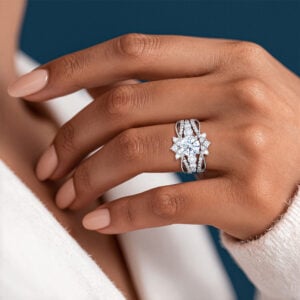
Often referred to as the ultimate customization asset for modern bridal ring sets, an enhancer band acts like an architectural frame for your hand. Designed to nestle your original engagement ring perfectly inside a double-railed framework, this style delivers an immediate upgrade in luxury footprint.
Whether you are looking for smart stacking diamond bands to commemorate an anniversary or mapping out the perfect geometric pairing for a new custom ring design, understanding the mechanics of enhancers is essential. In this comprehensive guide, we will break down the structural anatomy of these interlocking pieces and explore the golden rules for matching them perfectly to your existing setting.
II. What is an Enhancer Band? Decoupling the Design Aesthetics
To navigate the custom bridal market successfully, you must first understand the engineering behind these unique settings. An enhancer is not a typical single band that sits below your engagement ring; it is a unified piece of fine jewelry engineered to transform a solo ring into a complete visual statement.
The Double-Band Architecture
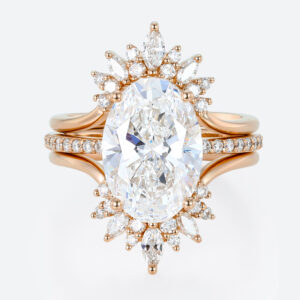
At its core, a classic enhancer consists of two separate, parallel diamond bands that are permanently joined together at the bottom by a solid metal bridge. This creates a precise internal channel or opening slot right through the center of the piece.
When you slide your engagement ring into this slot, the lone center stone is enveloped on both the top and bottom rails simultaneously. The two independent pieces nestle into one another, instantly behaving as unified, interlocking wedding rings that look like they were born together from a single wax mold.
The Role of Ring Guards for Engagement Rings
Beyond the undeniable aesthetic upgrade, enhancers serve an essential dual purpose as structural ring guards for engagement rings. Because these double-railed designs wrap around the perimeter of your primary setting, they act as a beautiful precious-metal bumper.
The raised diamond rails absorb the friction of daily impacts, protecting your center stone’s delicate baskets and prongs from catching on clothing, clipping against tables, or sustaining side-angle damage. For active individuals or professionals who use their hands constantly, an enhancer provides top-tier physical security while delivering high-end, symmetrically balanced sparkle.
III. The Style Matrix: The Three Core Eras of Enhancer Design
Selecting the perfect framework for your bridal set requires balancing the shape of your center diamond with the overarching aesthetic of your wardrobe. Modern jewelry design breaks enhancers down into three primary stylistic families:
The Halo Enhancer (The Instant Carat Doubler)
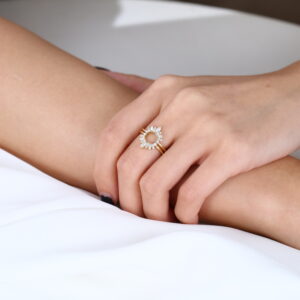
This style is specifically engineered for classic solitaire settings. The inner channel of the enhancer features a curved, circular, or square grouping of micro-pave diamonds that form a tight frame around your lone center stone the moment it is inserted. This structural framing creates a clever optical illusion, instantly transforming a simple solitaire into a massive, multi-dimensional halo ring that looks twice its original carat weight from a distance.
The Chevron and Curved Guard (The Fancy Shape Silhouette)
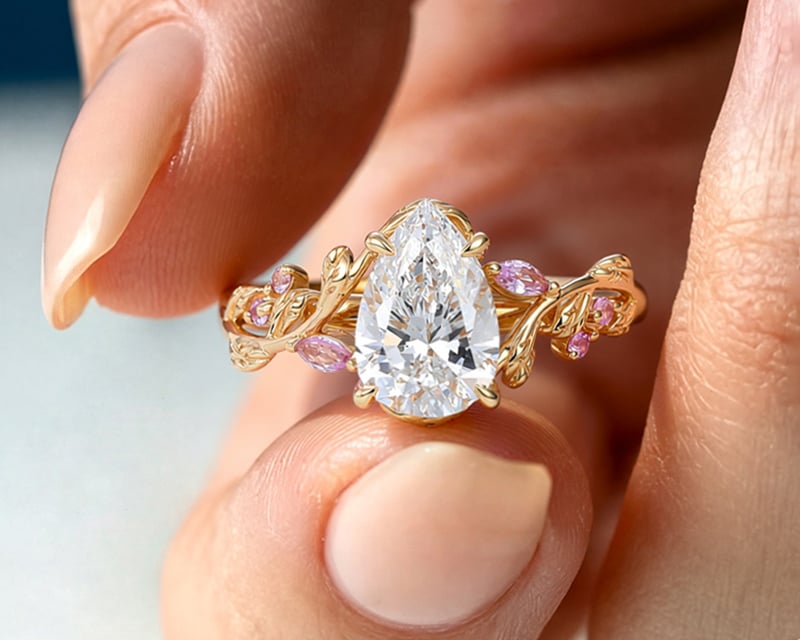
If your engagement ring features an elongated or asymmetrical fancy cut—such as a liquid-like oval, a striking pear, or a dramatic marquise—a straight enhancer will not work. You need a curved design engineered with a gentle chevron V-shape or a soft U-shaped dip. These contoured cutouts allow the sharp tips and wide curves of your fancy diamond to rest flush inside the metal frame without pinching the stones or creating visual misalignment.
The Vintage Milgrain & Art Deco Frame
For the bride who wants to inject historic character into a modern, minimal setting, a vintage-inspired enhancer is the perfect tool. Incorporating delicate milgrain bead borders, alternating round and marquise-cut accent panels, and open filigree details, these frames allow you to shift styles effortlessly. You can enjoy a clean, contemporary look during workdays by wearing your solitaire alone, and slide it into a vintage framework for evening events to exude high-glam, old-world opulence.
IV. Hardcore Performance Showdown: Enhancers vs. Traditional Standard Bands
To help you decide between a double-railed framework and a standard single wedding ring, let’s look at how an enhancer performs head-to-head against a traditional band across key wearability metrics.
Visual Expansion and Symmetry
If your goal is absolute symmetry and maximum presence, the enhancer is the undisputed winner. A standard wedding band sits on only one side of your engagement ring, creating an asymmetrical look that pulls the visual weight to one side. An enhancer envelopes the ring on both sides, creating a perfectly balanced frame that double-frames your stone and pushes its optical perimeter outward.
Anti-Spin Security
A common annoyance for women with prominent center diamonds—or those with larger finger knuckles—is “ring spin,” where the heavy center stone constantly swivels toward the palm of the hand. Because an enhancer creates a wide, dual-tracked foundation on your finger, it significantly increases friction against the skin. Once your engagement ring is locked into the center channel, the interlocking framework stabilizes the entire set, keeping your diamond upright and centered all day long.
V. The Matching Blueprint: Pairing the Guard with Your Main Stone
Achieving a seamless, gapless fit requires careful attention to the geometry and dimensions of your primary setting. To turn your individual rings into unified interlocking wedding rings, manage these three critical structural areas:
The Opening Space vs. Fancy Shape Width
When purchasing an enhancer for an elongated or wider fancy diamond (like an oval, marquise, or radiant cut), the inner opening space between the top and bottom rails must perfectly accommodate the widest point of your stone’s girdle. If the opening is too narrow, the engagement ring will sit too high, riding up on the enhancer prongs and leaving a large, hollow gap underneath the shank. Always cross-reference the exact millimeter width of your main stone against the inner channel specifications.
The Basket Setting Height Factor
The vertical height of your diamond’s basket (the metal structure holding the gem) completely dictates how flush the rings will sit.
- High-Profile Settings: Rings where the diamond is held high above the band slip easily into almost any enhancer, as the basket easily clears the guard’s accent diamonds.
- Low-Profile Settings: If your diamond sits very close to your finger, a standard enhancer bridge will block it from sliding all the way down. For low-profile rings, look specifically for an enhancer engineered with a submerged or recessed connecting bridge so your engagement ring can sink down and sit flat against your skin.
Prong Interference and Stone Protection
When two rings sit flush against each other, diamond-on-diamond contact must be avoided. If the accent diamonds on your enhancer rub directly against the metal prongs or the girdle of your center stone, daily movement will cause the diamonds to slowly saw through the gold or platinum settings. Ensure your enhancer features a small, built-in metal resting shelf or structural stop that keeps the stones perfectly aligned without touching.
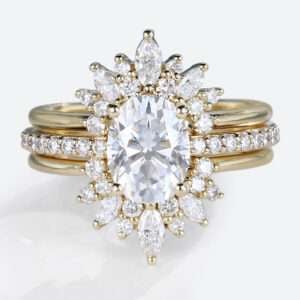
VI. Custom Design Mastery: Four Gold Rules for a Flawless Bridal Set
When building a high-end bespoke look using an enhancer wedding band, you are no longer managing a standalone piece of jewelry; you are coordinating a complex multi-ring system. To ensure your custom set wears comfortably for a lifetime, keep these four technical rules in mind during your design phase:
Maintain Absolute Metal Unity
Always match the exact metal alloy and purity across your entire bridal set. If your engagement ring is crafted from 14K white gold, your enhancer should also be 14K white gold. Pairing a harder metal like platinum with a softer metal like 18K yellow gold creates a destructive friction point. Over years of daily wear, the harder ring will act like a file, slowly shaving down the prongs of the softer ring and compromising your stone’s security.
Respect the Visual Balance (The Leaf vs. The Tree)
An enhancer is designed to be the ultimate supporting act, not the main protagonist. Choose accent diamonds for your rails that gracefully complement—but do not overpower—your center stone. If your center diamond is a 1.5-carat oval, avoid an enhancer featuring massive, heavy cluster diamonds that distract the eye. The accent stones should serve as a delicate border that pulls focus directly toward your primary diamond.
Factor in the Multi-Band Sizing Adjustments
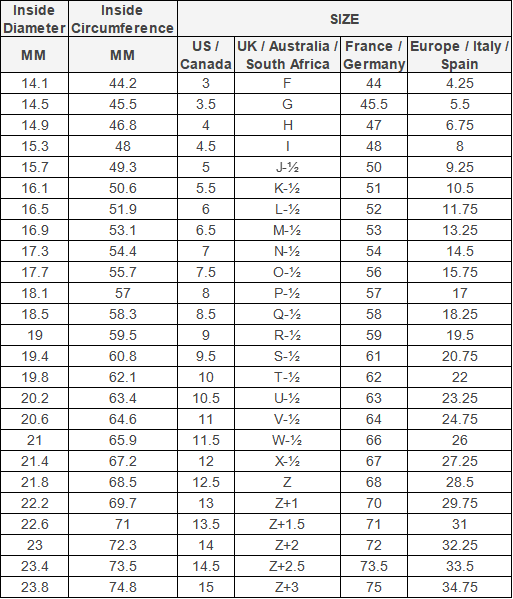
When you wear a single, thin ring, it occupies very little tissue space on your finger. However, when you slide your ring inside a dual-railed enhancer, you are suddenly wearing a combined metal stack that spans 5mm to 8mm in width. Wider stacks squeeze the finger tissue much more tightly than narrow bands. To prevent the set from feeling uncomfortably restrictive, it is highly recommended to order your enhancer 1/4 to 1/2 size larger than your engagement ring size.
Opt for Laser Lock Stabilization
If you are worried about the two rings shifting slightly out of alignment during high-activity days, ask your jeweler to perform a temporary laser tack weld. A micro-laser can join the rings seamlessly at the very bottom of the shank. This turns your independent pieces into a permanent, perfectly aligned set that slips on and off the finger as one solid unit, while remaining fully reversible if you ever wish to separate them in the future.
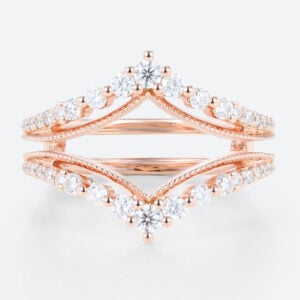
VII. The Next-Gen Horizon: Playing with Advanced Stacking Textures
Once you master the basic architecture of interlocking wedding rings, you can experiment with modern styling aesthetics to break away from traditional design templates.
The Mixed-Metal Contrast
You do not have to limit your bridal set to a single metal color. Combining a classic platinum or white gold solitaire engagement ring with a rich 14K yellow gold or romantic rose gold enhancer creates an incredible visual sandwich effect. The two-tone framing accentuates the boundaries of each ring, giving your bridal stack a highly curated, contemporary fashion edge.
Layering with Independent Stacking Diamond Bands
For an ultra-luxurious look, you can build a three-tiered layout. Start by nesting your solitaire inside a curved enhancer, then slip a ultra-thin, pavé-set stacking band directly underneath the entire assembly. This multi-layered approach introduces varied texturing across your hand, shifting your bridal look from a traditional ceremony set into a magnificent piece of custom architectural art.
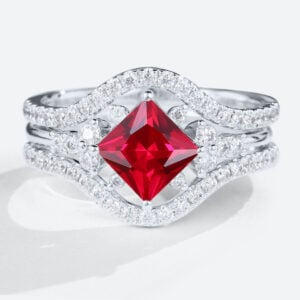
Conclusion: Locked in Perfect Visual Harmony
Investing in an Enhancer wedding band marks a beautiful transition from a standalone engagement ring to a unified architectural expression of your style. It addresses the common frustrations of uneven gaps and spinning bands while acting as a stunning visual frame that doubles the presence of your center stone.
By matching the vertical basket heights, protecting delicate fancy-cut tips with curved guards, and maintaining absolute metal consistency, you create a seamless layout that performs flawlessly under daily wear. Let your enhancer serve as both a brilliant armor and a design amplifier, locking your independent rings into a breathtaking, cohesive bridal ring set that shines with the power of two coming together as one.