














I. Moving Beyond the Number Myth in Stud Selection
When shopping for diamond jewelry online, few pieces are as universally loved or as versatile as the classic diamond stud. They are the ultimate wardrobe staple—effortless, elegant, and timeless. However, buying them online presents a unique, distinct challenge: trying to visualize how different carat weights translate to physical size when worn.
Many online shoppers open multiple tabs, look at flat product photos, and try to guess what a 1-carat or 2-carat stone looks like in real life. The most common pitfall is relying strictly on numbers. We often expect a 2-carat diamond to look exactly twice as large as a 1-carat diamond, only to be surprised when the physical piece arrives.
The core gemological truth that trips most people up is simple: carat is a measure of weight, not visual surface area. A diamond’s carat weight tells you how heavy the crystal is, but how large that diamond looks on your ear lobe depends entirely on its cut proportions and millimeter measurements. A stone cut too deep hides its weight at the bottom, making it look smaller from the top view, while a stone cut too shallow might look large but lose its brilliant sparkle.
To guide you toward the perfect purchase, this article provides a clear, reliable diamond stud earring size chart alongside a comprehensive earring carat size comparison. Let’s break down the exact math behind these luxury staples so you can confidently choose the ideal carat weight for your daily style, face shape, and personal aesthetic.
II. The Data Blueprint: Round Brilliant Carat vs. Millimeter Size Chart
Before diving into design styles, it is essential to establish a baseline using industry-standard measurements. When shopping for stud earrings on ear, the standard baseline is always calculated using the round brilliant cut, as its symmetrical geometry offers the most consistent correlation between physical weight and diameter.
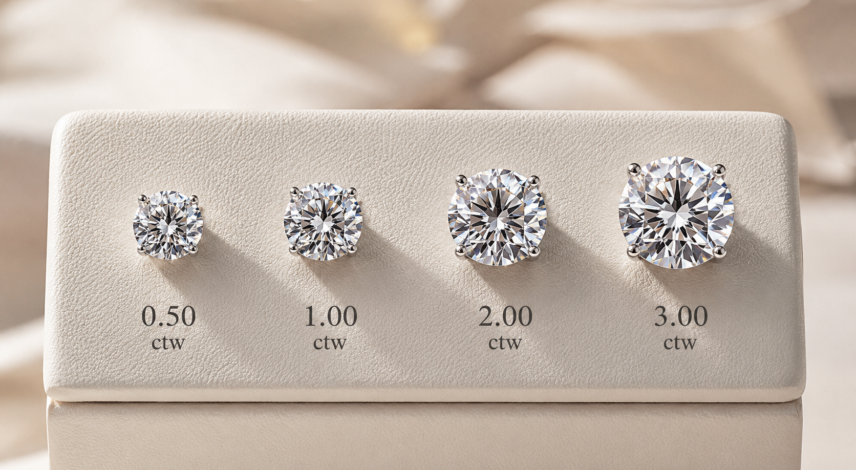
Crucial Industry Standard Note: In the jewelry industry, stud earrings are almost always sold and labeled by their Carat Total Weight (CTW). This metric represents the combined weight of both earrings in the pair, not the weight of a single stone. For example, a pair of 1.00 ctw diamond studs means each ear will feature a 0.50-carat diamond.
The blueprint below details standard round brilliant dimensions to help you understand how CTW translates to millimeter diameter and overall visual impression.
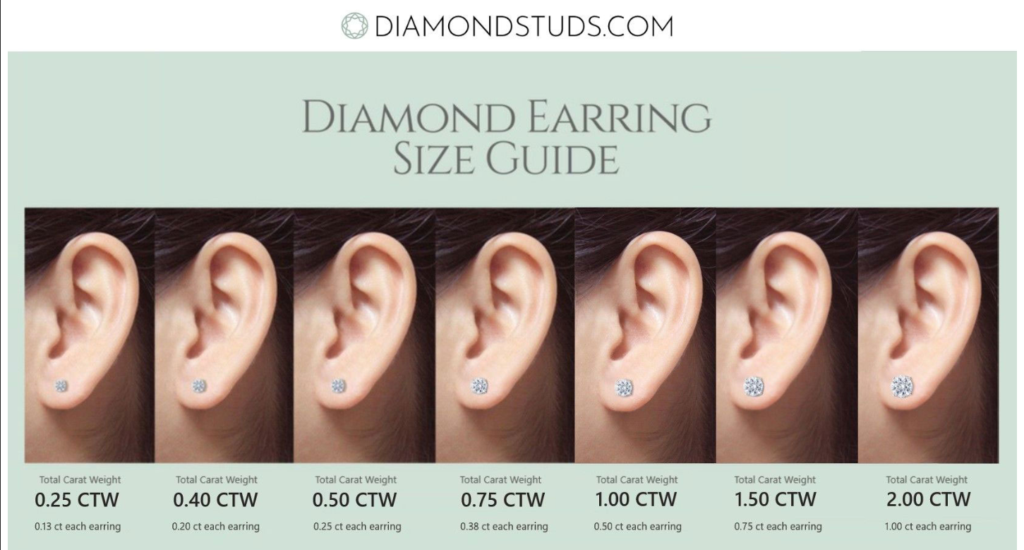
| Carat Total Weight (CTW) | Per Ear Carat Weight | Standard Diamond Diameter (mm) | Visual Impression & Practical On-Ear Placement |
| 0.50 ctw | 0.25 ct | ~4.1 mm | Delicate & Minimalist. Highly understated. This size provides a subtle hint of sparkle without dominating the earlobe, making it the premier choice for active lifestyles, daily office wear, or as a secondary accent stone in multi-pierced ears. |
| 1.00 ctw | 0.50 ct | ~5.1 mm | The Universally Loved Sweet Spot. This is the classic, go-to standard for gifts and engagements. At roughly 5mm wide, it provides an undeniable visual presence that catches the light beautifully while remaining light and comfortable enough for 24/7 wear. |
| 1.50 ctw | 0.75 ct | ~5.8 mm | Modern & Noticeable. For those who want their jewelry to stand out clearly from a distance. The extra millimeter in diameter dramatically increases the surface area, giving the stones a bolder look that bridges the gap between classic daytime wear and evening elegance. |
| 2.00 ctw | 1.00 ct | ~6.5 mm | The Statement Classic. Each ear holds a full 1.00-carat diamond measuring roughly 6.5mm across. This size covers a significant portion of the average earlobe, offering maximum fire and drawing immediate attention. Ideal for major milestones and formal occasions. |
| 3.00 ctw | 1.50 ct | ~7.4 mm | Red-Carpet Luxury. An elite, high-profile selection. At nearly 7.5mm wide per stone, these studs deliver striking brilliance and high-end luxury, requiring proper structural settings and secure backings to stay perfectly balanced on the lobe. |
III. Step-by-Step On-Ear Visual Guide: From Minimalist to Red-Carpet Luxury
To fully master how to choose diamond studs, we need to translate these millimeter measurements into real-world styling dynamics. The physical scale of a diamond alters not just its light performance, but also the overall mood of your wardrobe.
0.50 ctw to 1.00 ctw: The Pillars of Daily Elegance
The 0.50 ctw to 1.00 ctw range represents the foundational core of classic jewelry collections. A 0.50 ctw pair is perfect if you love the “barely there” look or need a comfortable, low-profile set that won’t catch on clothing or workout gear.
Stepping up to the 1.00 ctw mark introduces the classic bridal proportions. A 5mm stone covers roughly one-third of a standard earlobe’s width. This specific ratio creates a beautiful balance: it leaves enough space on the lobe so the jewelry does not look overcrowded, yet possesses a large enough face to capture surrounding light and throw off brilliant flashes of fire.
1.50 ctw to 2.00 ctw: The Standout Statement
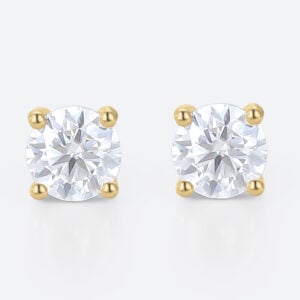
When you move into the 1.50 ctw to 2.00 ctw tier, the visual dynamic shifts from subtle enhancement to a distinct style choice. A 2.00 ctw pair places a 6.5mm stone on each ear. Because the surface area expands horizontally and vertically, the diamond now occupies nearly half of the earlobe’s visible surface.
This scale allows the unique characteristics of different diamond shapes to shine. While round cuts offer classic circular brilliance, fancy cuts like Radiant, Cushion, or Princess shapes look incredibly striking at this size, utilizing their distinct architectural borders to frame the face.
3.00 ctw: High-Profile Glamour
At 3.00 ctw (1.50 carats per ear), the diamond moves into the realm of rare luxury. Measuring approximately 7.4mm in diameter, the stone acts as a major focal point on the face. The massive crystal structure allows you to see the deep facets working together to bounce light.
At this scale, the primary consideration shifts from size to engineering. Because large diamonds carry more physical weight, they naturally tend to pull forward on the earlobe. Achieving a flawless look at this carat level requires matching the stone with an equally sophisticated setting that keeps the diamond sitting upright, proud, and facing directly forward.
IV. The Practical Selection Formula: Matching Lobe Anatomy and Face Shape
Selecting the perfect diamond stud size is not just a matter of choosing the largest carat weight within your budget. Because earrings sit directly against the skin and frame your face, understanding your physical anatomy is essential to mastering how to choose diamond studs that flatter you perfectly.
Lobe Size and Structural Integrity
Your earlobe acts as the physical canvas for the jewelry. Evaluating its shape and thickness will help you narrow down the ideal carat weight:
Petite or Thin Lobes: If your earlobes are small or thin, opt for the 0.50 ctw to 1.20 ctw range. Heavy stones can pull thin skin downward, causing the piercing hole to stretch visually and tilting the face of the diamond toward the floor.
Stately or Plump Lobes: Smaller studs (under 0.50 ctw) can sometimes look swallowed or lost on fuller earlobes. A carat weight of 1.50 ctw to 3.00 ctw offers the necessary physical presence to balance the lobe beautifully.
The Hidden Architecture: Upgrading Your Earring Backs
As you move up the earring carat size comparison scale, the physical weight of the diamond increases significantly. Standard butterfly friction backs are perfectly adequate for lightweight 0.50 ctw studs, but they often fail to support larger stones.
For any pair exceeding 1.50 ctw, look for specialized structural backings:
Jumbo Backs: These feature an extra-large circular disc that distributes weight evenly across the back of the lobe, acting as a stabilizing wall.
La Pousette / Protektor Backs: These heavy-duty, pressure-release locking mechanisms clamp tightly onto a grooved post, providing security and preventing heavy 2.00 ctw or 3.00 ctw stones from drooping or sagging forward.
V. Optical Sorcery: Settings That Alter Visual Scale
If you love the impact of a high-carat look but want to keep the profile streamlined, the design and setting style you choose can dramatically trick the eye, changing how large stud earrings on ear actually appear.
The Halo Effect: Instant Magnification
Surrounding a modest center stone with a seamless ring of tiny, brilliant-cut melee diamonds is the single most effective way to amplify visual scale. A 0.50 ct center stone (1.00 ctw total) framed by a delicate, icy-white halo instantly mimics the physical dimensions and presence of a solid 2.00 ctw solitaire stud, offering a major look at an efficient price point.
3-Prong Settings (The Martini Look): Shaped like a martini glass, this setting narrows at the base, allowing the diamond to sit incredibly low and flush against the earlobe. It minimizes metal visibility, maximizing light entry from the sides for unparalleled fire.
4-Prong Settings (The Basket Look): A highly classic structure that creates a distinct, tailored look. The four corners box the round brilliant stone, giving it a slightly square, architectural boundary on the ear.
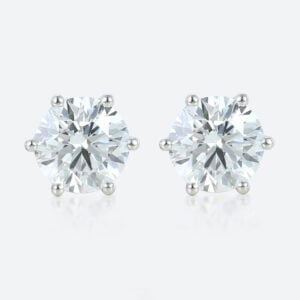
6-Prong Settings (The Crown Look): By spacing six delicate prongs evenly around the perimeter, the metal frames the stone into a perfect, unbroken circle. This configuration accentuates the outer edge, making the stone look significantly rounder and larger from a distance.
VI. Smart Material Strategy: Embracing Moissanite and Lab-Grown Diamonds
Achieving your dream aesthetic on a realistic budget comes down to choosing the right modern crystal structure. For decades, scaling up to a 2-carat or 3-carat look meant navigating exponential price curves. The modern fine jewelry landscape provides two brilliant paths forward.
The Freedom of Scale with Lab-Grown Diamonds
Because lab-grown diamonds share identical physical, chemical, and optical traits with mined diamonds, opting for a lab-grown alternative removes the traditional financial barriers to large carat sizes. You can secure a pristine, high-clarity 2.00 ctw or 3.00 ctw pair of lab diamond studs for a fraction of the cost of mined stones, allowing you to prioritize exceptional cut quality and breathtaking facial brilliance without compromising on the prestige of a genuine diamond.
The Explosive Fire of Fancy Moissanite
For those who want to maximize pure visual energy, moissanite is a stellar choice. Thanks to its double-refractive index, a moissanite stud produces an intense, colorful rainbow dispersion that is highly visible even in smaller sizes like 0.50 ctw. When scaled up to a 1.50 ctw or 2.00 ctw layout, moissanite turns into an absolute powerhouse of light performance, offering an exceptionally bright, hard-wearing daily staple that stands up beautifully to the rigors of everyday wear.
VII. Daily Care and Security: Protecting Your Brilliance
A beautiful pair of diamond studs is a lifelong investment, but because they are worn on the ear, they require specific attention to security and cleanliness. Avoiding common blind spots will ensure your studs remain as brilliant and secure as the day you first put them on.
The First Rule of Loss Prevention
Earrings are the most frequently misplaced category of fine jewelry, typically because they get snagged on clothing or knocked loose during daily transitions.
The Habit: Make it an absolute rule to remove your studs before pulling sweaters or tight clothing over your head, and never wear them while swimming in the ocean or pools.
The Storage Rule: When taking them off, never place them loosely on a nightstand or counter. Store them immediately in a dedicated, fabric-lined jewelry box or a secure pouch to prevent the metal posts from scratching other pieces.
Overcoming the "Prong Build-Up" Effect
Because earrings sit closely against the skin and hair, they act as magnets for daily cosmetic products. Hairspray, face serums, natural skin oils, and shampoo residue quickly form a cloudy film over the diamond’s pavilion (the lower half of the stone). This film blocks light from entering the gem, turning a high-voltage sparkle into a dull, flat appearance.
- The Safe Home Cleansing Method: You do not need professional equipment to maintain their fire. Once a week, soak your studs in a bowl of warm water mixed with a few drops of mild, fragrance-free dish soap for 10 to 15 minutes. Gently brush behind the setting and between the prongs using a clean, soft-bristled baby toothbrush. Rinse thoroughly with warm water and pat dry with a lint-free microfiber cloth.
Conclusion: Finding Your Perfect Proportion
Navigating a diamond stud earring size chart ultimately reveals that the perfect choice is entirely personal. There is no singular “correct” carat weight—the ideal size is the one that aligns seamlessly with your daily lifestyle, complements your physical anatomy, and gives you an instant boost of confidence the moment you look in the mirror.
Whether you are looking for a delicate 0.50 ctw pair to complete a sleek, minimalist daily look, or ready to step onto the red carpet with a show-stopping 3.00 ctw statement, focusing on excellent cut quality and proper structural settings ensures your jewelry performs beautifully. Explore our custom layout collections to select your perfect fire, and let our design team craft a custom pair of studs tailored precisely to your unique story.