



















I. Why Diamond Certification Matters More Than Ever
When shopping for loose diamonds — whether for engagement rings or fine jewelry — many buyers focus on carat weight, sparkle, or price. But one of the most important factors influencing a diamond purchase often receives less attention: diamond certification.
In both the natural diamonds and lab grown diamonds market, certification acts as the foundation of trust. A grading report verifies a diamond’s identity, evaluates its clarity grade, and confirms whether the stone meets recognized grading standards.
However, not all certification laboratories operate in the same way.
Understanding the difference between diamond certification laboratories can help buyers make informed decisions when evaluating diamonds. The issuing gemological institute determines how accurately a diamond’s quality is described, how consistent its grading standards are, and how reliable its diamond grading reports will be over time.
This applies equally to mined diamonds and laboratory grown diamonds, including stones created through advanced processes such as chemical vapor deposition or HPHT diamonds methods.
Without proper certification, buyers risk misunderstanding a diamond’s true value — regardless of whether the stone is natural or lab created.

II. The Role of Diamond Certification in the Modern Diamond Industry
Diamond certification serves as a universal language within the jewelry industry.
Before a diamond enters the retail market — whether it is a natural stone or a lab created diamond — it is typically evaluated by an independent gemological institute. These organizations assess the diamond using standardized grading systems.
Certification generally includes:
Carat weight
Clarity grade
Cut evaluation
Color assessment
For engagement rings and loose diamonds alike, this grading process allows buyers to compare stones objectively rather than relying solely on visual appearance.
The importance of certification has grown alongside the expansion of lab diamonds in the market. As laboratory grown diamonds become more widely available, consistent diamond grading ensures that both natural stones and lab stones are evaluated under comparable frameworks.
Institutions such as the Gemological Institute of America, the International Gemological Institute, and the European Gemological Laboratory play key roles in maintaining grading standards across the global diamond industry.
Each organization provides diamond grading reports, but differences in methodology, global presence, and grading strictness can influence how diamonds are evaluated.
For example:
Some laboratories are known for stringent grading standards
Others are more commonly used in commercial jewelry segments
Certain institutes specialize in evaluating lab grown diamonds
As lab grown diamonds — including CVD diamond varieties — continue to gain visibility, the need for reliable certification becomes even more important. Buyers evaluating diamonds must understand that certification is not just documentation — it is a quality benchmark.
Ultimately, diamond certification protects both transparency and consistency across the jewelry market.
III. How Certification Laboratories Evaluate Diamonds
While all major certification bodies aim to assess a diamond’s quality, the grading process itself is more complex than many buyers realize.
Both natural diamonds and lab grown stones share the same chemical properties — each is composed of carbon arranged in a crystalline structure. The difference lies in how they form.
Natural diamonds originate deep within the earth’s crust under extreme pressure over millions of years. Lab grown diamonds, by contrast, are created through a controlled growth process using advanced technology inside a large machine that replicates these natural conditions.
Despite these different origins, both natural stones and their lab grown counterparts must undergo the same diamond grading process before entering the jewelry market.

The Importance of Accurate Grading
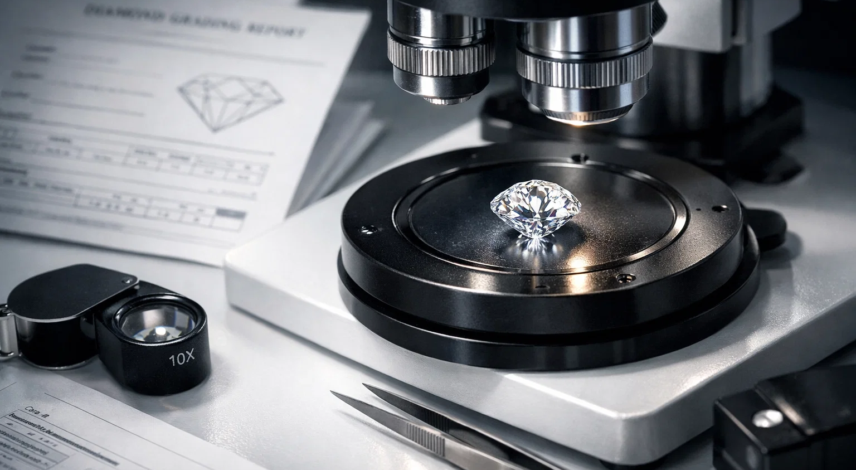
Certification laboratories evaluate diamonds using highly controlled procedures that go beyond what the naked eye can detect.
For example, graders examine:
Light performance
Internal clarity
Color consistency
Structural integrity
Subtle details — such as a faint blue nuance that may appear in some lab grown stones — can only be identified through professional assessment.
A grading report provides this information in a standardized format, allowing buyers to compare diamonds objectively. This is especially important when distinguishing between natural counterparts and laboratory grown alternatives.
Institutions such as the Gemological Institute of America have established globally recognized frameworks for diamond evaluation. GIA certification is often considered a benchmark because of its consistency and global presence.
GIA reports, along with reports issued by other gemological institutes, help ensure transparency within the diamond industry.

Certification and Consumer Protection
Diamond certification is not only about quality — it also supports consumer protection.
Organizations such as the Federal Trade Commission provide guidance on how diamonds should be represented in the marketplace. These guidelines help ensure that lab grown diamonds are clearly identified and not misrepresented as mined stones.
This clarity matters because although lab grown diamonds share identical chemical properties with natural diamonds, their origin and growth process differ.
Understanding these distinctions helps buyers evaluate diamonds with confidence — whether selecting a stone formed from natural graphite deep within the earth or one created through a modern technological process.
Certification ensures that regardless of origin, diamonds are graded using consistent standards.
IV. Key Differences Between Major Certification Laboratories
Understanding the difference between diamond certification laboratories becomes especially important when comparing grading consistency and report reliability.
While multiple organizations operate within the global diamond industry, their grading standards and approaches can vary.
Some of the most recognized gemological institutes include:
Gemological Institute of America
International Gemological Institute
European Gemological Laboratory
Each laboratory follows its own grading process, which may influence how a diamond’s clarity grade, light performance, and color are interpreted.
For instance, GIA certification is widely known for maintaining stringent grading standards. GIA reports are often viewed as highly consistent across different markets due to the institute’s long-standing global presence.
Other laboratories also provide valuable certification services, particularly for commercial jewelry segments and lab grown stones. Some institutes specialize in evaluating diamonds created through chemical vapor deposition, ensuring that lab grown stones are graded accurately alongside their natural counterparts.
Regardless of origin, whether formed deep within the earth’s crust or produced under controlled conditions in a large machine, diamonds require consistent evaluation frameworks.
V. Certification for Lab Grown Diamonds
As lab grown diamonds become more widely available, certification plays an even greater role in helping buyers understand their characteristics.
Although lab grown stones share identical chemical properties with natural diamonds, differences in the growth process can influence appearance.
For example:
Some lab grown diamonds may exhibit subtle blue nuance
Trace growth patterns may form during chemical vapor deposition
These characteristics are typically undetectable to the naked eye and require laboratory analysis.
Certification laboratories evaluate these features to ensure that lab grown diamonds are properly identified and distinguished from natural stones.
This distinction is important not only for transparency but also for compliance with industry guidelines supported by organizations such as the Federal Trade Commission.
Clear labeling protects buyers and helps maintain trust across the diamond market.

VI. How Certification Impacts Diamond Purchase Decisions
For buyers selecting engagement rings or loose diamonds, certification directly influences purchasing confidence.
A grading report provides objective information about a diamond’s:
Carat weight
Clarity grade
Light performance
Structural quality
Without certification, evaluating diamonds becomes significantly more difficult — especially when comparing lab grown stones to natural counterparts.
Certification also supports resale clarity and long-term documentation.
As the diamond industry continues evolving with the rise of lab grown diamonds, consistent certification ensures that both traditional and modern stones can be evaluated within the same framework.
Whether a diamond originates from natural graphite deep within the earth or from a controlled growth process, reliable certification allows buyers to focus on quality rather than uncertainty.

Conclusion
The difference between diamond certification laboratories ultimately shapes how diamonds are understood, compared, and trusted.
Certification is more than a technical formality — it is a foundation of transparency within the jewelry industry.
As lab grown diamonds continue to expand their role alongside natural stones, consistent grading standards will remain essential. From light performance to clarity grade, professional evaluation ensures that every diamond is assessed beyond what the naked eye can see.
In an industry where origin may vary, certification provides the common language that allows buyers to make informed and confident decisions.