
I. Introduction
Over the past decade, lab-grown diamonds have become one of the most talked-about developments in the jewelry industry. More couples choosing engagement rings today are discovering that lab diamonds offer the same brilliance and durability as mined stones, often at a much more accessible price point. As a result, these diamonds are quickly becoming a popular option not only for engagement rings but also for many types of fine jewelry.
However, many buyers are surprised to learn that there are actually different types of lab-grown diamonds. While all lab diamonds share the same chemical and physical properties as natural diamonds, the way they are created can vary depending on the technology used during the growth process.
Understanding the types of lab-grown diamonds can help buyers make more confident decisions when selecting a diamond. The production method can influence factors such as crystal formation, trace inclusions, and sometimes even subtle color characteristics. For shoppers comparing different diamonds or trying to understand grading reports, knowing how lab diamonds are produced can provide useful context.
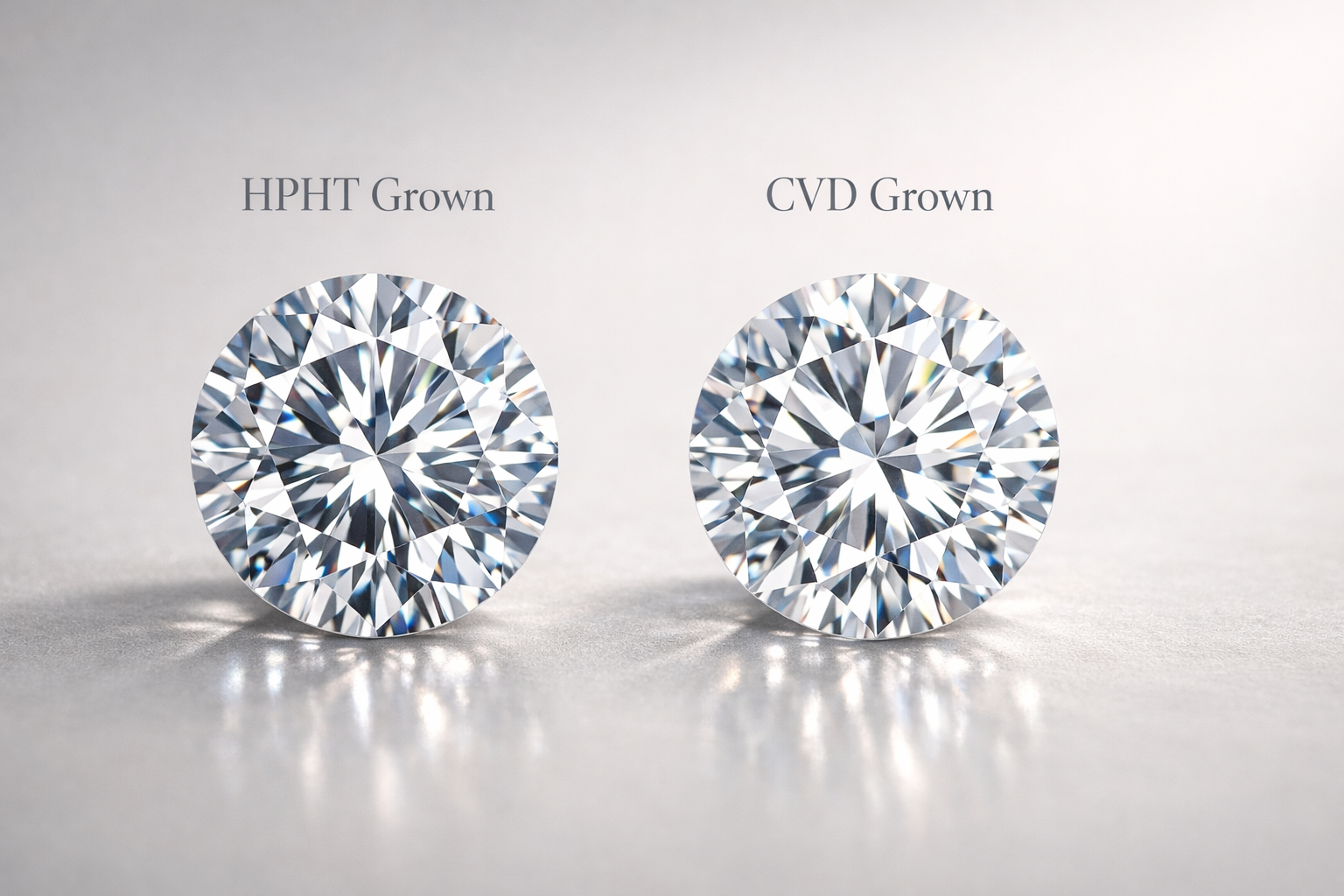
In modern diamond manufacturing, two primary technologies dominate the industry: HPHT (High Pressure High Temperature) and CVD (Chemical Vapor Deposition). These two methods represent the main types of lab-grown diamonds available in today’s market.
Before exploring how these two techniques differ, it helps to first understand what lab-grown diamonds actually are and how they compare with natural diamonds.
II. What Are Lab-Grown Diamonds?
Despite the name, lab-grown diamonds are not imitation stones. They are real diamonds with the same chemical composition, crystal structure, and optical properties as diamonds formed naturally in the Earth.
Like natural diamonds, lab diamonds are composed entirely of carbon atoms arranged in a crystal lattice structure. This structure is what gives diamonds their famous hardness and exceptional light performance. On the Mohs scale, both lab diamonds and natural diamonds rank at the same level of hardness, making them highly durable for everyday wear in engagement rings and other jewelry.
The key difference lies in how they are formed. Natural diamonds develop deep within the Earth's mantle under extreme heat and pressure over billions of years. In contrast, lab-grown diamonds are produced in controlled laboratory environments using advanced technological processes that replicate the conditions necessary for diamond formation.
These controlled environments allow scientists to carefully manage factors such as temperature, pressure, and carbon supply during the diamond growth process. As a result, lab-created diamonds can develop with the same structure and brilliance as mined stones, while also allowing manufacturers to produce diamonds more efficiently.
Because of these advancements, lab diamonds today can achieve the same grading standards used for natural diamonds. They are evaluated based on the same factors of carat weight, cut quality, color, and clarity, which means buyers can compare them using the same criteria when selecting a center stone for engagement rings.
Once we understand that lab diamonds are genuine diamonds created through controlled processes, the next step is exploring the two primary methods used to produce them.
III. The Two Main Types of Lab-Grown Diamonds
Although all lab-grown diamonds share the same chemical composition and physical properties as natural diamonds, they can be produced using different technological processes. Today, the two primary types of lab-grown diamonds available on the market are HPHT diamonds and CVD diamonds.
Both methods aim to recreate the natural conditions that allow carbon atoms to form the crystal structure of a diamond. However, they achieve this in different ways. One method replicates the intense pressure found deep within the Earth, while the other grows diamonds layer by layer using carbon-rich gas.
For most consumers purchasing engagement rings or other fine jewelry, these differences are not immediately visible. Both HPHT and CVD diamonds can produce high-quality gemstones that meet standard grading criteria for carat weight, color, clarity, and cut quality.
Still, understanding how these two growth methods work can help buyers better interpret diamond reports and feel more confident about their purchase decisions. Each technology has its own history, production process, and typical characteristics.
Let’s take a closer look at how each method works.
IV. HPHT Diamonds: The High Pressure High Temperature Method
HPHT diamonds, short for High Pressure High Temperature diamonds, are created using a process that closely mimics the natural environment where diamonds form deep inside the Earth’s mantle.
In this method, a small piece of diamond known as a diamond seed is placed inside a specialized growth chamber. The chamber then exposes the seed to extremely high pressure and temperatures exceeding those found in many industrial processes. Under these conditions, carbon begins to crystallize around the seed, gradually forming a larger diamond crystal.
This technique was originally developed in the mid-20th century and was one of the first successful methods used to create lab-created diamonds. Early HPHT diamonds were often used for industrial applications, but modern technology has significantly improved the quality of gemstones produced using this method.
Today, HPHT technology can produce beautiful lab diamonds suitable for engagement rings and other fine jewelry. These diamonds often display strong crystal structures and excellent durability. However, because the process involves metal catalysts in some cases, HPHT diamonds may occasionally contain trace metallic inclusions, although these are rarely visible to the naked eye.
Advancements in diamond manufacturing have greatly improved the clarity and color control of HPHT diamonds, making them a widely accepted option in the jewelry market.
V. CVD Diamonds: Chemical Vapor Deposition Technology
The second major category of lab-grown diamonds is produced using Chemical Vapor Deposition, commonly referred to as the CVD method.
Unlike HPHT diamonds, which rely primarily on pressure and temperature, the CVD process grows diamonds through a controlled chemical reaction inside a vacuum chamber. A thin diamond seed is placed inside the chamber, which is then filled with carbon-rich gases such as methane.
When energy is applied to the chamber, these gases break apart, allowing carbon atoms to settle onto the diamond seed. Over time, the carbon atoms bond together in a crystal lattice structure, slowly building the diamond layer by layer.
Because the growth environment is highly controlled, the CVD process often allows manufacturers to fine-tune diamond characteristics such as clarity and crystal structure. In some cases, additional treatment may be applied after growth to refine color and improve overall appearance.
Many modern lab diamonds used in engagement rings today are produced using the CVD method because it allows for precise control during the growth process. The result is a diamond that can achieve excellent cut quality, sparkle, and visual performance while maintaining the same durability as natural diamonds.
From a consumer perspective, CVD diamonds and HPHT diamonds can appear virtually identical once cut and polished. Both types can meet high grading standards and serve as stunning center stones in engagement rings.
VI. HPHT vs CVD Diamonds: What’s the Difference?
After learning about the two main types of lab-grown diamonds, many buyers naturally ask the same question: Is there a visible difference between HPHT and CVD diamonds?
In most cases, the answer is no. Once a diamond is cut and polished, both HPHT diamonds and CVD diamonds can look virtually identical to the naked eye. They share the same chemical composition, crystal structure, and hardness as natural diamonds, which means their brilliance and durability are essentially the same.
The main difference lies in how the diamonds grow during the production process. HPHT diamonds form under extremely high pressure and temperature conditions that simulate the environment deep within the Earth. By contrast, CVD diamonds grow layer by layer in a vacuum chamber using carbon-rich gas.
Because the growth environments are different, certain microscopic characteristics may appear during the diamond formation process. For example, HPHT diamonds may sometimes contain tiny metallic inclusions related to the catalysts used during production. Meanwhile, CVD diamonds may show subtle growth patterns that reflect their layered formation.
However, these differences are usually detectable only with specialized gemological equipment. In terms of appearance, both types can produce beautiful lab diamonds that meet the same grading standards for cut quality, color, clarity, and carat weight.
For buyers selecting engagement rings or other fine jewelry, the most important factors remain the traditional diamond quality characteristics rather than the growth method itself.
VII. Are HPHT or CVD Diamonds Better?
Many shoppers assume one production method must be better than the other, but in reality, both technologies are capable of producing exceptional lab-grown diamonds.
The quality of a diamond ultimately depends on how well it is cut and graded rather than how it was grown. A well-cut lab diamond with excellent proportions can display remarkable brilliance regardless of whether it was created using the HPHT or CVD method.
When purchasing a diamond, it is far more important to pay attention to the traditional grading factors:
- Carat weight
- Cut quality
- Color grade
- Clarity grade
These characteristics determine how much a diamond sparkles and how visually appealing it appears when set into engagement rings or other jewelry.
Another factor buyers may consider is availability. Because lab-grown diamonds can be produced in controlled environments, manufacturers can create diamonds in a wide range of sizes and qualities. This flexibility allows buyers to find larger stones or higher quality diamonds at more accessible prices compared with many natural diamonds.
As a result, modern lab diamonds provide consumers with greater freedom to choose a diamond that fits their personal style, design preferences, and budget.
Conclusion
Understanding the types of lab-grown diamonds helps buyers feel more confident when exploring modern diamond options. While HPHT and CVD diamonds are created using different technological processes, both methods produce genuine diamonds with the same beauty, durability, and brilliance as natural diamonds.
For most consumers, the difference between these growth methods will not affect how the diamond looks once it is cut and polished. Instead, factors such as carat weight, cut quality, color, and clarity will have a much greater impact on the overall appearance of the diamond.
Whether a diamond is produced using HPHT or CVD technology, today’s lab-grown diamonds offer an exciting alternative for those seeking stunning engagement rings and fine jewelry. With advanced diamond-growing techniques and strict grading standards, buyers now have access to beautiful diamonds that combine innovation, quality, and value.