


















I. Decoding the Hidden Language of Your Diamond
Imagine finding the absolute perfect lab-grown diamond ring online. The sparkle in the video is mesmerizing, and the price fits your budget seamlessly. But as you scroll down to verify its credentials, you are hit with a wall of technical grading reports from the International Gemological Institute (IGI). Suddenly, your screen is filled with cryptic acronyms, precise percentages, and geometric mapping diagrams like VVS2, Ideal, None, and CVD.
If you feel slightly overwhelmed, you are not alone. For many gemstone lovers, looking at a professional grading report feels like trying to read an advanced physics paper in a foreign language. Many retail buyers simply skip past the data, trusting a salesperson’s verbal reassurance.
But here is the truth: a grading report is not just a receipt; it is your diamond’s irreplaceable DNA profile. Learning how to read a diamond certificate is the single most powerful step you can take to protect your investment, cut through retail marketing smoke, and ensure you are getting exactly what you pay for.
As a premier authority on sustainable luxury, IGI serves as the global gold standard for grading lab-grown diamonds. In this comprehensive, fluff-free diamond certificate guide, we will break down the complex world of IGI reports into simple, actionable steps. By the end of this guide, you will be able to read an IGI certificate like an industry veteran in less than sixty seconds.

II. The Authenticity Check: Verifying the Diamond’s "Identity Card"
Before diving into the complex data of diamond color or clarity, you must first verify that the certificate is authentic and that it flawlessly matches the physical stone in front of you. Think of this as checking a passport before analyzing a biography.
The IGI Report Number
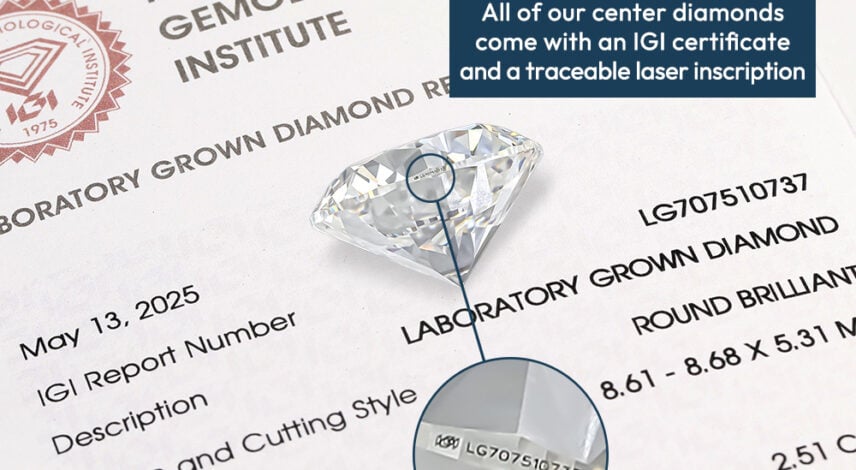
At the very top of every authentic IGI document, you will find a unique, multi-digit IGI Report Number. This is the diamond’s official social security number. You can instantly head to the official IGI website and type this number into their verification database to pull up a digital twin of the certificate. If the online database records do not match your paper or PDF copy perfectly, it is an immediate red flag.
The Security Mesh: Certifications vs. Personalizations
The physical stone itself carries a hidden safety mechanism. Upon finishing the grading process, IGI laboratory technicians use an ultra-precise, microscopic laser to engrave the official logo and certificate report number directly onto the narrow outer rim of the stone. When shopping, always ask your jeweler to show you this laboratory certification inscription under a gemological microscope or a high-powered jeweler’s loupe.
Important Buyer Note: It is absolutely critical to separate these official, immutable laboratory security codes from in-house customizable laser engraving services. While a brand can easily engrave a custom anniversary date, a romantic phrase, or a name onto the band or diamond per your request, those are personalized design features. The IGI laser inscription is a strict, non-negotiable security stamp from an independent third-party laboratory.
III. The Core Specs: Navigating the IGI 4Cs Section
Once authenticity is locked in, your eyes should immediately move to the core specifications panel. This is where the physical characteristics of the diamond are quantified. Let’s translate the industry jargon into plain English.
The Laboratory Grown Statement
Right under the shape description, an authentic IGI report will explicitly state “LABORATORY GROWN DIAMOND.” This provides total transparency, guaranteeing that you are receiving a sustainably manufactured stone rather than a mined alternative.
Shape, Cutting Style, and Measurements
- Shape and Cutting Style: This defines the geometric form of your stone (e.g., Round Brilliant, Oval Brilliant, Pear Brilliant, or Marquise Brilliant).
- Measurements: Written as a sequence of three numbers in millimeters (e.g., $7.71 \times 5.67 \times 3.53 \text{ mm}$). The first two numbers represent the length and width of the top surface area, while the final number indicates the total depth. As we established in our previous guide, always cross-reference these millimeter dimensions against the carat weight; the surface area in millimeters tells you how large the diamond will actually look on your hand, regardless of how heavy it is on a scale!
Carat Weight, Color, and Clarity
- Carat Weight: The physical weight of the diamond measured to two decimal places.
- Color Grade: IGI grades lab-grown diamond colors on a strict alphabetical scale running from D (completely colorless) to Z (light yellow/brown). To get the cleanest, most icy visual impact, smart buyers typically aim for the “Colorless” range (D-F) or the highly cost-effective “Near Colorless” range (G-H).
- Clarity Grade: This evaluates the tiny, natural birthmarks trapped inside the stone. The scale moves from FL/IF (Flawless/Internally Flawless) down to I (Included). Your goal here shouldn’t be spending a fortune on absolute perfection. Instead, use the certificate to hunt for an “Eye-Clean” diamond in the VS1, VS2, or SI1 ranges—meaning the minor inclusions are completely invisible to the naked human eye, allowing you to save thousands of dollars without sacrificing beauty.
IV. Technical Mastery: The Hidden Parameters That Control Sparkle
Now that the 4Cs are established, it is time to look at the advanced technical data that separates an average diamond from one that catches everyone’s eye across a crowded room. These parameters determine how efficiently the stone manipulates light.
Cut Grade: The Multiplier of Brilliance
While color and clarity are determined by nature and technology, the Cut is entirely a master craftsman’s triumph. On an IGI report, the Cut grade is only assigned to Round Brilliant diamonds, rated from Ideal down to Poor.
To maximize your visual return, you should look for the coveted Triple Excellent designation (though IGI officially titles the highest cut tier as Ideal). This means three specific columns on your certificate must all read Ideal/Excellent:
Cut Grade: Ideal
Polish: Excellent (How smooth the mirror-like surface facets are)
Symmetry: Excellent (How perfectly aligned the facets are to each other)
When a diamond achieves this trifecta, it acts like a flawless system of mirrors, bouncing nearly 100% of entering light back through the top table, creating breathtaking fire and scintillation.
The Proportions Diagram: Spotting "Inefficient" Weight
In the center of every IGI report sits a geometric blueprint of your diamond’s exact silhouette. This diagram reveals the precise percentages of the stone’s anatomy. When you are studying this graphic, keep your eyes on two specific figures:
- Table Percentage: The flat, top facet of the diamond. For an Ideal cut round diamond, look for a table percentage between 54% and 60%. A table that is too wide diminishes fire, while one that is too narrow reduces overall brilliance.
- Total Depth Percentage: The total height of the diamond from table to culet, divided by its width. The golden range here is 59% to 62.5%. If this number climbs past 63%, you are dealing with a “Deep Cut” diamond that is hiding its weight in a heavy bottom, meaning it will look visually smaller than its carat weight suggests.
V. The Lab-Grown Edge: Growth Methods and the Clarity Plot
Because IGI is the pioneering leader in grading lab-grown diamonds, their reports feature specialized sections tailored specifically to advanced diamond synthesis. Understanding these notes helps you verify the physical purity of your stone.
CVD vs. HPHT: The Growth Method
Near the bottom of the certificate, under the additional comments section, IGI will state the exact technological process used to create the diamond:
- CVD (Chemical Vapor Deposition): This method grows diamonds atom-by-atom inside a vacuum chamber using carbon-rich gas. CVD diamonds grow in flat, pristine layers and typically offer exceptional optical clarity.
- HPHT (High Pressure High Temperature): This process replicates the earth’s natural volcanic forces using massive mechanical presses, extreme heat, and a molten metal catalyst.
Neither method is inherently superior, but knowing the growth method allows you to understand the nature of the diamond’s internal characteristics.
Reading the Clarity Plot: Mapping Your Diamond's Fingerprint
The IGI certificate includes a graphic containing two diagrams of a diamond—one representing the top view (crown) and one representing the bottom view (pavilion). This is the Clarity Plot, a visual map of the diamond’s internal micro-features (inclusions).
Instead of fearing inclusions, use this diagram to shop strategically:
- The Key to Symbols: IGI uses colored symbols to represent different inclusion types. Red symbols indicate internal characteristics (like Crystals or Pinpoints), while green symbols mark surface blemishes.
- Location Matters: Look for a diamond where the symbols are scattered along the outer edges (the girdle or crown facets). Avoid stones where a cluster of symbols sits directly in the center of the square Table diagram. Inclusions directly under the table can block light reflection and are much more likely to be visible to the naked eye.
VI. Smart Shopping Tactics: Using Your Certificate to Unlock Maximum Value
With your ability to analyze an IGI report, you can now bypass retail markups and uncover high-value gems that others miss. Use these two advanced criteria during your next purchase.
Exploiting the "Magic Weight" Price Drops
The diamond industry prices stones based on strict weight milestones. A 1.00-carat or 1.50-carat diamond experiences a sharp spike in cost simply because it hits an emotionally satisfying round number.
By utilizing the IGI online portal, look for stones graded at 0.91 to 0.97 carats or 1.40 to 1.46 carats that possess an Ideal cut grade. When you check their physical Measurements line, you will find they span the exact same millimeter diameter as their heavier counterparts, but their price tag can be significantly lower.
Leveraging Elongated Geometry
If you want to maximize your visual impact on a specific budget, use the IGI measurement data to compare shapes. A standard 1.00-carat Round Brilliant diamond will show a diameter of roughly 6.5mm on its IGI report. However, a 1.00-carat Oval Brilliant diamond often measures around 7.7mm in length. By trusting the millimeter metrics on the certificate rather than the weight on the scale, you can easily select a shape that offers an expanded visual footprint on the hand.
Conclusion: Data Empowers Your Selection
A diamond certificate is far more than a legal formality; it is a shield against inflated retail prices and a roadmap to genuine quality. By shifting your focus away from the simple carat number and looking closely at cut percentages, millimeter dimensions, and inclusion placements on an IGI report, you transform a confusing purchasing process into an exact science.
When you shop for your next piece of luxury jewelry, don’t rely on guesswork or sales pitches. Demand an independent IGI certificate, look for an Ideal cut grade, verify the laser inscription, and choose a diamond whose structural data matches its radiant beauty.