





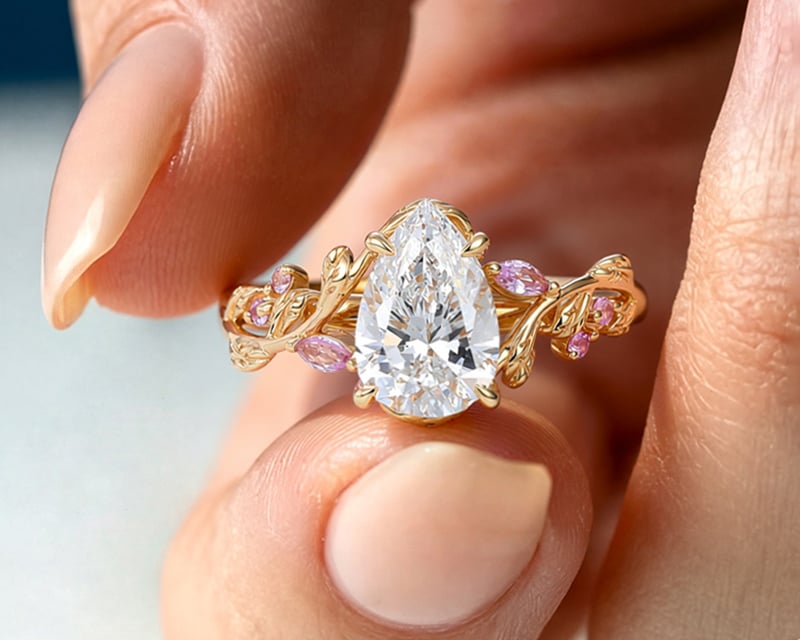




















You may have found the perfect ring and planned the perfect moment—but one practical question remains: what size should you order?
Learning how to measure ring size secretly can help you protect the surprise while reducing the risk of choosing a ring that is uncomfortably tight or too loose to wear. The most reliable approach is usually to begin with a ring your partner already owns, but a discreet conversation with a trusted friend or a casual visit to a jewelry store can also provide useful clues.
No secret method is completely foolproof. Finger size can vary between hands, and temperature, band width, knuckle shape, and the time of day can all affect how a ring fits. The goal is not to make a perfect guess from a single clue—it is to gather the most accurate information available and, when possible, confirm it in more than one way.
Below are five practical methods for estimating your partner’s ring size without revealing your plans, plus the common measurement mistakes you will want to avoid.
Before You Start: Know Which Finger You Are Measuring
Before borrowing a ring or printing a size chart, make sure you know exactly which finger—and which hand—you need to measure.
In the United States, engagement rings are traditionally worn on the left ring finger. However, a ring that fits the right ring finger may not fit the left one in exactly the same way. Even on the same hand, the index, middle, and ring fingers can differ significantly in size.
For this reason, do not choose a random ring from your partner’s jewelry box. First, observe when and where they wear it. A ring regularly worn on the left ring finger will provide a much more useful reference than one worn on the index finger or opposite hand.
Lisa Jewelry Tip:
An existing ring is only a reliable reference if it fits comfortably and is worn on the same finger and hand intended for the new ring.
1. Borrow a Ring They Already Wear
Choose a ring that fits comfortably on the same finger and hand intended for the new ring. Avoid adjustable, open, or visibly misshapen rings, since they may not provide an accurate reference.
Once you have the ring, you can use it in two ways:
- Take it to a professional jeweler for measurement.
- Compare its inside edge with a correctly printed ring size chart.
A jeweler can usually determine the size quickly with a ring-sizing mandrel. If your partner is likely to notice that the ring is missing, take a clear photo of it beside a millimeter ruler or trace its inside edge before returning it.
Be sure to tell the jeweler which hand and finger the ring is normally worn on. You should also mention whether the new design has a wide band, since wider rings can feel tighter than delicate bands of the same nominal size.
Best for: Getting the closest estimate from a ring that already fits the intended finger.
2. Trace the Inside of the Ring
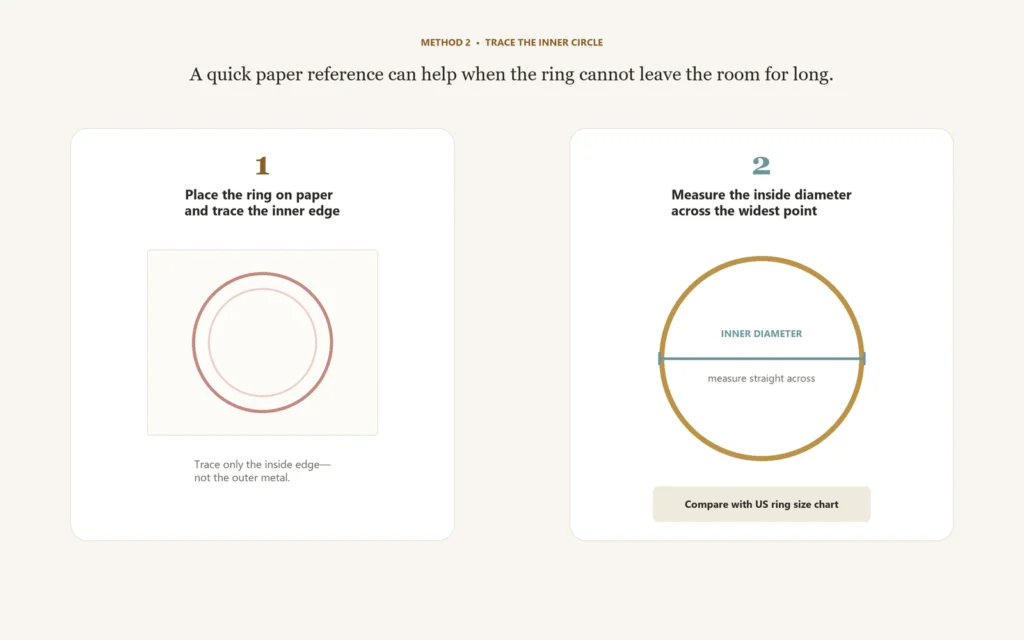
If you can access your partner’s ring but cannot take it out of the house, create a quick paper reference.
Place the ring flat on a clean sheet of paper. Using a fine-point pencil, carefully trace along the inside edge of the ring. Repeat the process two or three times to make sure the circles are consistent.
You can then give the tracing to a jeweler or measure the inner diameter across the widest point with a millimeter ruler.
Always measure the inner opening—not the outer edge of the metal. Including the thickness of the band will produce a size that is too large.
Write down which ring you traced and which finger it is worn on. This small detail can prevent confusion if you are comparing more than one ring.
Best for: Creating a fast reference when the ring can only be borrowed for a few minutes.
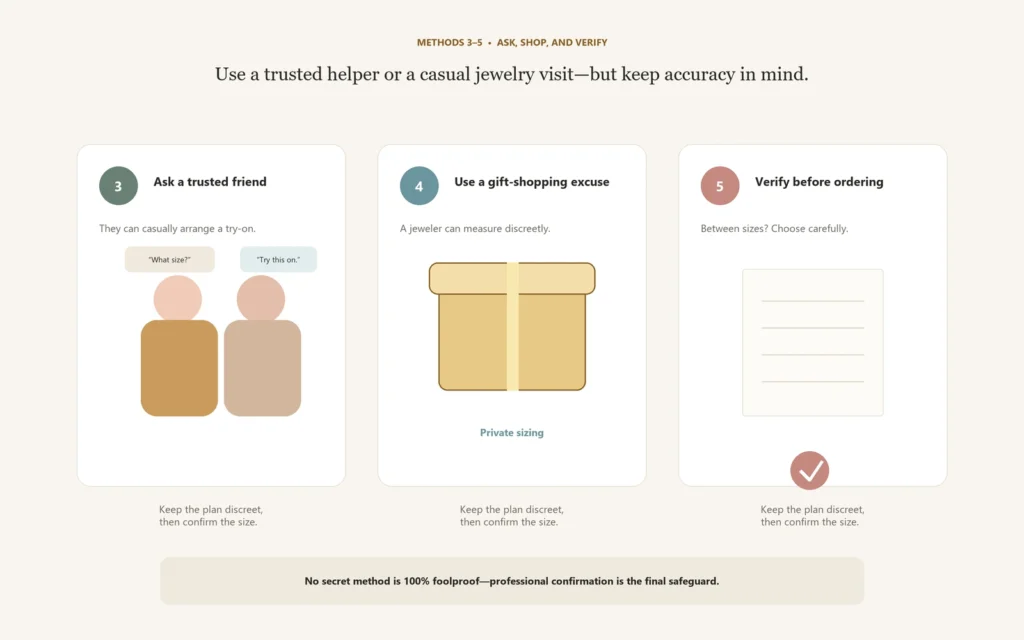
3. Ask a Trusted Friend or Family Member
A close friend, sibling, or family member may already know your partner’s ring size. If they do not, they may be able to find out without making the question seem suspicious.
For example, the friend could pretend to be shopping for a ring, invite your partner to try on jewelry, or casually compare rings during a conversation. If they arrange a try-on, ask them to note the exact size rather than relying on memory.
Choose your helper carefully. The ideal person can keep the proposal private and gather information naturally without asking an unusually direct question.
A friend’s guess should be treated as a clue rather than a final measurement. Whenever possible, confirm it with an existing ring or a professional jeweler.
Best for: Partners who regularly discuss jewelry with close friends or relatives.
4. Create a Casual Ring Try-On
A casual jewelry-shopping trip can provide a natural opportunity to have your partner professionally sized.
You might stop by a jewelry store while shopping for a birthday gift, helping a friend choose jewelry, or simply browsing together. Encourage your partner to try on a few fashion rings without focusing too heavily on the left ring finger.
If possible, speak with the jeweler beforehand. Explain that you are planning a surprise and ask whether they can discreetly record the size. An experienced jeweler may also notice whether the ring is too tight at the knuckle or too loose at the base of the finger.
This method provides more information than a simple size number. It can reveal whether your partner prefers a fitted or relaxed feel and how different band widths sit on their hand.
Best for: Getting a professional measurement without making the proposal obvious.
5. Compare the Ring with One of Your Own Fingers
If you only have a few moments with your partner’s ring, gently slide it onto one of your own fingers.
Do not force it over a knuckle. Instead, note where the ring naturally stops and mark that position with a washable pen. A jeweler can then measure your finger at the marked point and use it as an approximate reference.
This method is less precise than bringing the ring itself to a jeweler, but it can be useful when you cannot photograph, trace, or temporarily remove the ring.
For a better estimate, repeat the comparison on another occasion. If the ring stops at approximately the same point each time, the reference is more useful.
Best for: Last-minute situations when the ring cannot leave your partner’s jewelry box.
Ring-Size Guessing Mistakes to Avoid
Even a careful measurement can be misleading if you use the wrong reference. Before ordering, check for these common mistakes:
- Measuring the wrong finger: Finger sizes can vary between hands and between individual fingers.
- Using the outside diameter: Always measure the open space inside the ring, not the outside edge of the metal.
- Choosing a damaged ring: Bent, adjustable, or open rings do not provide a dependable size.
- Trusting a screen measurement: Phone and computer displays can resize charts automatically.
- Printing at the wrong scale: A printable chart must be printed at 100% or “Actual Size,” not “Fit to Page.”
- Ignoring band width: A wide ring may feel tighter than a thin ring in the same size.
- Relying on one clue: Whenever possible, confirm your estimate using a second method.
Also avoid wrapping string around your partner’s finger while they are asleep. String can stretch, twist, or tighten unevenly, making the result less reliable than measuring an existing ring.
Download the LisaJewelryUS Ring Size Chart
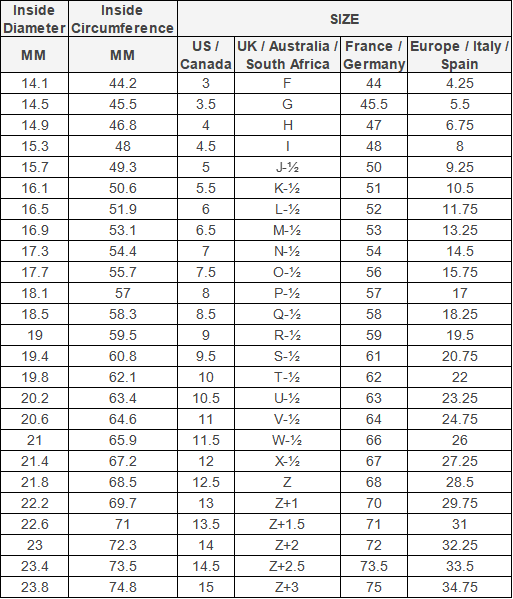
A properly calibrated ring size chart download lets you compare an existing ring with standard US ring sizes at home.
Download the LisaJewelryUS Ring Size Chart
Before using the chart:
- Print it at 100% or Actual Size.
- Disable “Fit to Page” or automatic scaling.
- Check the printed calibration line with a ruler.
- Place the ring over the circles and match its inside edge.
- If the ring falls between two sizes, record both results.
Never compare a physical ring with a chart displayed on a phone or computer screen. Screen size, zoom settings, and display resolution can change the apparent measurements.
Publishing note: Link the button above to the final calibrated LisaJewelryUS PDF rather than to a standard blog image.
What If the Measurement Falls Between Two Sizes?
When a measurement falls between two sizes, the better choice depends on the ring’s width, setting, and resizing options.
A slightly larger ring may be easier to wear temporarily than one that cannot pass over the knuckle. However, an overly loose ring can rotate or slip off. Wide bands may also require more room than narrow ones.
Before ordering, check whether the specific design can be resized. Eternity bands, full pavé rings, engraved bands, and certain alternative metals may have limited resizing options.
Lisa Jewelry Tip:
If you are uncertain, share the measurement method, inside diameter, and estimated sizes with the jeweler rather than providing only your final guess.
Keep the Surprise—Not the Guesswork
Learning how to measure ring size secretly requires observation, careful measurement, and sometimes a little help from someone your partner trusts.
Borrowing a well-fitting ring from the correct finger is usually the strongest starting point. Tracing its inner edge, arranging a casual try-on, or consulting a professional jeweler can provide additional confirmation.
No secret method guarantees a perfect fit, so check the ring’s resizing options before placing your order. With more than one reliable clue, you can preserve the surprise without leaving the fit entirely to chance.
Frequently Asked Questions
Borrow a ring she wears on the intended finger and have it professionally measured. If that is not possible, trace its inside edge or ask a trusted friend to arrange a casual ring try-on.
Usually not with enough accuracy to order confidently. Photos can distort proportions because of camera angle and perspective. A photo is only potentially useful when the ring is photographed flat beside an accurate millimeter reference.
Slightly larger may be easier to wear temporarily, but it is not always the correct choice. Band width, knuckle size, setting weight, and resizing limitations should all be considered before ordering.