















You may see “CVD” or “HPHT” listed beside a lab-grown diamond and wonder whether one method produces a more beautiful, durable, or brilliant stone.
The short answer is that neither growth method is automatically better. Both CVD and HPHT can produce genuine laboratory-grown diamonds with the same essential crystal structure and chemical composition as natural diamonds. The finished diamond’s cut, color, clarity, transparency, and overall visual performance matter more than the growth method alone. (gia.edu)
Understanding the difference between these two lab grown diamond growth methods can still help you shop with greater confidence. It allows you to read a grading report more carefully, distinguish growth method from post-growth treatment, and compare two individual diamonds based on what you can actually see.
In this guide, we explain how CVD and HPHT diamonds are made, what the growth method can—and cannot—tell you about quality, and why HPHT vs. CVD sparkle is ultimately a question of the finished diamond rather than the acronym on its report.
The Quick Answer: Is CVD or HPHT Better?
Neither CVD nor HPHT is automatically superior. Both methods can produce beautiful laboratory-grown diamonds in a range of shapes, sizes, colors, and clarity grades.
If you are comparing two stones, focus first on the finished diamond:
- How lively and bright does it look?
- Does the color suit your preference?
- Are the proportions and symmetry well balanced?
- Is the stone transparent rather than hazy?
- Does an independent grading report clearly disclose its growth method?
- Is any post-growth treatment listed?
CVD May Appeal to You If:
- You want to compare a wide selection of lab-grown diamonds;
- You are considering a larger center stone;
- You are comfortable reviewing treatment disclosures;
- You care more about the finished diamond’s appearance than the growth label.
HPHT May Appeal to You If:
- You prefer a diamond grown under high-pressure and high-temperature conditions;
- You are considering colorless or fancy-color laboratory-grown diamonds;
- You want the growth method clearly identified on an independent report;
- You are comparing stones with similar 4Cs characteristics.
Lisa Jewelry Expert Note:
“HPHT-grown” and “HPHT-treated” are not the same description. A diamond may be grown using CVD and later receive HPHT treatment to improve its color. The growth method and any post-growth treatment should be evaluated separately.
The best buying decision is usually not “CVD or HPHT?” in isolation. It is choosing the individual diamond with the strongest combination of cut quality, appearance, documentation, and value.
What Is an HPHT Lab-Grown Diamond?
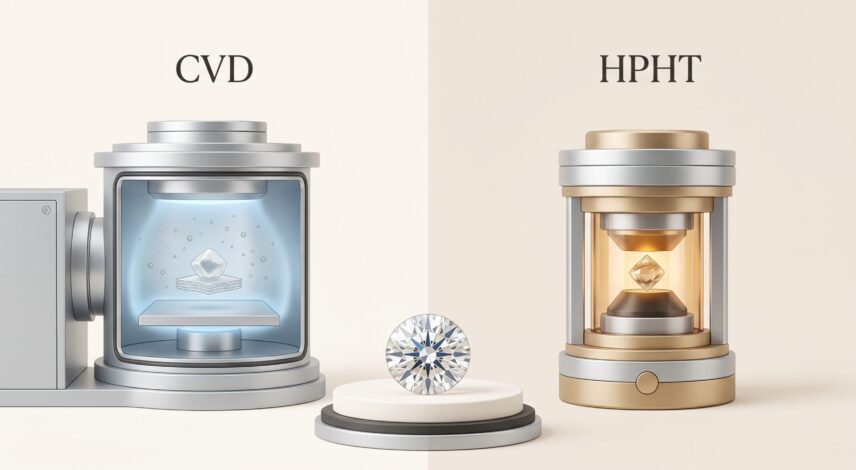
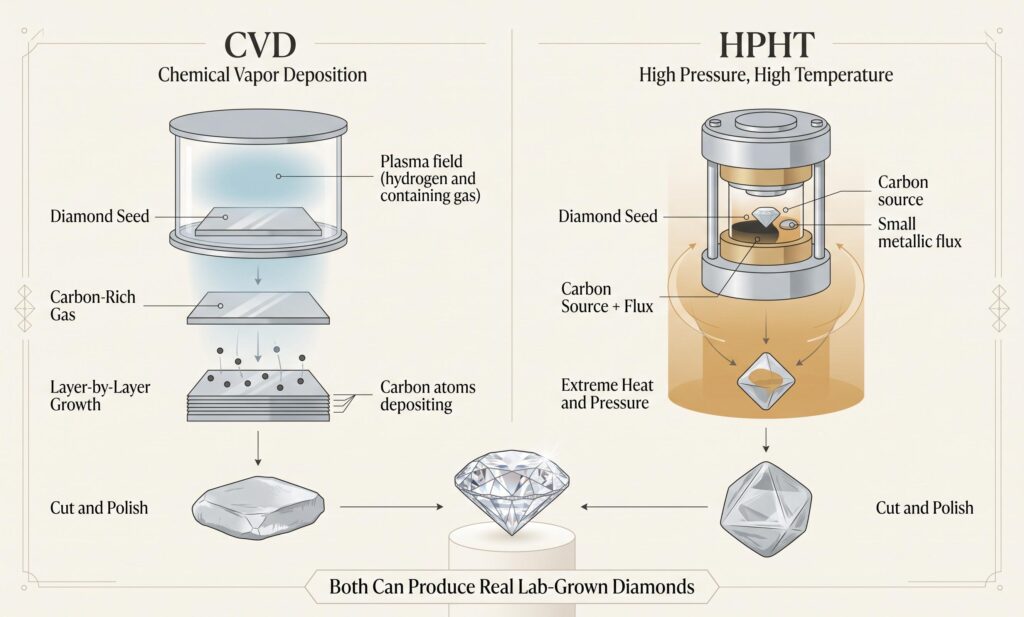
HPHT stands for high pressure, high temperature. It is one of the primary methods used to grow diamonds in a laboratory and is designed to recreate some of the extreme conditions associated with diamond formation deep within the Earth.
The process begins with a small diamond seed, a carbon source, and a metallic flux that helps dissolve the carbon. These materials are placed inside a specialized growth capsule. The chamber is then subjected to extremely high pressure and temperatures commonly ranging from approximately 1300°C to 1600°C. As the carbon dissolves in the molten metal, it travels toward the cooler diamond seed and crystallizes onto its surface.
The growth process can take anywhere from hours to several weeks, depending on the desired size and quality of the crystal. Once the crystal is complete, it is removed from the growth apparatus, cut, and polished into a finished diamond.
What Can HPHT Growth Features Look Like?
HPHT-grown diamond crystals typically develop a combination of cubic and octahedral growth faces. Some may also contain metallic flux inclusions or show characteristic color distribution, fluorescence zoning, or growth patterns.
These features are useful to gemological laboratories when identifying how a diamond was grown. They should not automatically be treated as signs that a finished diamond is unattractive or unsuitable for jewelry. A consumer should evaluate the actual stone’s transparency, clarity appearance, and overall beauty rather than attempting to judge the growth method from technical characteristics alone.
HPHT technology has also developed significantly over time. Earlier HPHT-grown diamonds were often associated with strong yellow, orange, or blue colors, while modern production can produce larger colorless to near-colorless diamonds as well.
What Is a CVD Lab-Grown Diamond?
CVD stands for chemical vapor deposition. Unlike HPHT, which grows diamond under extreme pressure, CVD grows diamond material inside a vacuum chamber from a carbon-containing gas.
The process starts with one or more flat diamond seed plates. The chamber is filled with a mixture of hydrogen and a hydrocarbon gas, such as methane. Microwaves activate the gas and create a plasma. Within that plasma, carbon-containing particles separate and move toward the cooler diamond seed, where they attach and crystallize in thin layers.
CVD growth commonly takes place at temperatures of approximately 900°C to 1200°C and may involve several stop-and-start cycles. The crystal can be removed periodically so its surface may be polished before it is returned to the chamber for additional growth. Once finished, the crystal is cut and polished like any other gem-quality diamond.
Does CVD Growth Affect Color?
Some CVD-grown crystals develop a brown or grayish body color during growth. Heat treatment after growth—often using HPHT conditions—may be used to improve the final color before the diamond is faceted.
This is why a diamond can be CVD-grown and HPHT-treated. The first term describes how the diamond crystal was created; the second describes a later process used to modify its appearance. Treatment does not make the diamond a simulant or change the fact that it is laboratory-grown, but the treatment should be disclosed clearly to the buyer.
Modern CVD production has also advanced substantially. High-quality CVD-grown diamonds are now available in larger sizes and improved color and clarity ranges, so it is no longer accurate to assume that CVD automatically means lower quality.
CVD Diamond Quality vs. HPHT Diamond Quality
Growth method does not assign a finished diamond a fixed quality level. Both CVD and HPHT can produce exceptional diamonds, and both can produce individual stones with characteristics a buyer may prefer to avoid.
Color
Both methods can produce diamonds ranging from colorless to near-colorless, as well as fancy-color stones. A CVD diamond may undergo post-growth treatment to reduce a brown or gray appearance, while HPHT growth can also produce diamonds with yellow, blue, pink, or other color appearances depending on the growth environment and any later treatment.
For this reason, do not assume that all CVD diamonds are warm or that all HPHT diamonds are colorless. Review the final color grade and examine the actual diamond in high-resolution images or video.
Clarity and Transparency
Clarity grades provide useful information, but the grade alone does not tell you exactly how a diamond will look in person. When comparing stones, look for:
- Black or dark inclusions;
- Hazy or cloudy areas;
- Visible strain or graining;
- A distracting center inclusion;
- Uneven transparency;
- A strong tint that is not apparent from the grade alone.
Two diamonds with similar clarity grades can still appear different because the location, contrast, and visibility of their internal features vary.
Growth Features
CVD and HPHT diamonds may display different internal growth patterns and strain characteristics. These features can help gemological laboratories identify the growth method, but they are not a simple beauty ranking.
Buy the Diamond, Not Just the Method.
When comparing CVD and HPHT stones, prioritize the finished diamond’s visual performance, cut quality, transparency, color appearance, grading report, and return policy.
HPHT vs. CVD Sparkle: What Actually Determines Brilliance?
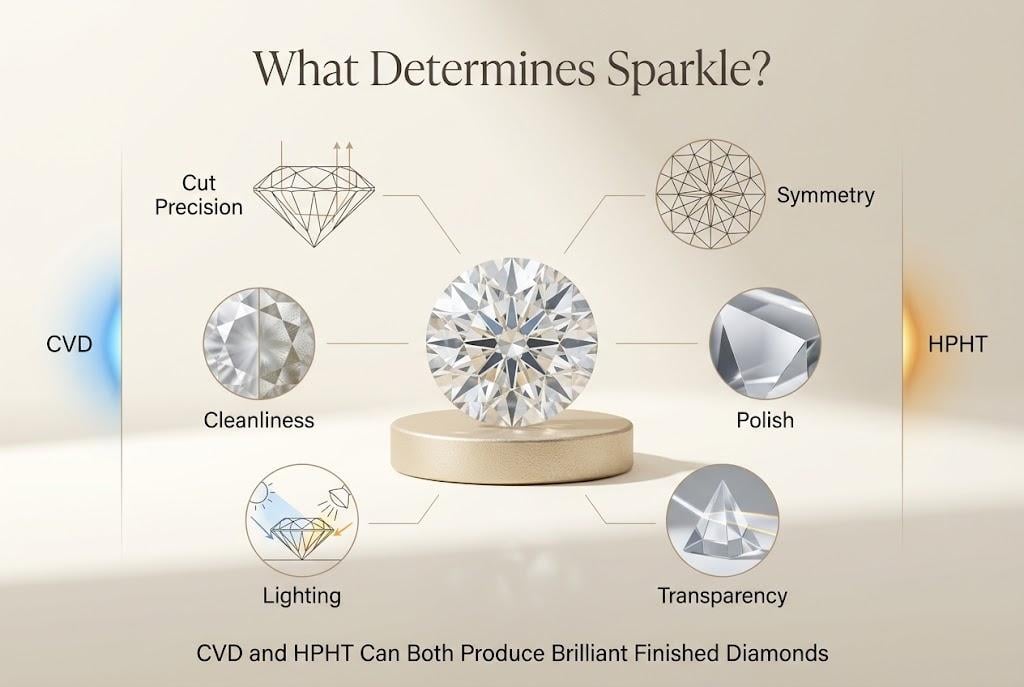
A CVD diamond does not automatically sparkle less, and an HPHT diamond does not automatically sparkle more.
The most important factors influencing brilliance and fire are found in the finished diamond, especially:
- Cut precision — Proportions determine how effectively light travels through the stone and returns to the viewer.
- Symmetry — Well-aligned facets help create a more balanced pattern of light and dark.
- Polish — A smooth facet surface supports the diamond’s ability to reflect light.
- Transparency — Haze, strain, or certain internal features can influence how clearly light moves through the stone.
- Shape — A round brilliant, oval, cushion, and emerald cut reflect light in different ways.
- Lighting and cleanliness — A diamond may look dramatically different under showroom lighting, daylight, or indoor light, and residue from lotion or oil can reduce its brightness.
This means HPHT vs. CVD sparkle is not a reliable method-versus-method competition. A beautifully cut CVD diamond may look more lively than a poorly cut HPHT diamond, just as a well-cut HPHT diamond may outperform a CVD stone with weaker proportions.
Lisa Jewelry Expert Note:
If sparkle is your priority, ask to see high-resolution video and compare diamonds under more than one lighting condition. Growth method is part of a diamond’s history, but cut quality determines much of its finished visual performance.
Does the Growth Method Affect Price, Size, or Availability?
CVD and HPHT can differ in production process, equipment, growth time, and the type of rough crystal they produce. However, the growth method alone does not determine the final retail price or automatically make one diamond a better value.
When comparing two lab-grown diamonds, compare similar stones as closely as possible:
- The same diamond shape;
- Similar carat weight;
- Similar color and clarity;
- Comparable cut quality;
- The same or a similar grading-report standard;
- Similar treatment disclosure;
- Comparable return and warranty policies.
A larger CVD diamond may be priced differently from a smaller HPHT diamond for reasons that have little to do with the growth method itself. Shape, proportions, color, clarity, cutting efficiency, brand, setting, inventory, and market conditions can all affect the final price.
For this reason, avoid comparing CVD and HPHT diamonds only by price per carat. A lower price does not automatically mean lower quality, just as a higher price does not guarantee better sparkle.
A Better Comparison Rule:
Compare the finished diamonds side by side—not only the abbreviations on their reports.
What to Check on a Lab-Grown Diamond Report
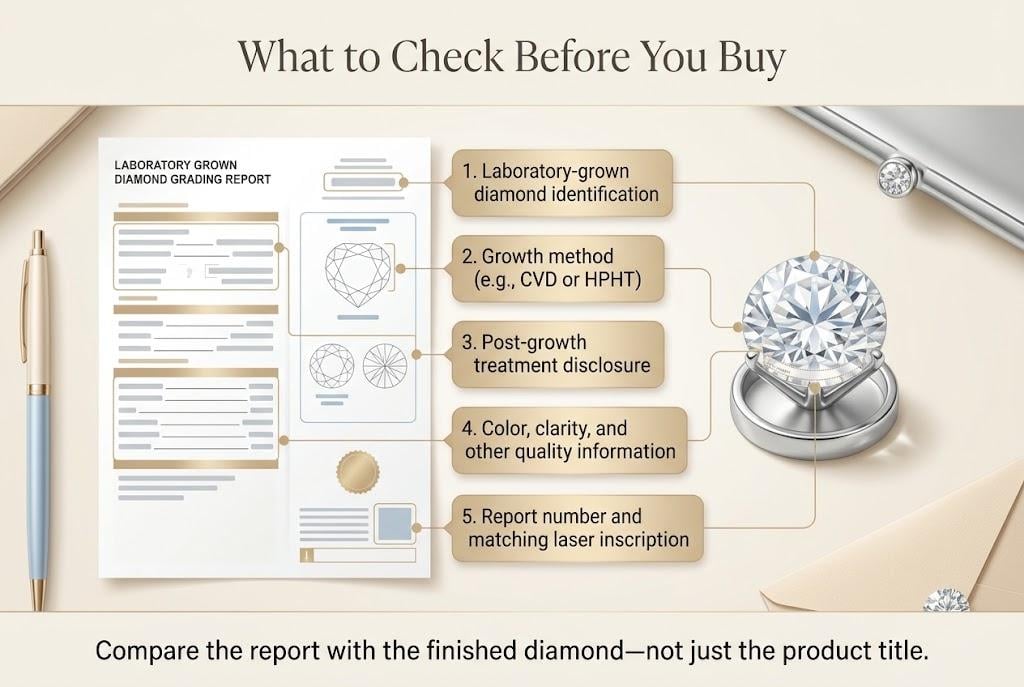
A grading report can help you understand what you are buying, but the information included may vary depending on the laboratory and report type. Before ordering, look for clear disclosure of the diamond’s laboratory-grown identity, growth method, treatment information, and quality characteristics.
Confirm the Laboratory-Grown Identity
Do not rely only on a product title or a seller’s description. The diamond should be accompanied by documentation from an established gemological laboratory or another clearly identified grading provider.
Some laboratory-grown diamond reports also include a laser inscription on the girdle with the report number and laboratory-grown designation.
Check the Growth Method
A report may identify the diamond as:
CVD — Chemical Vapor Deposition
or:
HPHT — High Pressure, High Temperature
This information describes how the crystal was grown. It is not a direct quality ranking.
For example, GIA reports that certain laboratory-grown diamond reports identify whether a stone was created using CVD or HPHT.
Review Post-Growth Treatment
Look for wording that explains whether the diamond has received post-growth treatment to change or improve its color.
This distinction matters because:
- A diamond can be CVD-grown and later HPHT-treated;
- HPHT growth and HPHT treatment are different processes;
- Treatment does not turn a laboratory-grown diamond into a simulant;
- The buyer should receive clear disclosure of the stone’s history.
GIA explains that its laboratory-grown diamond reports may state whether evidence of post-growth treatment was detected, not detected, or could not be determined, depending on the report type.
Verify the Report
Check that the report number matches the diamond’s documentation and, where applicable, the laser inscription on the girdle. If the report language is unclear, ask the seller or laboratory for clarification before purchasing.
How to Compare CVD and HPHT Diamonds in Person
If you have the opportunity to compare diamonds directly, look beyond the color and clarity grades.
View the Diamonds Face-Up
Look for brightness across the entire stone. A well-performing diamond should not appear noticeably dull, overly dark, or cloudy in the center.
Change the Lighting
Observe the stones under:
- Diffused daylight;
- Indoor lighting;
- Jewelry-store lighting;
- Slightly lower light conditions.
A diamond that looks impressive only under intense showroom lights may not perform as well in everyday environments.
Tilt and Rotate the Stone
Move the diamond gently and observe how it returns light. Look for balanced flashes rather than a single bright area surrounded by darkness.
Review the Side Profile
The side view can reveal:
- Unusual depth;
- Excessive darkness;
- Strong body color;
- A very thin or thick girdle;
- Proportions that may affect the final appearance.
Compare the Actual Stones, Not Only the Numbers
Two diamonds with similar grades can still look different because their inclusions, proportions, transparency, and facet alignment are not identical. This is especially important when comparing a CVD diamond with an HPHT diamond.
Lisa Jewelry Expert Note:
A grading report helps you understand a diamond. Your eyes—or high-quality video—help you decide whether you love the finished stone.
Which Growth Method Should You Choose?
The best choice depends on the individual diamond rather than a universal preference for CVD or HPHT.
Choose Based on the Finished Diamond If:
- The cut appears bright and balanced;
- The color is attractive in person or on video;
- The stone has good transparency;
- The clarity characteristics are not distracting;
- The grading information is clear;
- The price matches the overall quality.
Prioritize Documentation If:
- One stone has clearer treatment disclosure;
- One report identifies the growth method more specifically;
- The seller provides better images and video;
- The return policy is more flexible;
- You are purchasing a larger or more expensive diamond.
Ask for Additional Guidance If:
- The report uses unfamiliar terminology;
- The diamond has a strong body color;
- You are considering an unusual fancy color;
- The stone has visible strain, cloudiness, or unusual inclusions;
- You cannot compare it in person;
- The price seems unusually low compared with similar stones.
You do not need to become a gemologist to choose a beautiful lab-grown diamond. You do need enough information to understand the stone’s origin, appearance, documentation, and care requirements.
Final Verdict: Better Is About the Finished Diamond
CVD and HPHT are two different ways to grow a laboratory-grown diamond—not automatic rankings of beauty, durability, or sparkle.
A CVD diamond can be bright, colorless, and beautifully cut. An HPHT diamond can also be exceptional, while another HPHT or CVD diamond may have proportions, clarity features, or color characteristics that do not suit your preferences.
The most reliable approach is to compare the finished diamonds based on cut quality, transparency, color, clarity, visual performance, grading documentation, and value.
If you are still deciding between cvd vs hpht lab diamond options, focus on the stone you would be happiest to wear—not simply the method used to grow it.
Explore LisaJewelryUS laboratory-grown diamond designs, or contact our team for help reviewing growth disclosures, comparing diamond videos, and selecting a stone that suits your preferred shape, setting, and budget.
Frequently Asked Questions
No. Both methods can produce high-quality laboratory-grown diamonds. Compare the finished stone’s cut, color, clarity, transparency, grading report, and visual performance instead of relying on the growth method alone.
No. HPHT vs. CVD sparkle is primarily determined by cut precision, proportions, symmetry, polish, transparency, lighting, and cleanliness. A well-cut CVD diamond can be highly brilliant, just as an HPHT diamond can vary in performance from stone to stone.
Yes. A CVD-grown diamond that later receives HPHT treatment is still a laboratory-grown diamond. The important point is that the growth method and post-growth treatment should be disclosed clearly.
No. CVD diamond quality varies from one stone to another. Modern CVD production can create larger, colorless, and high-clarity gem diamonds, but each finished stone should be evaluated individually.
Usually not reliably with the unaided eye. Gemological laboratories use specialized instruments and testing methods to determine whether a laboratory-grown diamond was produced using CVD or HPHT.