


















Low-Profile vs. High-Profile Engagement Ring Settings: Which Is Right for You?
by Lisa Jewelry US 0 comments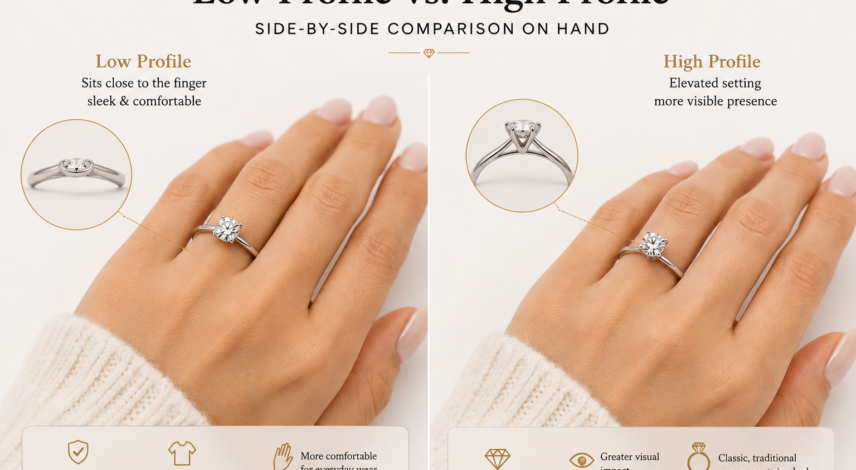
An engagement ring can look perfect in a photograph yet feel very different once it becomes part of your everyday life. A diamond set close to the finger may feel smooth and unobtrusive, while an elevated setting can give the center stone a more prominent, dimensional appearance.
Choosing between a low profile engagement ring and a high profile setting is therefore about more than style. Setting height can influence how often your ring catches on clothing, how exposed the center stone is to everyday bumps, and whether a wedding band can sit neatly beside it.
Height may also affect how openly the diamond is displayed, but it does not determine brilliance on its own. Diamond cut quality, setting construction, and cleanliness all have a greater influence on sparkle.
In this guide, we compare both profiles to help you find an engagement ring that complements your style, daily routine, and future wedding band.
Low Profile or High Profile: The Short Answer
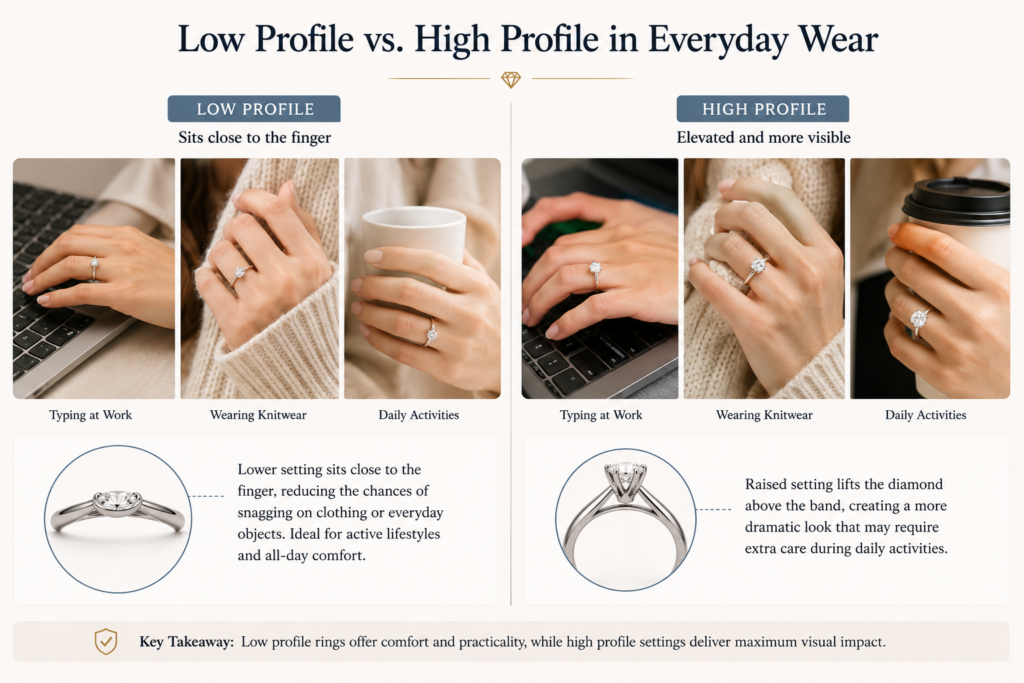
Choose a low profile engagement ring if you prioritize a smooth, streamlined feel. Because the center stone sits closer to the finger, a lower setting is generally less likely to catch on hair, sweaters, gloves, and delicate fabrics. It can be an appealing choice for people who work with their hands or are searching for comfortable diamond rings for everyday wear.
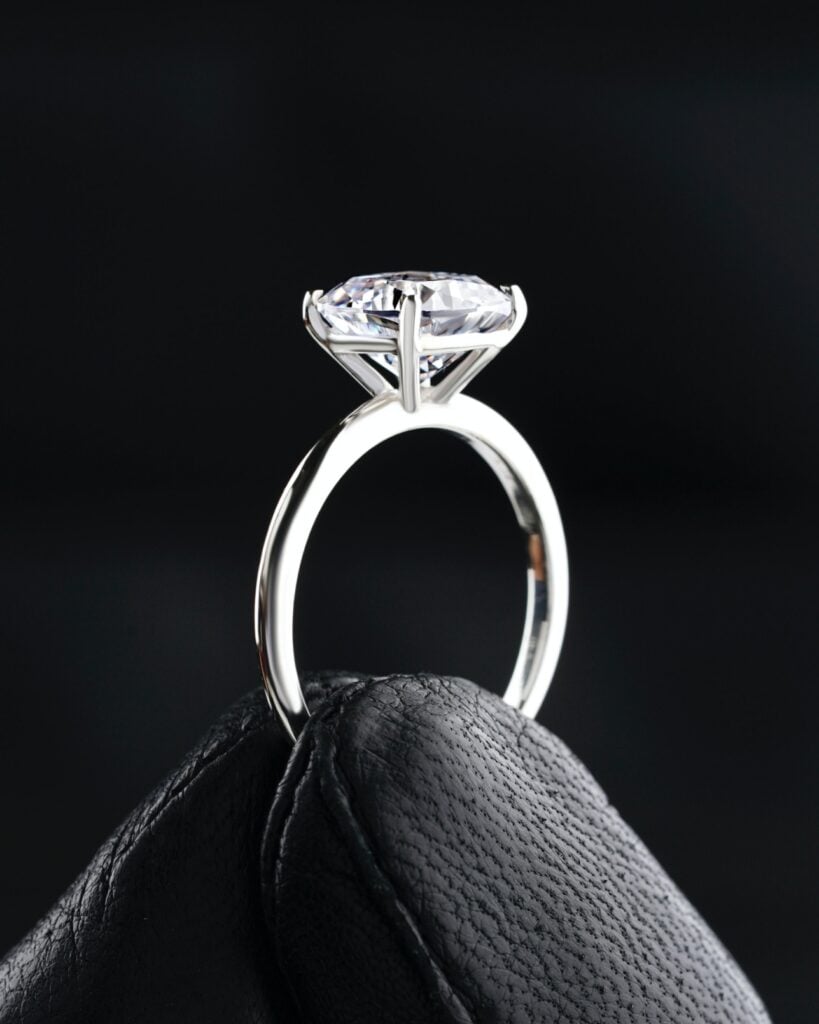
Consider a high profile setting if you want the center diamond to look elevated and visually prominent. A higher position may reveal more of the diamond from the side while providing additional space for design elements such as cathedral shoulders, decorative galleries, or hidden halos. Depending on its construction, it may also allow a straight wedding band to sit closer to the engagement ring.
Neither profile is automatically better, more brilliant, or more secure. The right choice depends on how the setting is constructed and how you plan to wear it.
Consider a Low Profile If You:
- Frequently work with your hands or wear gloves
- Want to reduce snagging during everyday activities
- Prefer a minimalist, close-to-the-finger silhouette
- Are sensitive to rings that feel bulky or top-heavy
- Do not mind wearing a curved wedding band if needed
Consider a High Profile If You:
- Want the center diamond to stand out
- Love the appearance of cathedral or elevated solitaire settings
- Want to see more of the diamond from the side
- Prefer hidden halos or decorative gallery details
- Hope to pair the ring with a straight wedding band
Lisa Jewelry Expert Note:
Profile height is only one part of a ring’s architecture. Comfort and security also depend on the basket, prongs, band proportions, diamond shape, craftsmanship, and fit.
What Does Engagement Ring Profile Mean?
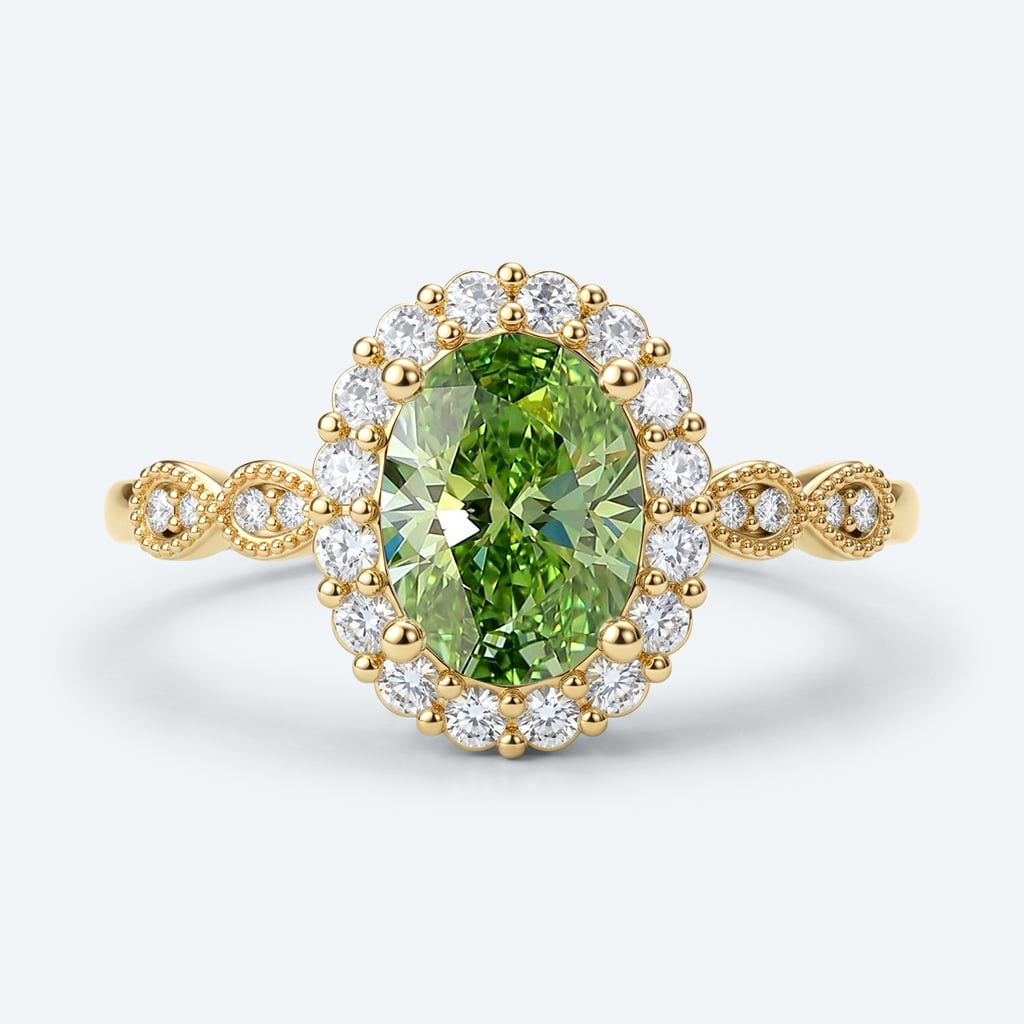
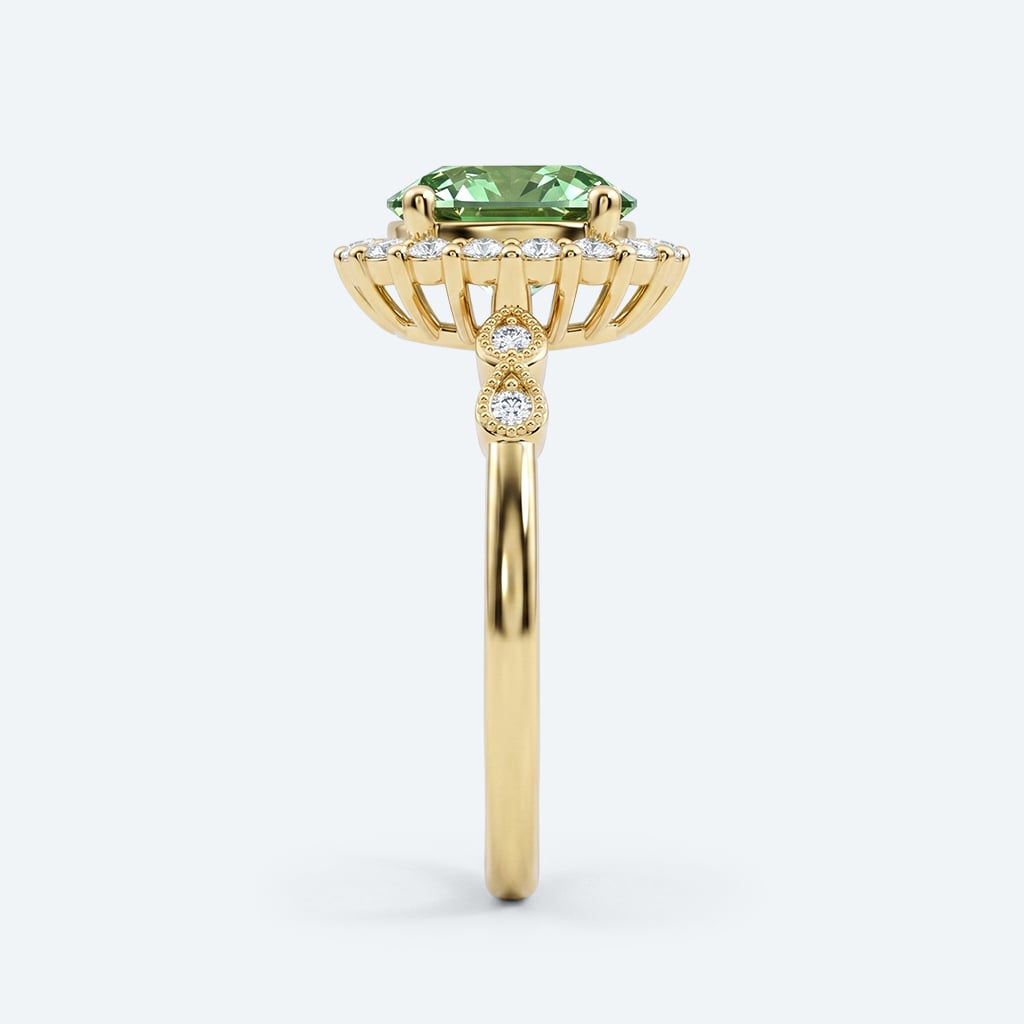
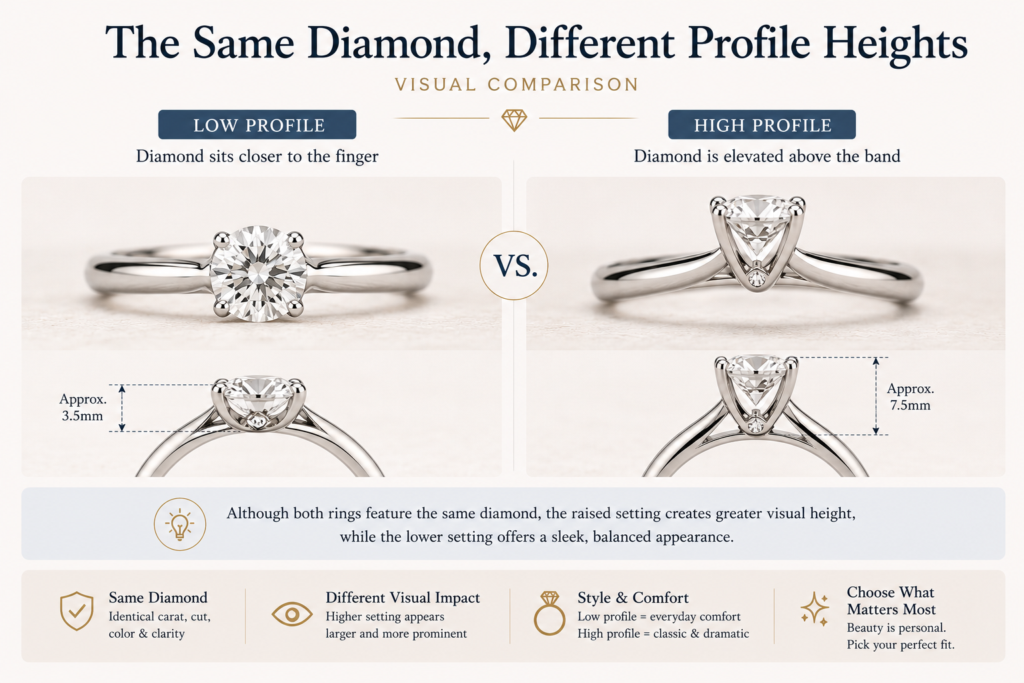
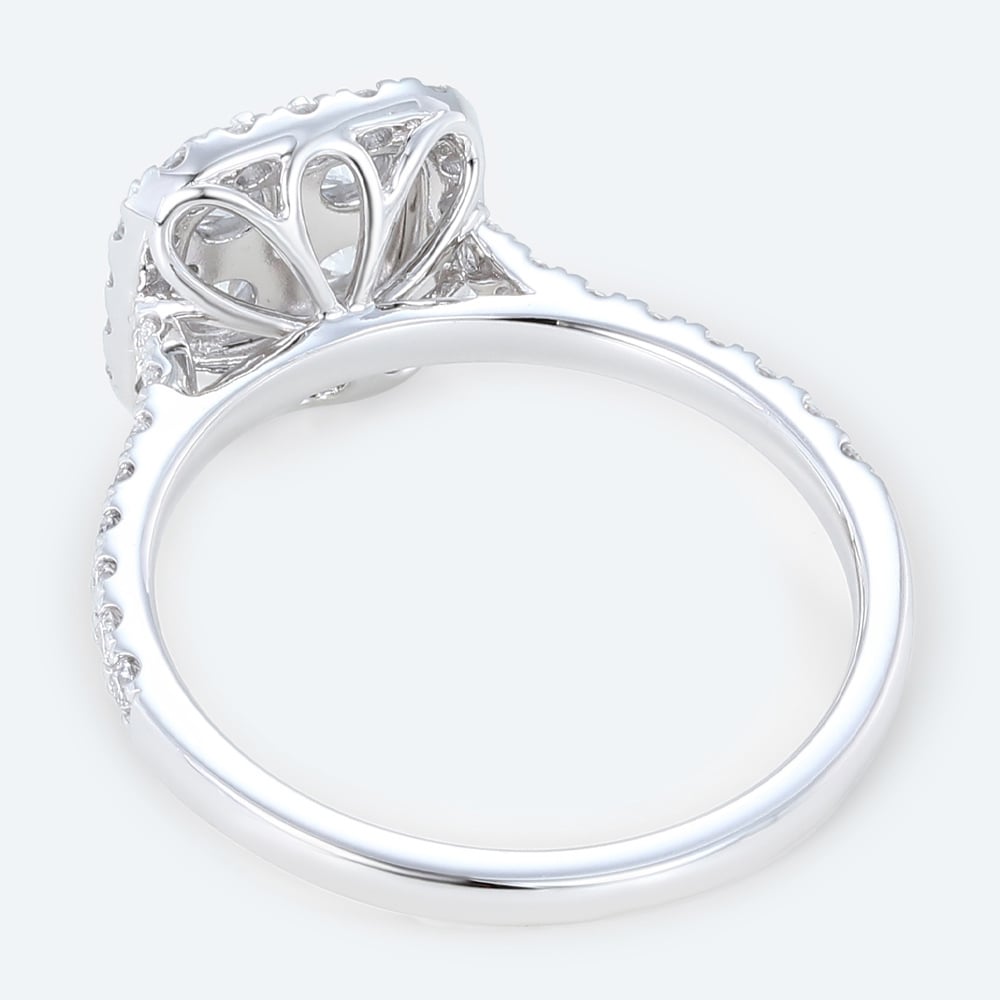
An engagement ring’s profile describes how high the center stone and its setting sit above the band and finger. This feature is easiest to evaluate from the side rather than from the top.
It is also important to distinguish profile height from setting type and ring style:
- Profile height refers to how high the center stone sits.
- Setting type describes how the stone is secured, such as with prongs or a bezel.
- Ring style describes the overall design, such as a solitaire, halo, cathedral, or three-stone ring.
A prong-set solitaire, for example, can have a low, medium, or high profile depending on its construction. Likewise, although bezel-set rings are often low, a bezel can also be elevated above a decorative gallery.
Several structural elements determine the final profile:
- The height and shape of the basket holding the diamond
- The design of the gallery beneath the center stone
- The bridge connecting the setting to the band
- The position and length of the prongs
- The diamond’s shape, carat weight, and depth
These details can also affect cleaning access, side visibility, and wedding band fit. A very low basket may block a straight wedding band, while a raised bridge may provide enough clearance for the two rings to sit closely together.
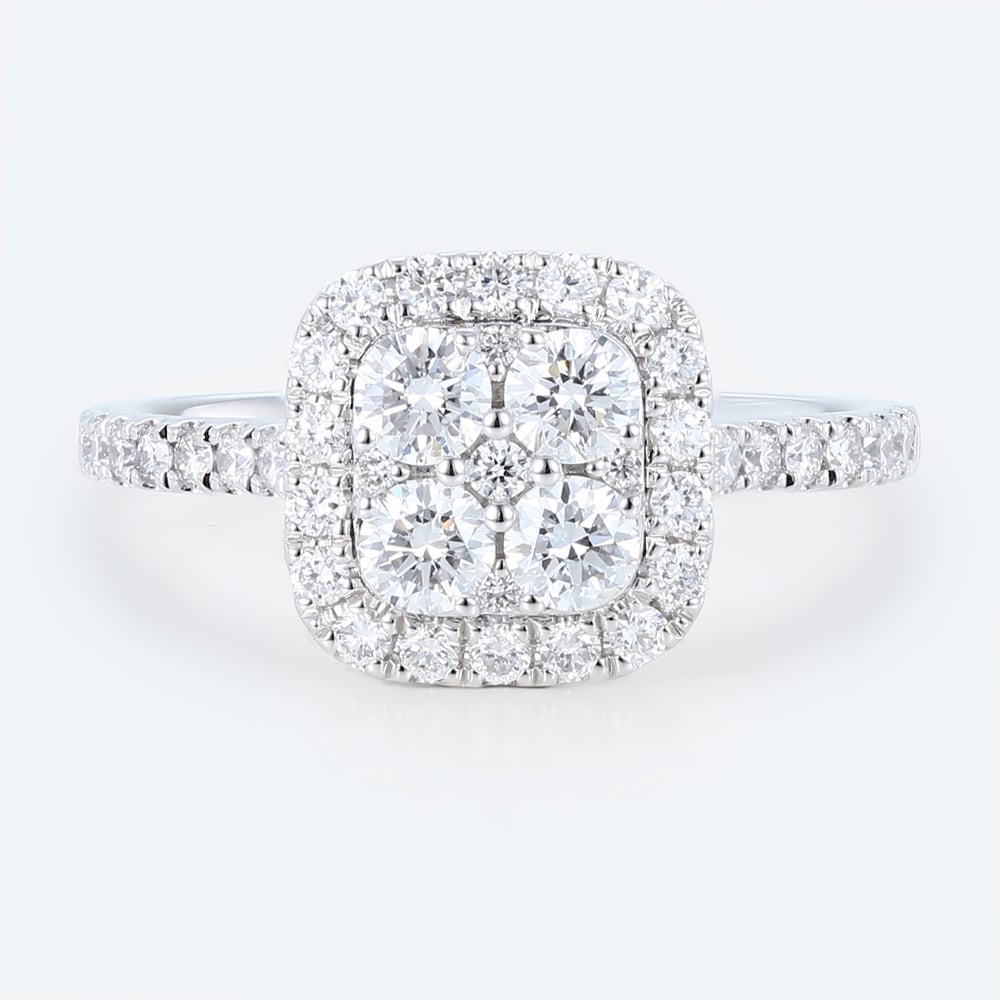
For this reason, always examine an engagement ring from the top, side, and three-quarter angle. The top view shows the face-up design, but the side view reveals how the ring will actually sit on your hand.
Low-Profile Engagement Rings: Pros and Cons
A low profile engagement ring positions the center stone closer to the band and finger. It may feature a compact basket, low-set prongs, a bezel, or another structure designed to minimize unnecessary height.
Advantages of a Low-Profile Setting
The primary benefit is everyday wearability. With less projection above the finger, a low setting generally feels smoother and is less likely to catch on hair, sweaters, gloves, or delicate fabrics. This can make it especially appealing to healthcare professionals, parents, people who work with their hands, and anyone seeking comfortable diamond rings for daily wear.
Keeping the diamond close to the hand may also reduce its exposure to routine bumps against countertops, furniture, and door frames. However, profile height alone does not guarantee security; the quality and condition of the prongs, bezel, basket, and metalwork remain essential.
Aesthetically, low-profile rings often have a clean, modern appearance. The center stone feels integrated with the band rather than dramatically elevated above it, making this profile well suited to minimalist and understated styles.
Potential Tradeoffs
One of the most important considerations is wedding band fit. A low basket, bezel, or halo may prevent a straight band from sitting flush against the engagement ring. Depending on the design, you may need a curved, contoured, open, or custom-fit wedding band.
A compact setting may also reveal less of the diamond from the side and leave less room for features such as cathedral arches, elaborate galleries, or hidden halos. If the area beneath the stone is enclosed, cleaning access can also be more limited.
A low profile is therefore an excellent choice when comfort and a streamlined silhouette are priorities—but the basket construction, cleaning access, and wedding band clearance should always be evaluated before purchasing.
High-Profile Settings: Pros and Cons
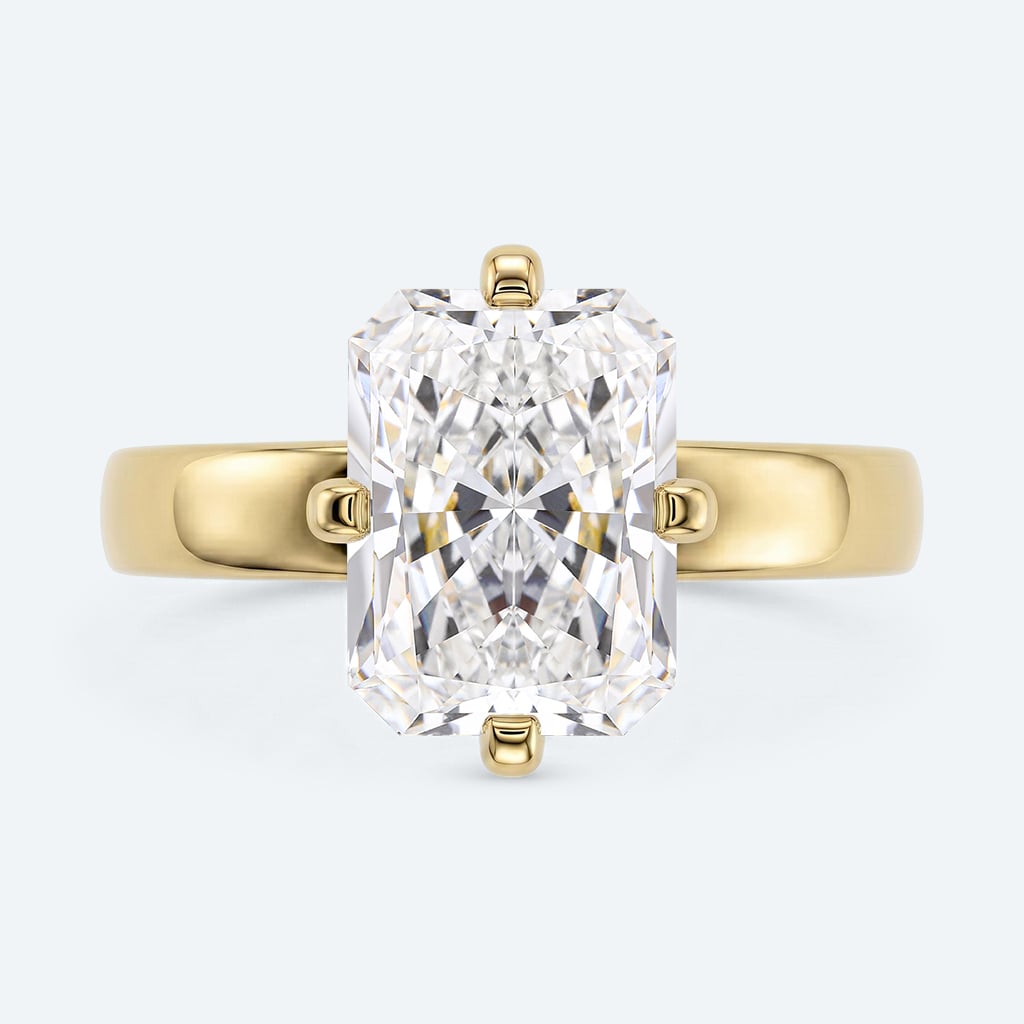
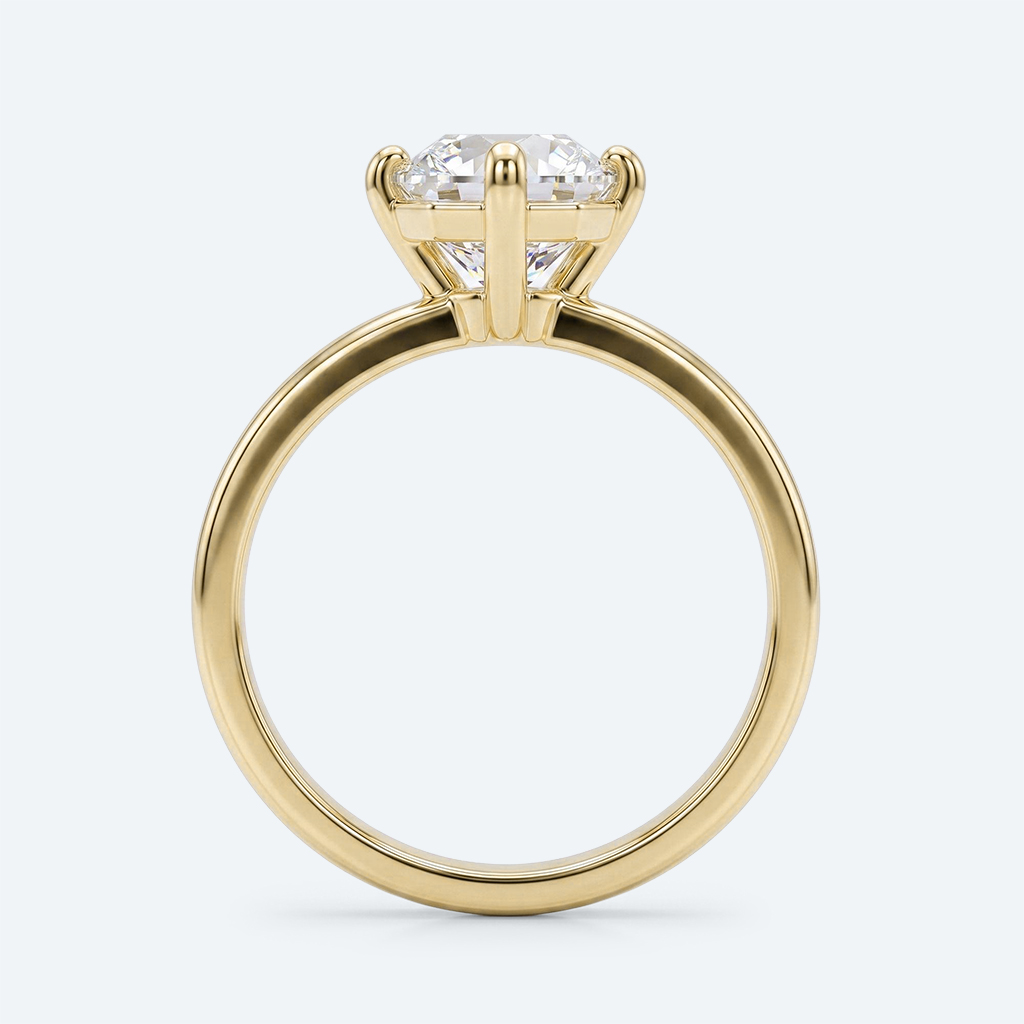
A high profile setting elevates the center stone farther above the band and finger. This height may be created by an extended basket, raised prongs, cathedral shoulders, or an open gallery beneath the diamond.
Advantages of a High-Profile Setting
The most noticeable advantage is visual presence. By separating the center stone from the band, a higher setting can make the diamond appear more prominent and create a classic, dimensional silhouette. It can be particularly effective in solitaire and cathedral designs where the center stone is intended to command attention.
An open, elevated basket may also display more of the diamond from the side. This provides additional space for decorative features such as:
- Hidden halos
- Pavé galleries
- Cathedral arches
- Vintage-inspired metalwork
- Two-tone baskets
Wedding band pairing can be another benefit. When there is sufficient space beneath the basket, a straight wedding band may sit closer to the engagement ring. However, height does not guarantee a flush fit—the bridge, prong placement, and width of the center setting must also be considered.
Potential Tradeoffs
Because the diamond projects farther above the finger, a high-profile ring is generally more likely to catch on clothing, hair, or gloves. The elevated stone and prongs may also be more exposed to everyday bumps.
Some wearers need time to adjust to the increased height, particularly if the center diamond is large or the band is very slim. A top-heavy design may rotate on the finger if the ring is not properly sized and balanced.
High settings can still be secure when thoughtfully constructed, but their prongs should be inspected regularly for wear, movement, or damage. As with any fine jewelry, the ring should be removed before exercise, heavy cleaning, gardening, or manual work.
A high profile may be right for you if you value an elevated diamond presentation and decorative detail—and are comfortable giving the ring a little more attention during everyday wear.
Does a Higher Setting Mean More Sparkle?
Not automatically. A higher setting may give a diamond a more open and prominent appearance, but setting height alone does not determine brilliance.
The most important factor in a diamond’s sparkle is its cut quality. The proportions, symmetry, polish, and arrangement of its facets determine how effectively the stone reflects light back to the viewer. A well-cut diamond in a low setting can appear more brilliant than a poorly cut diamond in a high one.
Setting construction also matters. An open prong setting may expose more of the diamond and make its side profile more visible, while a bezel or enclosed basket covers more of the stone’s outer edge. This can change the way the ring looks, but it should not be confused with the diamond’s inherent optical performance.
Cleanliness is equally important. Lotion, soap, skin oils, and everyday residue can collect beneath the stone and noticeably reduce its brightness, regardless of profile height.
Lisa Jewelry Expert Note:
Choose profile height for comfort, proportion, and personal style. Choose a well-cut diamond—and keep it clean—for brilliance.
In short, a high profile setting may make the center stone look more elevated, but it does not necessarily make it sparkle more.
Low Profile vs. High Profile: At-a-Glance Comparison
Both profiles can be beautiful, secure, and suitable for everyday wear when they are thoughtfully designed. The differences below are general tendencies rather than fixed rules.
| Feature | Low-Profile Engagement Ring | High-Profile Setting |
|---|---|---|
| Position | Sits closer to the finger | Elevates the center stone above the band |
| Everyday comfort | Generally smoother and less noticeable | More prominent during hand movement |
| Snagging | Usually less likely to catch on fabrics | More likely to catch on hair, clothing, or gloves |
| Diamond presentation | Streamlined and integrated | Elevated and visually prominent |
| Brilliance | Depends primarily on diamond cut and setting design | May look more open, but height alone does not create sparkle |
| Protection | Center stone is generally less exposed to bumps | Diamond and prongs may be more exposed |
| Wedding band fit | May require a curved or custom-fit band | May offer more clearance for a straight band |
| Side details | Less room for an elaborate gallery | More space for hidden halos and decorative metalwork |
| Best suited for | Active routines and minimalist preferences | Statement styles and elevated silhouettes |
Remember that two rings described as low profile can still differ significantly in height, comfort, and construction. Always review the actual measurements and side-view images rather than relying on the profile label alone.
Which Engagement Ring Profile Is Right for Your Lifestyle?
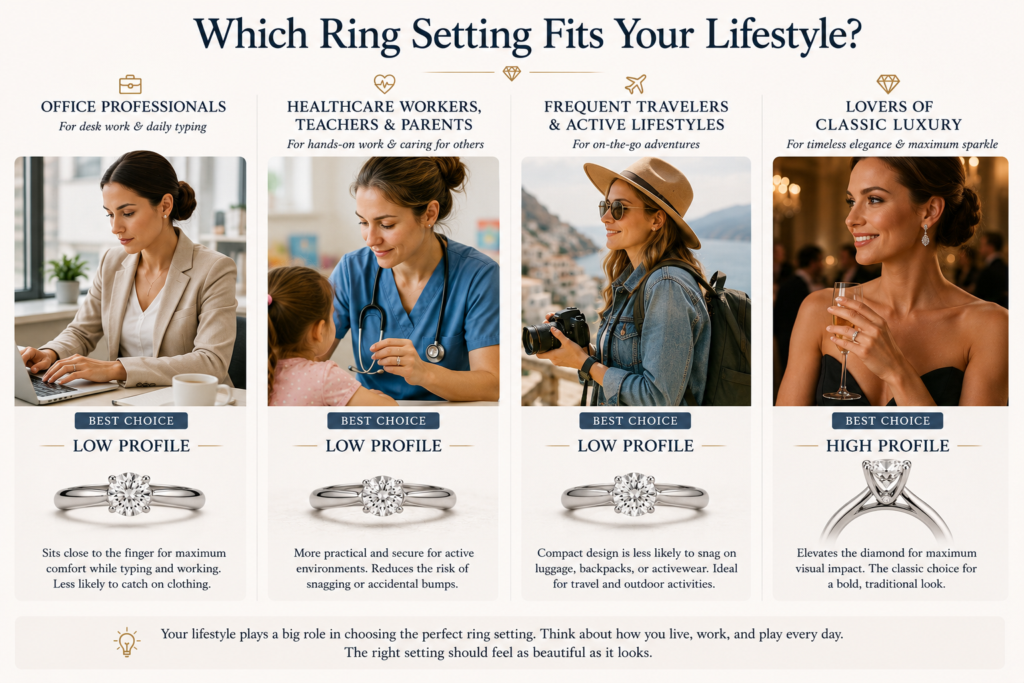
The right profile should complement how you use your hands as well as the style you love. Before choosing, consider the following questions.
Do You Frequently Work with Your Hands?
If your routine involves wearing gloves, handling fabrics, caring for children, or working closely with your hands, a lower and smoother setting may be more practical. It can reduce unnecessary projection, although fine jewelry should still be removed before heavy manual work.
Are You Concerned About Snagging?
A low profile engagement ring is generally less likely to catch on sweaters, hair, bedding, or delicate clothing. For an even smoother surface, consider compact prongs, a bezel, or a partially enclosed setting.
Do You Want the Diamond to Look Elevated?
If you prefer a center stone that rises prominently above the band, a high profile setting may better reflect your style. It can also provide space for cathedral shoulders, an open gallery, or a hidden halo.
What Kind of Wedding Band Do You Plan to Wear?
If you want a straight wedding band to sit flush against the engagement ring, examine the bridge and basket clearance carefully. A higher setting may provide more room, but this is not guaranteed.
A low setting may create a small gap or require a curved, contoured, or custom-fit wedding band. It is best to consider both rings together rather than waiting until after the engagement ring has been selected.
What Else Makes a Diamond Ring Comfortable?
The most comfortable diamond rings combine an appropriate profile with:
- Accurate ring sizing
- A balanced center stone
- Smooth, carefully finished prongs
- A suitable band width
- A comfortable interior shape
- Secure, well-proportioned construction
A medium-profile setting can be a useful compromise if you want more diamond visibility without the height of a dramatically elevated ring.
Final Verdict: Comfort or Brilliance?
Choosing between a low- and high-profile engagement ring is not simply a choice between comfort and sparkle.
A low-profile setting may be ideal if you want a streamlined ring with less snagging and reduced exposure during everyday activities. A high-profile setting may be more suitable if you prefer an elevated center stone, a dramatic side view, or additional space for decorative gallery details.
Neither profile automatically makes a diamond more brilliant. Cut quality remains the most important contributor to sparkle, while setting height primarily affects presentation, wearability, and proportion.
If you value qualities from both designs, consider a medium-profile ring with a balanced, open basket. It can provide diamond visibility and wedding band clearance without creating unnecessary height.
Ultimately, the best engagement ring is one that looks beautiful from every angle and feels natural in your real life. Compare the top, side, and three-quarter views, consider your future wedding band, and choose the profile you will feel comfortable wearing for years to come.
Frequently Asked Questions
They often are. Because the center stone sits closer to the finger, a low-profile ring generally feels smoother and is less likely to catch on clothing. Comfort also depends on ring size, band width, prong finish, and the balance of the center stone.
A high setting does not change the diamond’s actual size, but it may make the stone appear more prominent by lifting it above the band. Diamond shape, face-up dimensions, band width, and surrounding accent stones can also influence perceived size.
Not necessarily. A higher, open setting may display more of the diamond, but brilliance depends primarily on cut quality. Cleanliness, proportions, polish, symmetry, and setting construction also affect how bright the diamond appears.
Sometimes, but not always. A low basket, bezel, halo, or side-facing prongs may block a straight wedding band. A curved, contoured, open, or custom-fit band may provide a closer fit.
A low, smooth, and protective setting is often the more practical choice. Bezel and compact prong settings may reduce snagging and exposure, but no engagement ring is designed for every activity. Remove fine jewelry before exercise, heavy cleaning, gardening, or manual work that could damage the ring.