











I. Breaking the Round Brilliant Myth for Maximum Scale
When you begin shopping for an engagement ring or a signature jewelry piece, it is incredibly easy to fall into the traditional “Round Brilliant” trap. For generations, the standard industry narrative has funneled consumers toward classic circular diamonds. However, if your goal is to own a gemstone that commands attention, stretches your budget, and covers the maximum amount of physical real estate on your hand, sticking exclusively to round diamonds might be your biggest shopping mistake.
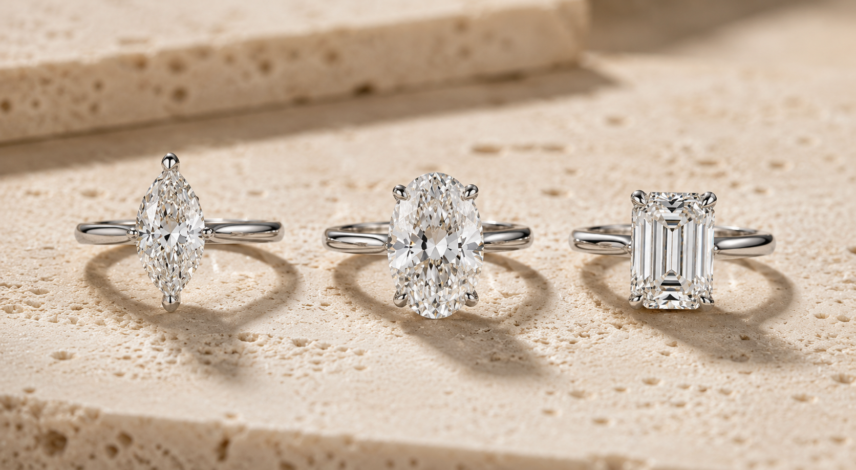
The arrival of fancy shape lab diamonds has completely rewritten the luxury playbook. Because laboratory-grown technology has dramatically democratized the price-per-carat scale, buyers are no longer forced to compromise on size or clarity due to hyper-inflated natural diamond markups. Today, you can intentionally explore the gorgeous world of non-round cuts—ovals, marquises, pears, radiants, and emerald cuts—to unlock incredible design flexibility.
But here is the ultimate insider secret that traditional jewelry counters rarely advertise: not all carats are created equal. Two diamonds can weigh identical amounts on a digital scale, yet one can appear up to 25% larger to the human eye simply because of its geometric silhouette.
If you want to maximize your investment and master the optical illusions of gem cutting, you need to know how to navigate these unique geometries. This comprehensive, seven-part masterclass will pull back the curtain on how to evaluate fancy cuts, identify which shapes offer the most explosive physical presence, and guide you toward the ultimate showstopping stone for your collection.
II. The Science of Visual Size: Why "Carat" Is Not "Dimensions"
To outsmart the diamond market and secure a stone that looks jaw-droppingly massive, you must first master a fundamental rule of metallurgy and gemology: carat is a measurement of physical weight, not visual size.
One carat weighs exactly 200 milligrams. How a master diamond cutter chooses to distribute those 200 milligrams of raw crystal carbon entirely dictates how big the stone will look once it is mounted on your finger.
The Face-Up Spread (The True Footprint)
When a diamond is set into a ring basket, its entire lower half—the cone-shaped pavilion—is completely buried in metal. Your friends, family, and coworkers will only ever view the stone from a bird’s-eye perspective. Therefore, the human brain judges the scale of a diamond entirely by its face-up spread—the actual physical millimeter dimensions (Length×Width) of the top surface table.
The Deep-Cut Pitfall
Why do some shapes look smaller than they weigh? To achieve a standard light bounce, certain shapes—such as square Cushion cuts or Princess cuts—require a very bottom-heavy structure. A massive percentage of their actual carbon weight is packed down into the bottom of the stone to prevent light from leaking out. You are physically paying for weight that remains hidden beneath the prongs.
Conversely, elongated fancy shapes allow the cutter to spread that identical mass outward across a wider horizontal plane. By keeping the depth shallower and expanding the top perimeter, these brilliant cuts convert hidden weight into visible, striking luxury. If you evaluate diamonds by their millimeter footprint rather than just the carat number on a certificate, you can effortlessly secure a stone that hits way above its weight class.
III. The Reigning Kings of Elongated Diamond Cuts
If your ultimate shopping objective is to claim the absolute maximum amount of visual real estate on your hand, your search should focus entirely on elongated diamond cuts. By stretching their proportions vertically, these magnificent cuts behave like an architectural magnifying glass for your finger.
The Marquise Cut Diamond: The Absolute Geometric Limit
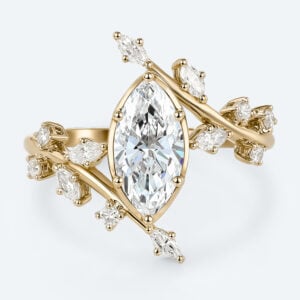
When it comes to pure, unadulterated surface area dominance, the marquise cut diamond is the undisputed world champion. Featuring an iconic, slender, football-shaped silhouette that tapers into two dramatic, sharp points, the marquise possesses the largest face-up millimeter footprint of any diamond shape in existence per carat weight.
The Illusion: A 1.00-carat marquise diamond can look up to 25% larger than a standard 1.00-carat round brilliant, effortlessly mimicking the presence of a 1.25 to 1.50-carat stone.
The Finger Effect: The intense vertical length creates a powerful slimming effect, instantly elongating shorter or wider fingers and making the hand look remarkably graceful.
The Oval and Pear Cuts: The Fluid Masters of Scale
Right behind the marquise sit the reigning darlings of the modern bridal world: the Oval and the Pear (teardrop) cuts.
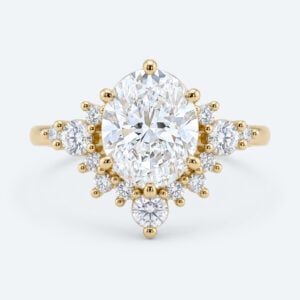
The Oval Cut stretches its boundaries into an elegant, continuous curve that retains the frantic, high-brilliance sparkle of a round diamond while offering a much larger visual spread.
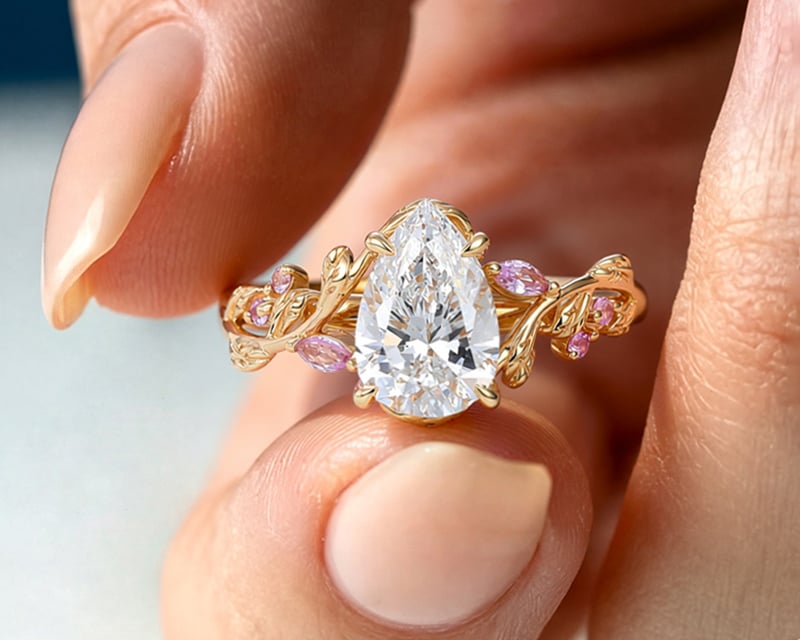
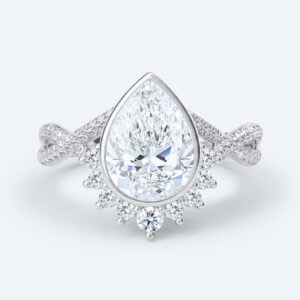
The Pear Cut uses an asymmetrical silhouette—one rounded end matching one sharp point—to draw the observer’s eye upward, creating a liquid-like elongation that stands out beautifully in custom settings.
By centering your luxury hunt around these long, elegant footprints, you turn the laws of optical physics into your greatest financial advantage, gaining massive visual impact without paying for excess vertical weight.
IV. The Ultimate Oval Cut Diamond Guide: Avoiding the Hidden Optical Traps
Because the oval cut is currently the absolute reigning superstar of the fancy shape market, it deserves its own dedicated inspection manual. Buyers flock to ovals because they beautifully combine the high-intensity sparkle of a round diamond with the finger-lengating benefits of a long cut. However, because ovals are geometrically complex, you cannot buy them blindly based on a certificate alone.
To secure an oval that looks truly massive, clean, and radiant, you must master the oval cut diamond guide checklist before finalizing your purchase.
The Golden Ratio ($1.35 \text{ to } 1.45$)
When analyzing the millimeter dimensions on a grading report, divide the length by the width to find the stone’s length-to-width ratio.
If the ratio is below $1.30$, the oval will look squat, bulky, and dangerously close to an off-round circle, losing its elongating magic.
If the ratio exceeds $1.50$, the stone becomes overly narrow and thin, which can cause it to look sparse and lose its side-to-side sparkle.
For the ultimate balance of maximum face-up size and classic elegance, target the sweet spot of $1.35 \text{ to } 1.45$.
Defeating the Dreaded "Bow-Tie Effect"
Because of the unique facet alignment required to cut an elongated stone, almost all oval, marquise, and pear cuts possess a structural phenomenon known as a bow-tie. This is a dark, shadow-like silhouette shaped like a neck bowtie that runs horizontally across the center table of the diamond.
A faint bow-tie is perfectly normal and actually gives the stone its unique visual depth. However, a severe, poorly cut bow-tie will create a prominent black dead-zone right in the middle of your diamond, completely killing its fire and making the stone look smaller and duller.
Always insist on viewing a high-definition 360-degree video of your lab diamond under moving light. If a harsh black bar dominates the center when the stone turns, pass on it—no matter how cheap it is.
V. The Wallet-Friendly Checklist: The Most Affordable Diamond Shapes
While maximizing visual scale is essential, a truly intelligent buyer looks at the intersection of face-up dimensions and price-per-carat value. This is where understanding the manufacturing physics behind most affordable diamond shapes can save you thousands of dollars on your lab-grown journey.
The Secret of Rough Crystal Yield
To understand why certain diamond shapes cost significantly less than others, you have to look at how raw diamond crystals grow. Lab-grown diamonds produced via Chemical Vapor Deposition (CVD) or High Pressure High Temperature (HPHT) typically grow into blocky, cubic, or rectangular crystal structures.
When a master diamond cutter forces that blocky rough crystal into a flawless, perfect sphere to create a Round Brilliant, they are forced to grind away and waste up to 60% of the raw material. You, the consumer, are financially absorbing the cost of that wasted diamond dust.
The Budget Champions: Princess, Radiant, and Emerald Cuts
Because fancy cuts gracefully follow the natural, straight-line architecture of the grown crystal, their material waste is incredibly low—often dropping to just 20%. This structural efficiency is passed directly to your wallet.
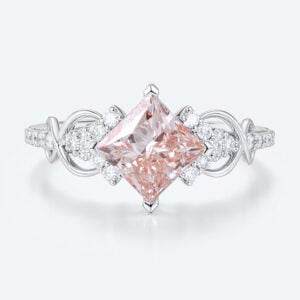
Shapes like the Princess cut, the Radiant cut, and the Emerald cut consistently rank as the most affordable options on the market, offering a lower price-per-carat than round diamonds. Even though square cuts like the Princess don’t have the long vertical spread of a marquise, their lower baseline cost unlocks a brilliant strategy: you can use your financial savings to simply “buy up” in carat weight.
Instead of a 2.00-carat round diamond, your same exact budget could easily command a magnificent 2.50 to 3.00-carat Radiant or Emerald cut, completely overpowering the round stone through pure, unadulterated mass.
VI. The Ultimate Fancy Shape Comparison Matrix
To help you visualize the trade-offs between size, price, and brilliance, here is a breakdown of how the most popular lab-grown shapes compare. Use this matrix to see how your favorite silhouette performs when put to the test.
| Diamond Shape | Visual Size Footprint | Affordability Rating | Sparkle & Fire Intensity | Best Fit For |
| Marquise Cut | 👑 Extreme ($+25\%$ spread) | 📈 High Value | 🌟 Highly Vibrant | Maximum elongation; making short fingers look slender. |
| Oval Cut | 📈 Significant ($+15\%$ spread) | ⚖️ Moderate | 👑 Top-Tier Brilliance | Modern brides wanting classic sparkle with extra visual scale. |
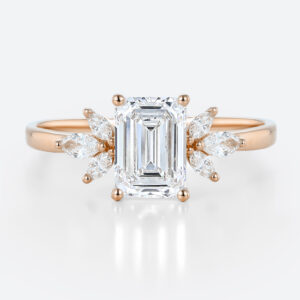
| Emerald Cut | ⚖️ Appears Large (Wide Table) | 👑 Maximum Savings | 💎 Elegant Step-Cut | Vintage lovers; sophisticated, mirror-like clarity over flash. |
| Radiant Cut | ⚖️ Standard Footprint | 👑 Maximum Savings | 🌟 Intense Crushed-Ice | High-glam styles; maximizing carats on a strict budget. |
| Cushion Cut | 📉 Compact (Deep-set mass) | 📈 High Value | 🌟 Soft, Romantic Flash | Lovers of vintage, pillow-soft aesthetics who don’t mind a deeper stone. |
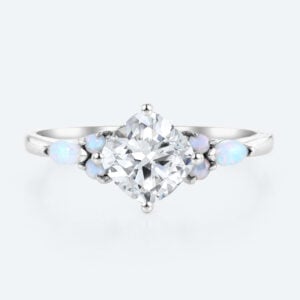
VII. Setting Sorcery: How to Make Your Fancy Cut Look Even Bigger
Once you have utilized your new knowledge to select a naturally sprawling or budget-friendly fancy shape, you can employ master jewelry design techniques to amplify its presence. The right setting acts like a frame for a painting, pushing the edges of your diamond outward.
The Power of the Ultra-Slim Band
The width of your metal band directly dictates how large the center diamond is perceived. A wide, chunky metal band will crowd the stone and swallow its visual presence. By mounting your elongated cut—like a spectacular marquise cut diamond or an oval—onto an ultra-slim, tapered band (around 1.5mm to 1.8mm), you create a dramatic contrast. The thin metal forces the diamond to pop forward, making it look instantly more grand.
East-West Settings: The Horizontal Trend
If you want to maximize the horizontal real estate across your hand, consider an East-West orientation. Instead of setting your marquise, oval, or emerald cut vertically along the finger, turn it 90 degrees so it sits horizontally across the band. This unexpected architectural twist spans the physical width of your finger, giving the illusion of a massive, custom-built luxury piece that fills the entire hand.
Protecting the Geometry: V-Prongs
For sharp-pointed fancy shapes like the marquise and the pear, safety and aesthetics go hand-in-hand. Always ensure your setting features specialized V-prongs to cradle those delicate tips. Not only do V-prongs protect the stone’s crisp corners from accidental chips, but the neat metal caps also extend the sharp lines of the diamond slightly outward, adding an extra millimeter of visual length to the silhouette.
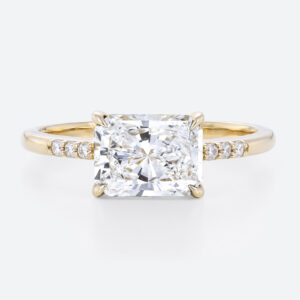
Conclusion: Outsmarting the Scale with Geometry
Navigating the world of fancy shape lab diamonds frees you from the rigid constraints of traditional buying advice. You no longer have to overextend your finances simply to chase a higher number on a grading report.
By prioritizing the physical millimeter spread over paper carat weight, opting for elongated diamond cuts like ovals and marquises, and taking advantage of the structural affordability of step-cuts and radiants, you turn geometry into your ultimate financial asset. Use this oval cut diamond guide and budget checklist to select a stone that flatters your unique hand structure, honors your design aesthetic, and delivers the absolute largest visual impact for your brilliant investment.