











The "Flawless" Budget Trap
When shopping for an engagement ring, it is easy to get caught up in the relentless pursuit of perfection. You start browsing diamond grading reports and quickly find yourself drawn to top-tier clarity grades like Flawless (FL) or Very, Very Slightly Included (VVS1/VVS2). It feels logical: the higher the grade on paper, the more brilliant and beautiful the stone will look on your partner’s hand.
However, striving for microscopic perfection is one of the most common—and expensive—mistakes diamond buyers make. Choosing a VVS or Flawless diamond often inflates your price tag by thousands of dollars without adding a single drop of visible sparkle.
Here lies the diamond industry’s best-kept secret: a diamond does not need to be flawless under a microscope to look completely flawless to the naked eye.
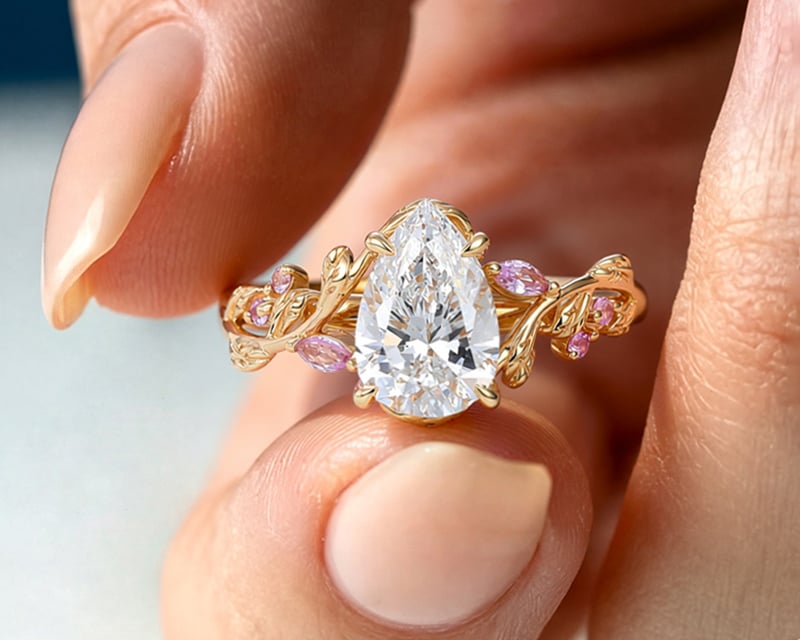
This principle is known as selecting an eye clean diamond. By understanding how diamond clarity actually works, you can strategically lower your clarity grade to a VS2 or eye-clean SI1, free up 20% to 40% of your budget, and reallocate those savings toward a larger carat size or a superior cut grade.
This guide breaks down the official diamond clarity chart, demystifies what “eye-clean” really means in daily life, and equips you with practical strategies on how to save money on diamond clarity without ever sacrificing beauty.
I. Understanding the Diamond Clarity Chart
To make a smart purchase, you first need to understand how gemological laboratories like the GIA (Gemological Institute of America) and IGI (International Gemological Institute) evaluate diamond clarity.
Clarity measures the presence of internal characteristics called inclusions (such as tiny mineral crystals, clouds, or feathers) and surface imperfections called blemishes.
Crucially, gemologists grade clarity under 10x magnification in controlled laboratory lighting. They are looking for microscopic features that standard human vision cannot detect on its own.
The Breakdown of GIA Clarity Grades
FL / IF (Flawless / Internally Flawless): Extremely rare and premium-priced. Under 10x magnification, no inclusions or blemishes are visible to a trained gemologist.
VVS1 / VVS2 (Very, Very Slightly Included): Inclusions are so minute that even an experienced grader finds them difficult to spot under 10x magnification.
VS1 / VS2 (Very Slightly Included): Inclusions are minor and visible under 10x magnification, but they rarely affect the visual purity of the stone to the naked eye. VS2 is widely considered the ultimate sweet spot for value.
SI1 / SI2 (Slightly Included): Inclusions are noticeable under 10x magnification. Many SI1 diamonds (and a select few SI2s) remain completely eye-clean, offering tremendous value.
I1 / I2 / I3 (Included): Inclusions are obvious under 10x magnification and are typically visible to the naked eye without magnification, often impacting both transparency and structural durability.
II. What Does "Eye-Clean" Really Mean?
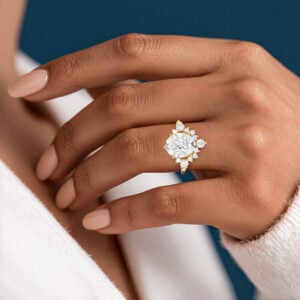
In gemology and fine jewelry retail, a diamond is considered eye-clean if it possesses no inclusions or blemishes that can be seen by the unaided human eye when viewed from a standard distance in normal lighting conditions.
To determine if a stone is eye-clean, jewelers evaluate it based on three criteria:
Distance: The diamond is held approximately 6 to 10 inches (15 to 25 cm) away from the eye—the typical distance someone would look at a ring on their finger.
Lighting: The stone is observed under daylight or standard residential/office lighting, rather than intense harsh laboratory spotlights.
Vision: The evaluation assumes normal 20/20 vision without external magnifying loupes or lenses.
Magnification vs. Everyday Reality
It helps to remember a fundamental rule of jewelry: your diamond will be worn on a finger, not under a microscope.
Paying a 30% premium to upgrade from a VS2 to a VVS1 simply means you are paying for piece of mind on a grading report. Once the diamond is set in a ring, both stones will look 100% identical to you, your partner, and anyone admiring the ring.
By prioritizing “eye-cleanness” over an arbitrary letter grade on a certificate, you unlock maximum visual brilliance while keeping your hard-earned money where it belongs.
III. Key Factors That Affect "Eye-Cleanness" (Not All VS2/SI1s Are Equal)
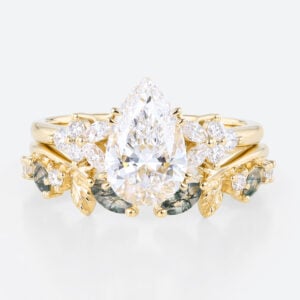
A common mistake diamond buyers make is assuming every diamond with a VS2 or SI1 grade automatically looks the same. In reality, two diamonds with identical clarity grades on paper can look completely different on a finger.
Whether a diamond is truly eye-clean depends heavily on three critical factors beyond the letter grade itself.
A. Diamond Cut Shape: Facet Arrangement Matters
The physical shape and faceting style of your diamond dictate how easily inclusions are hidden or exposed:
Brilliant Cuts (Round, Oval, Cushion, Radiant, Princess): These shapes feature dozens of small, intersecting triangular and kite-shaped facets. The complex light reflection creates a “hall-of-mirrors” or “crushed ice” effect, which brilliantly masks minor inclusions. In brilliant cuts, a VS2 or well-selected SI1 is almost guaranteed to be eye-clean.
Step Cuts (Emerald, Asscher): Step cuts feature long, rectangular facets that act like open glass windows. Because they prioritize crisp transparency over high-dispersion sparkle, inclusions are far easier to see. For step cuts, aim for VS1 or a carefully vetted VS2 to ensure an eye-clean appearance.
B. Inclusion Type and Location: The Real Estate of the Diamond
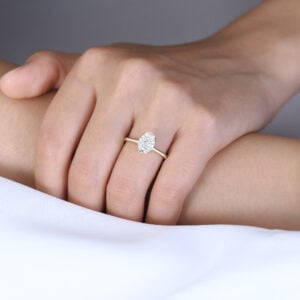
Where an inclusion sits inside the gem—and what kind of inclusion it is—directly determines its visibility to the naked eye.
The Table Zone (High Risk): A dark crystal or dark feather located directly under the top flat facet (the table) acts like a focal point. Even in a VS2 diamond, a dark center inclusion can catch the eye.
The Crown & Upper Girdle (Low Risk): Pinpoints, clouds, or light-colored inclusions hidden near the outer edges (under the crown or girdle facets) are virtually invisible, even in SI1 grades.
C. Carat Size: The Magnifying Effect
As carat weight increases, the surface area of the top table facet grows exponentially. A 3.0-carat diamond has a much larger “window” than a 0.90-carat diamond. Inclusions that stay hidden in a 1.0-carat VS2 stone may become noticeable when scaled up to a 2.5-carat or 3.0-carat stone.
Rule of Thumb: Under 1.5 carats, VS2 and SI1 are prime targets for eye-clean diamonds. Above 2.0 carats, inspect VS2 stones with extra care or narrow your focus to VS1.
IV. How to Save Money on Diamond Clarity: 4 Expert Strategies
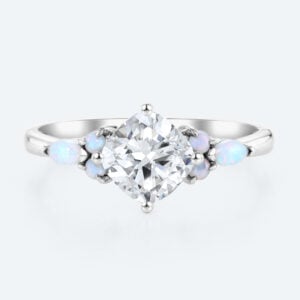
Understanding the mechanics of clarity allows you to shop strategically. Here is how savvy diamond buyers save 20% to 40% on their diamond purchase without compromising on visual quality.
Strategy 1: Target the VS2 / SI1 "Sweet Spot"
Instead of paying a heavy premium for FL, IF, or VVS grades, focus your search on VS2 and clean SI1 diamonds.
By dropping from a VVS1 to a VS2 grade on a 1.0-carat diamond, you can save anywhere from $1,000 to $2,500—money that can be far better spent on getting a larger carat size or an Ideal/Excellent Cut grade. Remember: a diamond’s sparkle comes almost entirely from its Cut, not its Clarity.
Strategy 2: Hide Inclusions Beneath Setting Prongs
If you find a diamond with an inclusion near the outer girdle (edge), consult with your jeweler before ruling it out. A skilled jeweler can strategically align the setting prongs directly over the inclusion, permanently covering it from view once the stone is mounted in the ring.
Strategy 3: Always Demand 360° HD Videos and 10x Images
Never buy a diamond based purely on the GIA/IGI certificate plotting diagram. A plot diagram shows where inclusions are located, but it doesn’t show their color or transparency (e.g., whether a feather is translucent white or pitch black).
Always inspect 360-degree high-definition video loops under 10x magnification to confirm that inclusions are light-colored and non-disruptive.
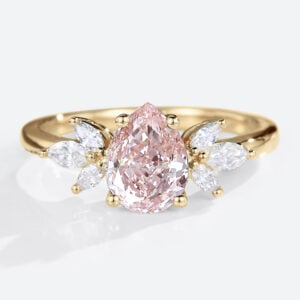
Strategy 4: Consider Lab-Grown Diamonds for Premium Specs
If you love the mental security of high clarity (like VVS or IF) but want to remain budget-conscious, lab-grown diamonds offer an exceptional path forward. Because lab-created diamonds share identical chemical and physical properties with natural diamonds at a fraction of the cost, you can easily secure a VVS1, Ideal-cut lab diamond well within a traditional budget.
V. Decision Cheat Sheet: Finding Your Clarity "Sweet Spot"
To simplify your search, use this quick reference matrix to select the most cost-effective clarity grade based on your preferred diamond shape and carat size.
| Diamond Shape | Ideal Clarity Grade for Max Savings | Key Inspection Tip (Pro Tip) |
| Round Brilliant | VS2 – SI1 | Highly forgiving. Avoid dark black crystals under the center table; clouds and light feathers are ideal. |
| Oval, Cushion, Pear, Radiant | VS2 – SI1 | “Crushed ice” faceting masks inclusions easily. Ensure bow-tie areas don’t concentrate visible dark spots. |
| Emerald & Asscher (Step Cuts) | VS1 – VS2 | Open table acts like a window. Skip SI1 unless you have inspected the 360° video thoroughly. |
| Princess & Marquise | VS2 – SI1 | Check that points and corners are free of feathers/cracks to prevent chipping during setting. |
Conclusion: Focus on Sparkle, Not Specifications
When choosing an engagement ring, it is easy to get caught up in certificate grades and assume higher specs equal a prettier diamond. But the true secret to buying smart is recognizing that visual beauty matters far more than microscopic perfection.
An eye clean diamond gives you 100% of the visible beauty, brilliance, and fire of a Flawless diamond at a fraction of the cost. By choosing a well-cut VS2 or clean SI1 stone, you free up substantial budget to invest where it truly counts—achieving an Ideal Cut or upgrading your carat weight.
At LisaJewelryUS, we believe every diamond should shine brilliantly without breaking your budget. If you are searching for the perfect eye-clean natural or lab-grown diamond, our team is always ready to provide high-definition 360° video inspections and expert guidance to help you make your decision with complete confidence.