
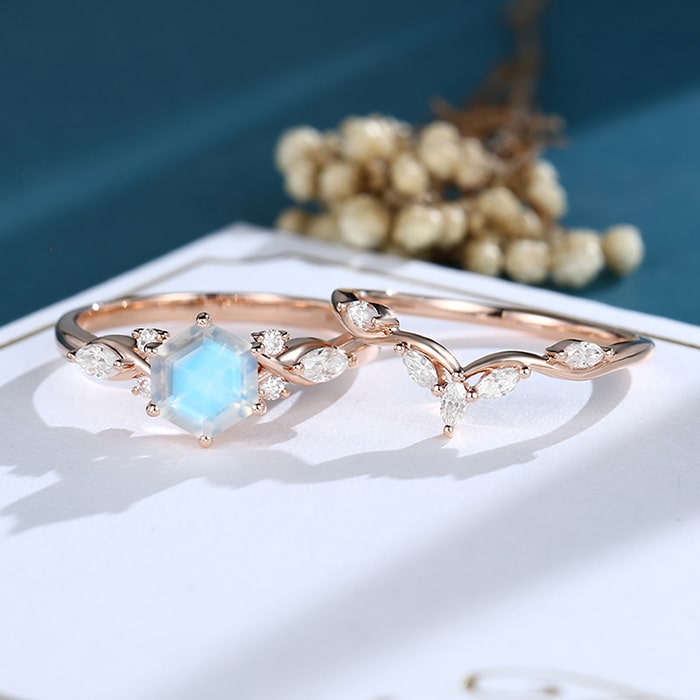
A moonstone engagement ring is a meaningful choice for couples who want ethereal beauty, personal symbolism, and a design that feels different from a traditional diamond ring. Moonstone creates a floating glow called adularescence, so the stone seems to change as it moves through the light. The result is expressive, distinctive, and closely connected with the moon and nature.
Moonstone is also a delicate gemstone. It needs more careful wear than diamonds or sapphires, and the quality of the setting matters. This guide explains why choose a moonstone engagement ring, what colors and cuts to explore, how moonstone engagement rings compare with conventional options, and how to select and care for the perfect moonstone engagement ring.
Moonstone Engagement Rings at a Glance
| Feature | What to know |
|---|---|
| Signature appearance | A gentle inner glow known as adularescence; the finest stones may show a vivid blue sheen |
| Common colors | Colorless or white, peach, pink, gray, yellow, and multicolor flashes |
| Popular cuts | Oval, round, pear, and other smooth cabochon shapes |
| Meaning | Traditionally associated with the moon, intuition, feminine energy, love, and new beginnings |
| Durability | About 6–6.5 on the Mohs scale, with cleavage that makes protection important |
| Best settings | Bezel, halo, low-profile, and secure prong designs that protect the surface and edges |
| Metal types | Rose gold for warmth, yellow gold for vintage richness, and white gold or silver for cool contrast |
| Best for | Brides who value distinctive design, natural optical effects, and unconventional jewelry |

What Is Moonstone?
Moonstone is a feldspar gemstone valued for adularescence: light scatters between microscopic layers within the stone and creates a drifting glow within the gem. Many moonstones have a transparent or translucent body. A high-quality colorless body with a centered blue sheen is especially sought after, although warmth, clarity, size, cut, and personal taste all affect value.
The name comes from its moonlike appearance, not from a literal connection to the moon. Since ancient times, different cultures have linked this beautiful gemstone with lunar cycles, love, protection, and intuition. These ideas are part of folklore and crystal traditions rather than scientifically proven effects.
Rainbow Moonstone and Classic Moonstone
Rainbow moonstone usually refers to white labradorite, another feldspar gemstone. It can display blue, green, yellow, pink, and rainbow flashes across a pale body. Classic moonstone is generally associated with orthoclase and albite layers and a softer-looking adularescent glow. Both can make a gorgeous moonstone ring, but a seller should identify the material accurately so you understand what you are buying.
Why Choose a Moonstone Engagement Ring?
1. Ethereal Beauty That Changes as It Moves
The main reason couples choose moonstone engagement rings is their ethereal beauty. Instead of relying on sharp brilliance alone, moonstone offers a soft glow that appears to move as the engagement ring turns. In ordinary light, one angle may look silvery and quiet; another may reveal a cool flash or a multicolor glow.
This shifting beauty gives moonstone engagement rings a sense of movement. Many moonstones also contain natural internal features, so no two stones look exactly alike. For someone who wants an engagement ring with a dreamy, organic presence, moonstone is an attractive option.
2. Symbolism of Love and Change
Moonstone symbolism has developed across many traditions. It is believed by some people to support intuition, emotional balance, feminine energy, and a deeper connection with natural cycles. Moonstone is also called a dream stone in some crystal traditions and is often treated as a symbol of hope, tenderness, and new beginnings.
Those beliefs are not medical claims, but the symbolism can still make a moonstone engagement ring personally significant. An engagement already marks a transition, so a gemstone associated with change can feel like a meaningful choice for couples beginning a shared chapter.
3. Individuality Beyond a Traditional Diamond
A traditional diamond is familiar, bright, and exceptionally durable. Moonstone engagement rings offer a different visual language: soft rather than sharply brilliant, mysterious rather than uniform, and organic rather than conventional. Choosing a moonstone ring can express individuality without making the design difficult to coordinate with other jewelry.
Moonstone can stand alone as a solitaire or be set with diamonds, moissanite, sapphires, or other gemstones. Small accent gems create contrast and additional sparkle while allowing the central moonstone engagement stone to remain the focus.
4. Flexible Design and Personalization
Moonstone's soft glow works with minimalist, vintage, celestial, botanical, and romantic settings. It can be set in warm or cool metal types, paired with smooth or geometric bands, and cut in several flattering shapes. This flexibility makes moonstone engagement rings appealing to brides who want a ring designed around their own style.
If you cannot find the right combination, LisaJewelryUS's custom engagement ring guide explains the customization process. A custom design can adjust the profile, accent stones, band width, and protection around the center stone.
5. A Range of Price Points
Moonstone offers an alternative to diamonds at a range of prices. Cost can vary substantially according to body color, transparency, adularescence, size, cut, treatment disclosure, craftsmanship, metal, and seller. This means moonstone engagement rings may be an accessible option, but “affordable” should never be assumed without comparing the complete ring.
Evaluate value by looking at the actual stone and construction, not carat size alone. A smaller stone with strong adularescence and a secure setting can be a great choice over a larger but dull or damaged gem.

Choosing the Color of a Moonstone Engagement Ring
Colorless and White Moonstone
A nearly colorless moonstone with a strong blue sheen creates a cool, elegant appearance. The moving glow is easiest to appreciate when the adularescence travels across the center instead of remaining at one edge. A pale moonstone engagement ring pairs naturally with cool metals and colorless accent gems.
Warm and Neutral Moonstone Colors
Peach moonstone has a warm blush that looks especially romantic in rose gold. Some stones lean pink or yellow, while gray moonstone creates a moodier, modern effect. These shades can show a softer glow than premium colorless material, but color preference is personal. A peach or gray engagement ring may be the perfect choice when it complements the wearer's skin tone and everyday style.
Multicolor Flashes
A rainbow moonstone engagement ring can show several colors as it moves. Look for lively light across the face, a pleasing pattern, and a surface without obvious chips. This material is a great choice for someone who enjoys changing color and celestial jewelry, but ask whether the listing uses the trade name for white labradorite.
Best Cuts and Shapes for Moonstone Engagement Rings
Moonstone is often cut as a cabochon—a smooth, domed shape without traditional facets—because the dome can display adularescence clearly. A well-oriented cut creates a centered glow instead of a weak flash that disappears from most angles.
- Oval: An oval moonstone engagement ring feels elegant and can visually lengthen the finger. The broad dome also provides space for the light effect to move.
- Round: A round stone offers symmetry and works well in halos, floral designs, and compact bezel settings.
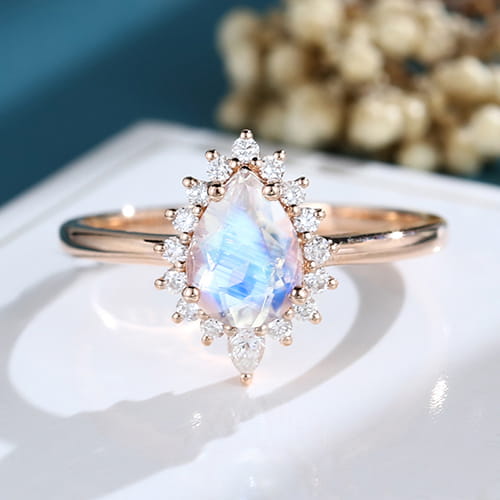
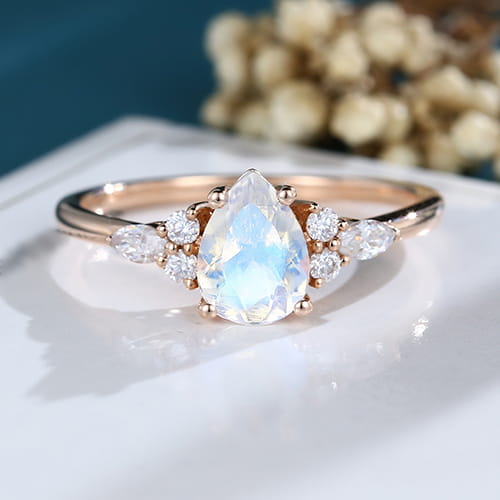
- Pear: A pear moonstone creates a graceful point and looks stunning in vintage or nature-inspired designs. Because the tip is vulnerable, choose a protective prong or bezel.
- Other shapes: Marquise, kite, hexagon, and freeform gems can look gorgeous, but exposed corners need careful protection.
The best shape is the one that shows the stone's glow attractively while fitting the wearer's style and daily routine.
Which Metal Looks Best with a Moonstone Ring?
- Rose gold adds warmth and emphasizes warm blush tones. It is especially effective for a romantic or botanical moonstone engagement design.
- Yellow gold creates a rich vintage contrast and complements cream and warm yellow shades.
- White gold gives a crisp frame to a colorless or pale stone and coordinates easily with diamond accents.
- Silver offers a cool, moonlit appearance. Confirm the alloy and maintenance expectations, because sterling silver may tarnish and is softer than common gold alloys.
For moonstone engagement rings, the best metal is not only a color decision. Consider durability, budget, skin sensitivity, upkeep, and how the engagement ring will pair with a future band. Browse the engagement ring collection to compare setting profiles and design directions.
Protective Settings for a Delicate Gemstone
Because moonstone is a delicate gemstone with cleavage, the safest engagement ring setting protects both the perimeter and the surface. A bezel surrounds much of the edge, while a halo can create a visual buffer. A low-profile basket reduces snagging, and rounded prongs are generally kinder to soft edges than an exposed tension-style design.
Protective settings for moonstone engagement rings do not have to feel heavy. A slim bezel, a partial bezel, or a refined halo can remain elegant. The key is to set the stone securely without covering its strongest light effect. Pear shapes and other pointed cuts need extra attention at their tips.
Ask a professional jeweler to inspect the mounting before purchase when possible. For a custom moonstone engagement ring, discuss band thickness, stone height, prong placement, and whether a wedding band will rub against the center setting. You can compare stacking options in the wedding bands collection.
Moonstone Engagement Rings vs. Diamond Engagement Rings
| Consideration | Moonstone engagement rings | Diamond engagement rings |
|---|---|---|
| Visual effect | Soft adularescent glow | Bright brilliance and fire |
| Individuality | Natural variation makes each stone distinctive | Cut and grading offer more standardized comparison |
| Hardness | Approximately 6–6.5; requires mindful wear | 10; highly resistant to scratches |
| Impact concerns | Cleavage and edges need protection | Very hard, although any ring can chip or loosen with impact |
| Symbolism | Lunar folklore, intuition, love, and cycles | Enduring love, strength, and familiar bridal tradition |
| Maintenance | Gentle cleaning and separate storage | Generally more tolerant, depending on setting and treatment |
Neither option is universally better. Diamonds suit people who prioritize maximum scratch resistance and traditional sparkle. Moonstone engagement rings suit people who prioritize ethereal beauty, symbolism, and individuality and who are comfortable with more careful habits. If durability is your first priority but you still want a non-mined center, explore lab diamond engagement rings.
Can You Wear Moonstone Engagement Rings Every Day?
Moonstone engagement rings can be worn regularly, but they are not maintenance-free. Moonstone ranks about 6–6.5 on the Mohs scale, so it is more vulnerable to scratches than diamonds, sapphires, and many other gemstones. Its cleavage also means a hard knock can cause a chip or fracture even when the stone previously looked clean.
For safer everyday wear:
- remove the engagement ring before exercise, cleaning, gardening, lifting, cooking with heavy tools, or hands-on work;
- avoid striking counters, door frames, gym equipment, and other hard surfaces;
- do not wear the ring in pools, hot tubs, or while applying lotions and household products;
- inspect the setting if it catches on fabric or receives an impact;
- store the moonstone ring away from harder jewelry.
A protective setting and realistic routine matter more than a promise that any gemstone is indestructible. Active wearers may prefer a moonstone engagement ring for special occasions and a more durable band for demanding tasks.

How to Choose the Perfect Moonstone Engagement Ring
Use this buying checklist before choosing a ring:
- Watch the glow move. Ask for video in diffused light and confirm that the adularescence travels across the stone rather than appearing only in one tiny area.
- Check body color. Decide whether you prefer transparent clarity, milky translucence, warm peach, cool gray, or multicolor flash.
- Inspect condition. Natural inclusions can be acceptable, but chips, deep scratches, and surface-reaching fractures may affect durability. Ask for close photographs from several angles.
- Confirm identity and treatment. The seller should disclose whether the material is classic moonstone, white labradorite sold as rainbow material, or another feldspar, and whether it has been treated.
- Review the setting. Check edge coverage, prong security, profile height, and whether the center is set where it can take direct impact.
- Consider the whole design. Make sure the band, accent diamonds, other gemstones, and wedding-band fit support your lifestyle rather than only the product photo.
- Compare policies. Read sizing, warranty, return, and repair terms before purchase.
- Request professional help. If a listing is unclear, consult a professional jeweler or qualified gemologist before committing.
The perfect moonstone engagement ring is not simply the largest stone. It is the ring that balances beauty, construction, comfort, honest disclosure, and the wearer's habits.
How to Use Reviews and Comments When Comparing Rings
Customer reviews and comments can show how a moonstone engagement ring looks outside studio lighting. Read comments for observations about the blue sheen, ring profile, sizing, packaging, and whether the real stone resembles the listing. Comments that include clear photos or video are usually more useful than short reactions alone.
Also compare comments with the seller's specifications and policies. Positive comments do not prove durability, and negative comments may reflect shipping or sizing rather than gemstone quality. Look for repeated themes across recent comments, then ask the seller direct questions when details are missing. You can also read LisaJewelryUS customer reviews for broader service context.
How to Clean and Store Moonstone Jewelry
Clean moonstone jewelry with lukewarm water, a small amount of mild soap, and a very soft brush or lint-free cloth. Rinse carefully and dry completely. For light dust, wipe the stone with a slightly damp cloth. Do not scrub aggressively around an inclusion or open fracture.
Avoid harsh chemicals, abrasive cleaners, steam, sudden temperature changes, and ultrasonic cleaning unless a jeweler who has examined the exact piece confirms the method is suitable. Remove the engagement ring before using cosmetics, hairspray, bleach, or household cleaners. Extended heat and strong direct sunlight are also unnecessary risks for some treated or included stones.
Store the clean ring in a soft pouch or a fabric-lined compartment separate from diamonds and harder gems. A second soft pouch is useful when traveling. Periodic inspections can catch a loose prong before the stone is lost.
Is a Moonstone Engagement Ring Right for You?
Moonstone engagement rings are a great choice if you love luminous color, subtle movement, natural variation, and nontraditional symbolism. They may also suit brides who want a celestial, vintage, or nature-inspired engagement ring rather than a conventional look.
They are less suitable if you expect to wear the same ring through heavy manual work without removing it, or if visible scratches would be upsetting. In that case, consider a traditional diamond, sapphire, or another durable center and use moonstone in a pendant or occasional-wear ring.
The right decision depends on lifestyle as much as appearance. If the wearer understands the care needs and still loves the stone, moonstone offers a stunning and deeply personal symbol of commitment.
Frequently Asked Questions
Why Choose a Moonstone Engagement Ring Instead of a Diamond?
Choose a moonstone engagement ring if you prefer a floating, moonlike glow, distinctive natural variation, and lunar symbolism over the sharp brilliance of a traditional diamond. Choose a diamond if maximum scratch resistance and conventional bridal sparkle are higher priorities.
Are Moonstone Engagement Rings Durable Enough for Daily Use?
Moonstone engagement rings can be worn regularly with mindful habits, but moonstone is softer and has more cleavage risk than diamond or sapphire. A protective, low-profile setting and removing the ring for exercise, cleaning, gardening, and manual work will reduce avoidable damage.
What Does a Moonstone Engagement Ring Symbolize?
Across folklore and crystal traditions, moonstone is believed to represent intuition, love, change, feminine energy, and a connection with the moon. Many couples choose it as a symbol of a shared beginning, but these associations are cultural beliefs rather than scientifically proven effects.
What Color Moonstone Is Best for an Engagement Ring?
There is no single best color. A clear or translucent stone with a centered blue flash is highly valued, while peach, gray, and multicolor varieties offer warmer or more dramatic character. Select the color and light effect that suit the wearer and verify the stone description.
Can Moonstone Be Set with Diamonds or Other Gems?
Yes. Small diamonds, moissanite, sapphires, and other gems can frame a moonstone and add sparkle or color. The layout should protect the center stone, avoid abrasive contact, and leave enough space for cleaning and a wedding band.
What Setting Is Best for a Moonstone Engagement Ring?
A bezel, partial bezel, secure halo, or low basket is usually a practical choice because it protects more of the edge and reduces snagging. The best setting also depends on the stone shape, ring profile, and wearer’s routine.
How Do I Know Whether a Moonstone Is Good Quality?
Look for an attractive glow that moves across the face, pleasing body color, a well-oriented cut, and no serious chips or open fractures. Ask for video, treatment disclosure, material identification, measurements, and close images of the exact stone.
How Should I Clean a Moonstone Engagement Ring?
Use lukewarm water, mild soap, and a soft cloth or gentle brush. Rinse carefully, dry completely, and keep the piece away from harsh chemicals, abrasives, steam, and unapproved ultrasonic cleaning. Store it separately from harder jewelry.
Explore a Ring That Reflects Your Story
A memorable engagement ring should suit both the person and the life around it. Moonstone engagement rings can be tailored to both. Explore LisaJewelryUS engagement rings, compare silhouettes, and use the custom design guide if you want a moonstone engagement ring built around a specific stone, setting, or band.