

The meaning of an emerald engagement ring is commonly associated with enduring love, loyalty, growth, hope, and renewal. Its green color connects it with spring and nature, while its rich history gives it a sense of timeless elegance. Those associations make emerald a compelling choice for couples who want a colored center stone with meaning as well as beauty.
Symbolism is personal, however. An emerald does not guarantee any quality in a relationship, and historical beliefs about wellness should be understood as lore rather than medical fact. An emerald engagement ring can be the perfect engagement ring for the right wearer, but the practical side matters too: emeralds require more thoughtful care than diamonds, and color, appearance, treatments, cut, and setting should all be considered before buying.
Table of Contents
- Meaning at a glance
- What is an emerald gemstone?
- Historical significance across cultures
- What does an emerald engagement ring symbolize?
- How to choose an emerald engagement ring
- Emerald cut, shape, and setting
- Metal choices
- Emerald vs. diamond engagement rings
- Care and cleaning
- Buying checklist
- Frequently asked questions
Emerald Engagement Ring Meaning at a Glance
| Symbolic association | Why people connect it with emerald | A practical interpretation |
|---|---|---|
| Enduring love | Green remains visually linked with life and renewal | A personal promise to keep a relationship growing |
| Loyalty | Emeralds have appeared in love stories and royal jewelry for centuries | Commitment and trust between partners |
| Hope and new beginnings | Green recalls spring and fresh growth | A fitting theme for the beginning of an engagement |
| Wisdom and clarity | Different cultures assigned emeralds protective and truth-seeking powers | A reminder to communicate honestly—not a supernatural guarantee |
| Nature | The stone's green color evokes gardens and landscapes | A natural-looking alternative to a colorless focal stone |
| Timeless beauty | Emerald jewelry has crossed many cultures and time periods | A distinctive look that is not limited to a short-lived trend |
The deepest symbolism is the one a couple chooses together. Some see a green stone as a symbol of hope; others simply love its vivid green color. Either reason can make an emerald engagement ring feel personal.
What Is an Emerald Gemstone?
Emerald is the bluish green to green variety of the mineral beryl, the same mineral family that includes aquamarine. According to the GIA emerald overview, stone experts use color to distinguish emerald from lighter green beryl, although the exact boundary is not universally identical.
Emeralds are precious gemstones valued primarily for color. Desirable examples often show a saturated bluish green to pure green, but there is no single shade that every buyer must prefer. Compare each stone under neutral lighting and decide whether its emerald color remains attractive in the environments where the ring will be worn.

Color, Appearance, Inclusions, and Carat Weight
Four important factors help describe an emerald:
- Color: Consider hue, tone, saturation, and how evenly the green color appears across the face of the stone.
- Appearance: Emeralds often contain visible inclusions. Dealers sometimes call their internal appearance a jardin, the French word for garden.
- Cut: A thoughtful cut balances color, brightness, weight retention, and protection of vulnerable areas.
- Weight: Carat measures weight, not face-up dimensions. Compare dimensions as well as the stated weight.
Inclusions are not automatically a defect, and an eye-clean standard used for diamonds should not be applied mechanically to emeralds. Still, examine the center stone carefully. Large surface-reaching fractures, weak corners, or inclusions that threaten durability deserve more attention than a small feature visible only under magnification.
Fine emeralds can command high prices, but origin, size, or a vivid photograph alone does not prove quality. Ask whether the stone is natural, laboratory-grown, treated, or an imitation, and request that material identity and treatments be stated in writing.
Historical Significance of Emeralds Across Cultures
Emeralds have captivated hearts across different cultures for centuries. The GIA history and lore guide notes that the first known emerald mines were in ancient Egypt and that Cleopatra was known for her passion for emeralds. Ancient Egyptians connected green with fertility, renewal, and life, although specific beliefs changed across eras and sources.
In the Americas, people were using Colombian emeralds in jewelry and religious ceremonies before Spanish explorers arrived in the sixteenth century. Trade later introduced more emeralds to European and Asian royalty. This broad historical significance helps explain why emerald jewelry appears in royal collections, ceremonial pieces, rings, necklaces, and earrings around the world.
Historical stories also gave emeralds powers of foresight, truth, protection, and healing. These accounts reflect deep tradition and fascinating cultural symbols, not scientific evidence. The original article's claims about emeralds healing organs or improving eyesight should not be treated as health advice.
Colombian Emerald History and Geographic Origin
A Colombian emerald may be admired for its origin and color, but the country name is not a complete grade. Emeralds also come from Zambia, Brazil, Afghanistan, Ethiopia, and other sources. Quality varies within every deposit, as it does with other precious gemstones.
For a costly natural emerald, ask how geographic origin was determined and whether an independent laboratory report supports the claim. A seller's use of “Colombian color” is not the same as laboratory confirmation that the stone came from Colombia.

What Does an Emerald Engagement Ring Symbolize?
Love, Loyalty, and Deep Emotions
The most familiar emerald engagement ring meaning is enduring love. Green growth provides an intuitive metaphor: a relationship is living, develops over time, and benefits from care. The stone's long association with truth and fidelity also makes loyalty a common part of its symbolism.
An emerald ring can therefore represent a couple's intention to build a life together. That deep symbolic meaning does not come from price alone. A modest engagement ring selected with shared values may carry more meaning than a larger gem chosen only to impress.
Growth, Nature, and New Beginnings
Green is closely connected with the natural world, spring, and renewal. For many couples, an emerald engagement ring offers a fitting symbol for a new chapter and the continuing growth of a partnership. They can be especially meaningful for someone who feels restored by gardens, forests, or the natural world.
Emerald is also the May birthstone and is associated with twentieth and thirty-fifth wedding anniversaries. These calendar connections can add another layer of meaning, but a person does not need a May birthday to wear an emerald engagement ring.
Hope, Wisdom, and Clarity
Across many cultures, emeralds have been linked with hope, wisdom, and clear judgment. Modern couples may interpret those symbols as reminders to approach marriage with honesty, patience, and curiosity.
Claims that a stone produces mental clarity or changes the body are not established medical benefits. It is more responsible to describe these ideas as tradition, folklore, or personal intention.
Timeless Elegance and Individual Style
An emerald combines recognizable color with timeless elegance. It can look vintage in an ornate warm-metal setting, contemporary with clean lines, or romantic in a blush-toned metal. Its natural beauty also makes it a popular choice—and sometimes the perfect choice—for people who prefer color to the icy appearance of many diamond engagement rings and other diamonds.
Not every emerald engagement ring design has to feel formal. A simple solitaire, an east-west emerald cut, a round green center stone, or a modest diamond halo can express very different style preferences.

How to Choose an Emerald Engagement Ring
A perfect engagement ring should suit the wearer's taste, routine, budget, and tolerance for maintenance. Start with the actual stone rather than assuming every emerald ring will look like a highly edited photograph.
1. Confirm What the Stone Is
Ask whether the featured stone is a natural emerald, a laboratory-grown emerald, another green stone, or an imitation. Natural emeralds formed in the earth; lab-grown emeralds are created in controlled conditions and can have essentially the same relevant chemical, physical, and optical properties. They do not have the same rarity or origin story.
Neither “lab-created” nor “natural” is automatically the perfect choice. The important point is accurate disclosure and a price that reflects what is being sold.
2. Review Treatment Disclosure
Many mined emeralds have surface-reaching fractures filled with oil, resin, or another substance to improve apparent transparency. Treatment type and degree can affect value, appearance, care, and future servicing.
Ask these questions before ordering:
- Has the emerald been treated, and if so, how?
- Is the fracture filling described as minor, moderate, or significant?
- Can the filler be affected by heat, chemicals, steam, or future repair work?
- Is an independent report included for a valuable stone?
- What return period applies after you inspect the emerald in person?
3. Compare Color in More Than One Light
A vivid green emerald can appear darker indoors and brighter near a window. When comparing an emerald engagement ring, view photographs and videos taken in neutral daylight-equivalent lighting and ordinary indoor light. Avoid judging color only under intense spotlights.
Look for a green color you enjoy, enough brightness to see the cut, and a tone that does not appear black in normal conditions. Personal preference matters; the “best” color is not meaningful if you do not enjoy wearing it.
4. Inspect Clarity and Durability Features
Examine the stone with the naked eye first, then use magnified images to understand the inclusions. Ask whether any fracture reaches a corner or lies near a prong. An independent gemologist can help assess an expensive natural emerald.
Emerald measures 7.5 to 8 on the Mohs hardness scale, but hardness describes resistance to scratching, not resistance to every chip or break. Inclusions and filled fractures can make an emerald more vulnerable to impact than a diamond.
5. Compare Dimensions, Not Carat Weight Alone
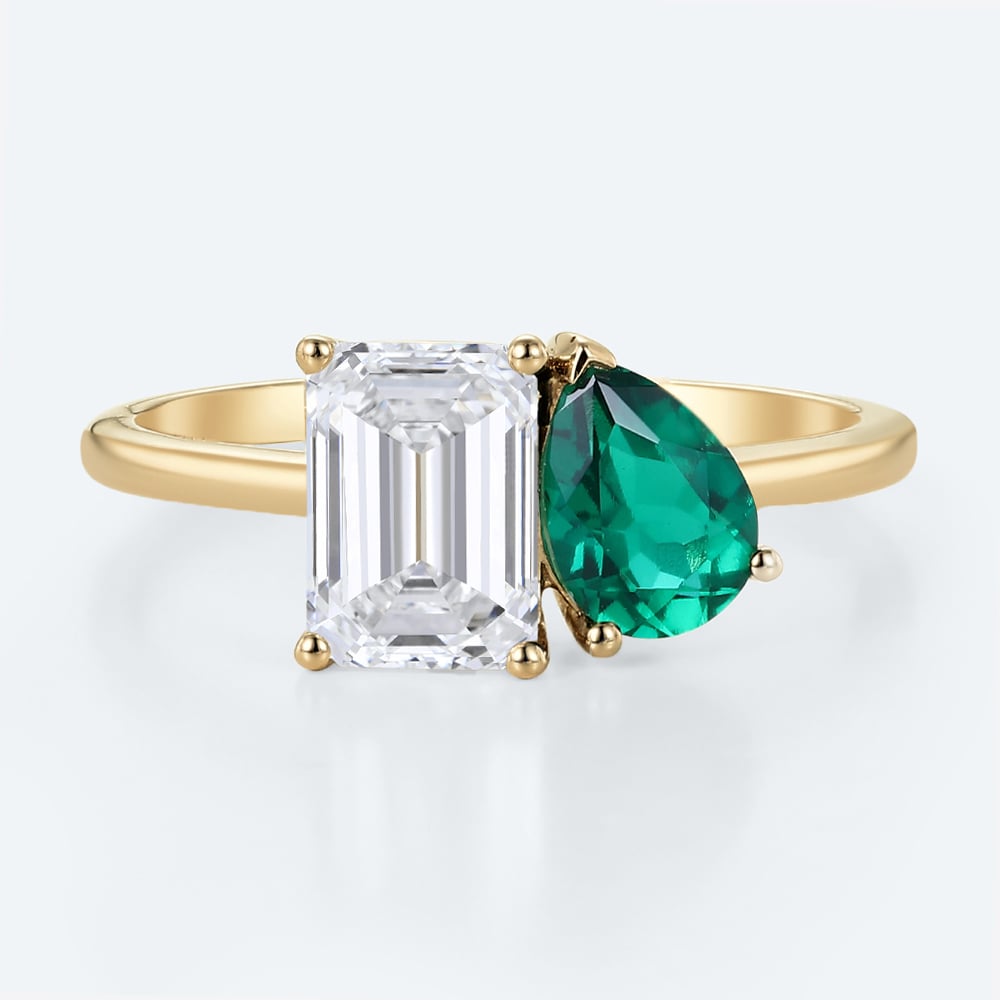
Emerald and diamond have different densities, so equal carat weights do not necessarily face up at the same size. Shape, depth, cut, and setting also change how large a stone appears. Request length, width, and depth in millimeters.
6. Match the Ring to Everyday Life
An emerald engagement ring can be worn regularly, but it is not a maintenance-free object. Someone who works with tools, lifts weights, gardens, or frequently exposes their hands to chemicals may need to remove the ring during those activities.
Consider insurance, inspection intervals, prong maintenance, and whether a protective setting works with the wearer's habits. Practical planning supports the ring's beauty rather than diminishing its romance.
Emerald Cut, Shape, and Setting
“Emerald” identifies a gem, while “emerald cut” identifies a rectangular step-cut shape that can be used for emeralds, diamonds, and other gemstones. An emerald gemstone can also be oval, pear shaped, cushion shaped, or round.
Emerald Cut and Clean Lines
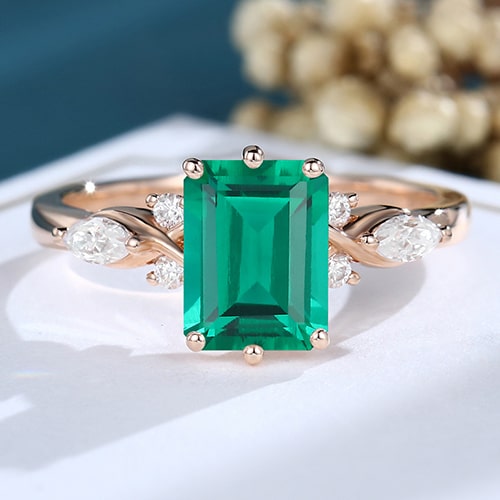
The emerald cut is known for long facets and clean lines. Its clipped corners can help protect vulnerable points, and the broad facets emphasize color and internal character rather than the splintery sparkle associated with many brilliant cuts.
Because step cuts can make inclusions easier to notice, inspect the actual stone rather than selecting from shape alone. A well-proportioned emerald cut with deep, saturated color should show an appealing balance of color and brightness without a large lifeless area through the center.
Choosing a Protective Setting
The setting should hold the stone securely and fit the wearer's style. Prongs keep more of the stone visible, while a bezel or partial bezel can provide additional edge protection. A diamond halo can add contrast and visual size, but its small diamonds and prongs also require inspection and cleaning.
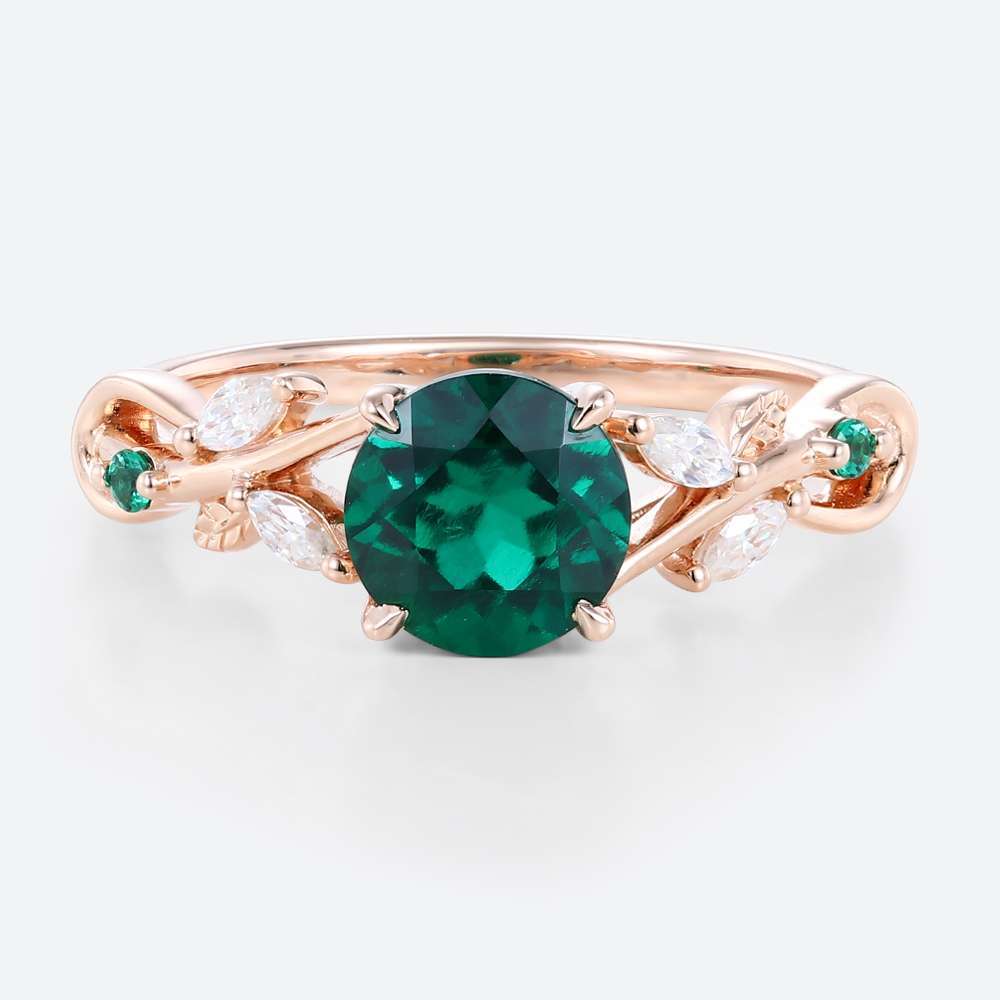
For a pear or marquise shape, protect the pointed tip. For an emerald cut, make sure the clipped corners are supported. Low-profile settings may reduce snagging, but they must still allow a compatible wedding band if a flush stack is important.
Choosing a Metal for an Emerald Engagement Ring
Metal changes both the visual mood and maintenance of an emerald ring:
| Metal | Visual effect with emerald | What to check |
|---|---|---|
| Yellow gold | Warm, classic contrast that can reinforce an antique style | Karat, alloy composition, prong condition, and finish |
| White gold | Cool contrast that coordinates easily with diamonds | Alloy ingredients and whether rhodium replating may be needed |
| Rose gold | Romantic warmth beside green | The exact rose shade and whether the prongs protect the stone |
| Platinum | Naturally gray-white and often substantial | Weight, price, finish, dimensions, and construction |
Metal color is a style decision, not a quality shortcut. Warm, cool, and blush-toned metals can all support a beautiful engagement ring when the construction is appropriate. If the wearer has a known metal sensitivity, ask for the full alloy composition rather than relying on a generic “hypoallergenic” claim.
Emerald vs. Diamond Engagement Rings
Emerald and diamond engagement rings, especially designs featuring diamonds, create different experiences. A diamond is significantly harder and usually emphasizes brilliance and fire. An emerald emphasizes saturated green color, internal character, and symbolism.
| Consideration | Emerald engagement ring | Diamond engagement ring |
|---|---|---|
| Main visual feature | Green color and individual internal features | Brightness, fire, and scintillation |
| Mohs hardness | 7.5–8 | 10 |
| Typical clarity expectations | Inclusions are common | Graded under a different clarity system |
| Treatments to ask about | Fracture filling is common in natural emeralds | Treatment and lab-grown/natural disclosure still matter |
| Care | Avoid impact, heat, harsh chemicals, steam, and ultrasonic cleaners | Durable but not damage-proof; setting still needs care |
| Symbolism | Growth, hope, renewal, loyalty | Often permanence, strength, and classic bridal tradition |
An emerald can be a perfect choice for a person who loves green and accepts extra care. Diamonds may be the more practical classic choice for someone who prioritizes hardness and diamond sparkle. A halo or three-stone design can combine emeralds and diamonds and other gemstones without forcing an either-or decision.
How to Care for an Emerald Ring
Proper care is especially important because these stones often contain fractures, and many fashioned emeralds have clarity enhancement. The GIA emerald care guide recommends warm, soapy water and gentle scrubbing as the safest routine method.
Use this conservative process:
- Check that the stone and prongs do not appear loose.
- Use lukewarm water with a small amount of mild soap.
- Clean gently with a very soft brush, avoiding aggressive pressure.
- Rinse carefully and dry with a soft, lint-free cloth.
- Store the ring separately so harder gemstones, especially diamonds, do not scratch it; diamonds can abrade softer stones.
Do not automatically use ultrasonic cleaners or steam. Heat can extend existing fractures, and harsh chemicals can affect oils, resins, or polymers used in filled fractures. Remove an emerald ring before impact-heavy work, swimming, household cleaning, and applying products that may leave residue.
If the ring needs repair, tell the jeweler that the main stone is emerald and provide any treatment documentation before heat is applied. Ask a qualified jeweler to inspect the setting periodically.
Emerald Engagement Ring Buying Checklist
Before choosing an emerald engagement ring, confirm these important factors:
- The stone is identified as natural emerald, lab-grown emerald, another gemstone, or imitation.
- Any clarity treatment is disclosed in writing.
- Color is shown in realistic, identified lighting.
- Inclusions and surface-reaching fractures can be inspected clearly.
- Millimeter dimensions are provided alongside the stated weight.
- The cut and shape suit the wearer's personal style.
- The setting protects vulnerable corners or points.
- The metal and alloy fit the desired color and maintenance routine.
- Ring size, wedding-band compatibility, production details, return policy, and warranty are confirmed.
- A laboratory report is considered when price, natural origin, or geographic origin materially affects the purchase.
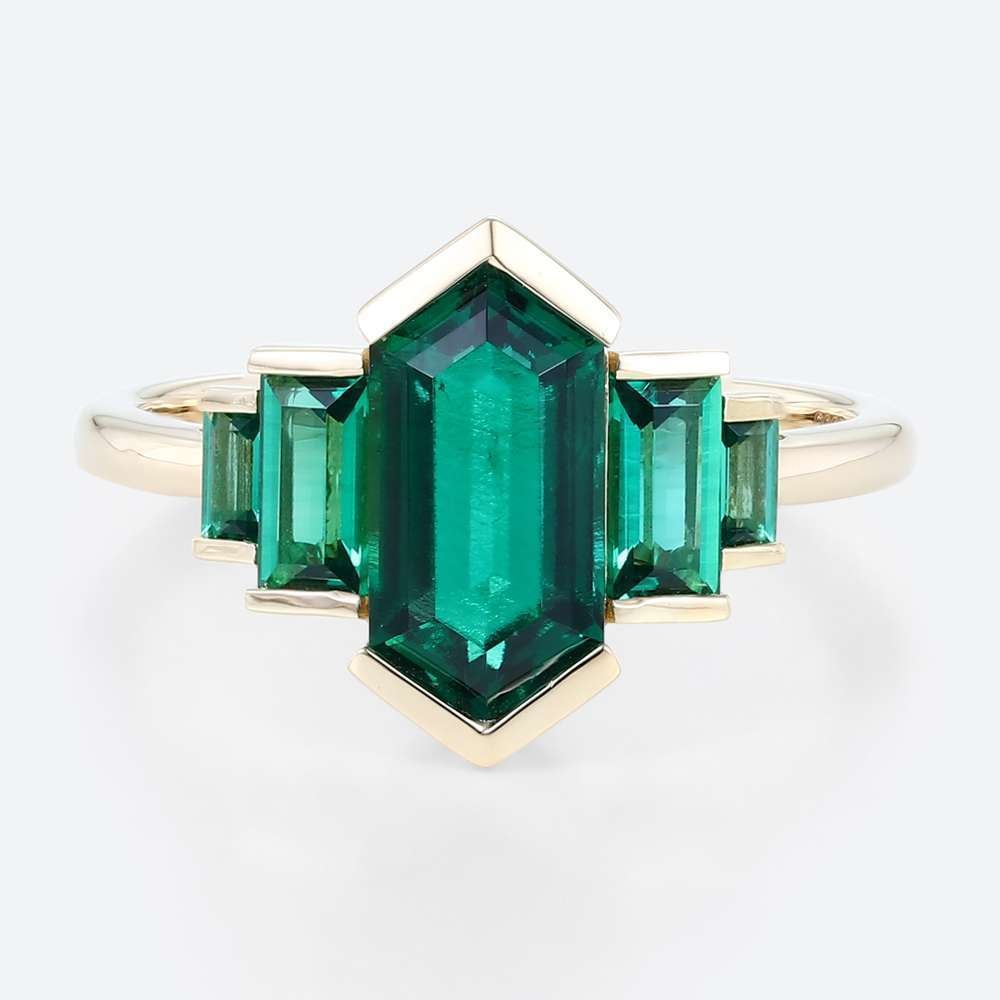
A thoughtfully chosen emerald engagement ring is not simply the largest or deepest green stone. It is a well-disclosed piece of jewelry whose beauty, construction, meaning, and care requirements suit the person who will wear it.
Frequently Asked Questions
What Does an Emerald Ring Mean?
Its meaning is commonly connected with love, loyalty, growth, hope, and renewal. These are cultural and personal symbols rather than guarantees produced by the stone.
Is an Emerald a Good Engagement Ring Stone?
Yes, an emerald can be a good engagement ring center stone for someone who loves its green color and is prepared to protect it from impact, heat, harsh chemicals, steam, and ultrasonic cleaning. Its 7.5–8 Mohs hardness does not make it chip-proof.
Are Inclusions Normal in Emeralds?
Yes. Emeralds commonly have inclusions visible to the naked eye, and their garden-like appearance is sometimes called jardin. Evaluate whether the inclusions affect beauty or durability, especially when fractures reach the surface or vulnerable edges.
Is an Emerald Cut the Same as an Emerald Gemstone?
No. Emerald is a green variety of beryl. Emerald cut is a rectangular step-cut shape that can be used for emeralds, diamonds, and other gemstones.
Are Natural Emeralds Better Than Lab-Grown Emeralds?
Neither is automatically better for every buyer. Natural emeralds offer geological rarity and individual origin, while lab-grown emeralds can offer similar material properties and colored beauty without mined rarity. Accurate disclosure is essential.
What Metal Looks Best with an Emerald Ring?
Yellow gold creates warm contrast, white gold and a naturally white metal produce a cooler look, and a blush-toned metal creates a romantic color combination. The best choice depends on personal style, alloy sensitivity, maintenance preferences, and setting construction.
Can I Clean an Emerald Engagement Ring in an Ultrasonic Cleaner?
It is generally unsafe to assume that you can. Many emeralds contain filled fractures, and ultrasonic vibrations or steam may damage the stone or its filler. Warm soapy water and gentle cleaning are the safer default unless a qualified professional who knows the treatment history advises otherwise.
Does Origin in Colombia Guarantee the Best Quality?
No. Colombia is a historically important source, but origin alone does not guarantee superior color, transparency, treatment level, durability, or value. Evaluate the individual stone and obtain appropriate documentation for a high-value purchase.
Choose an Emerald Engagement Ring with Meaning and Confidence
Emeralds continue to be a popular choice because few gemstones combine such recognizable green beauty, rich history, and layered symbolism. An emerald engagement ring can express love, growth, hope, loyalty, or simply a shared appreciation for color and the outdoors.
Explore LisaJewelryUS engagement rings for design inspiration, or contact LisaJewelryUS to ask about material disclosure, ring size, setting details, and customization before ordering. Choose the ring for the person and the life behind it—not for symbolism or a product photograph alone.