
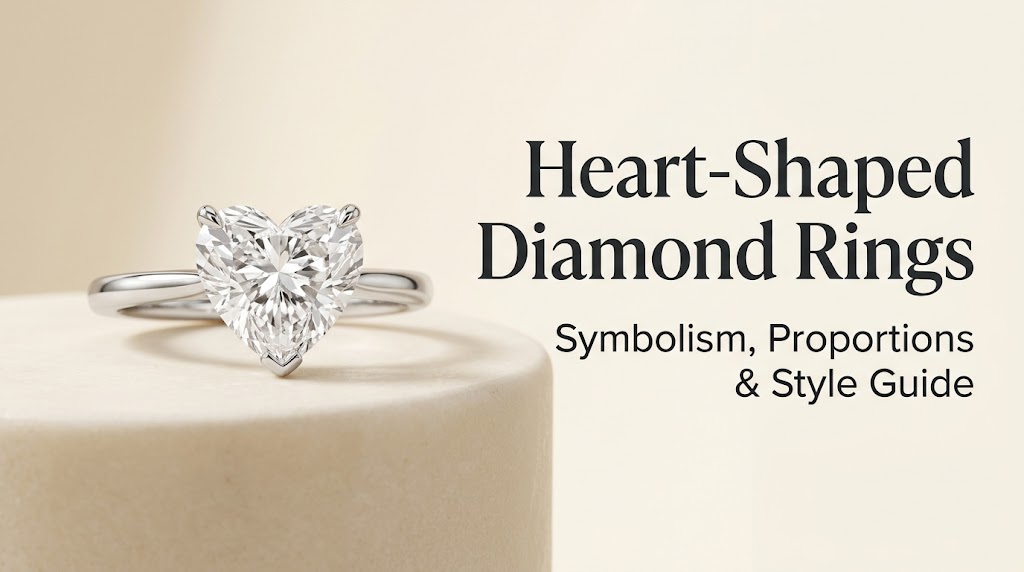
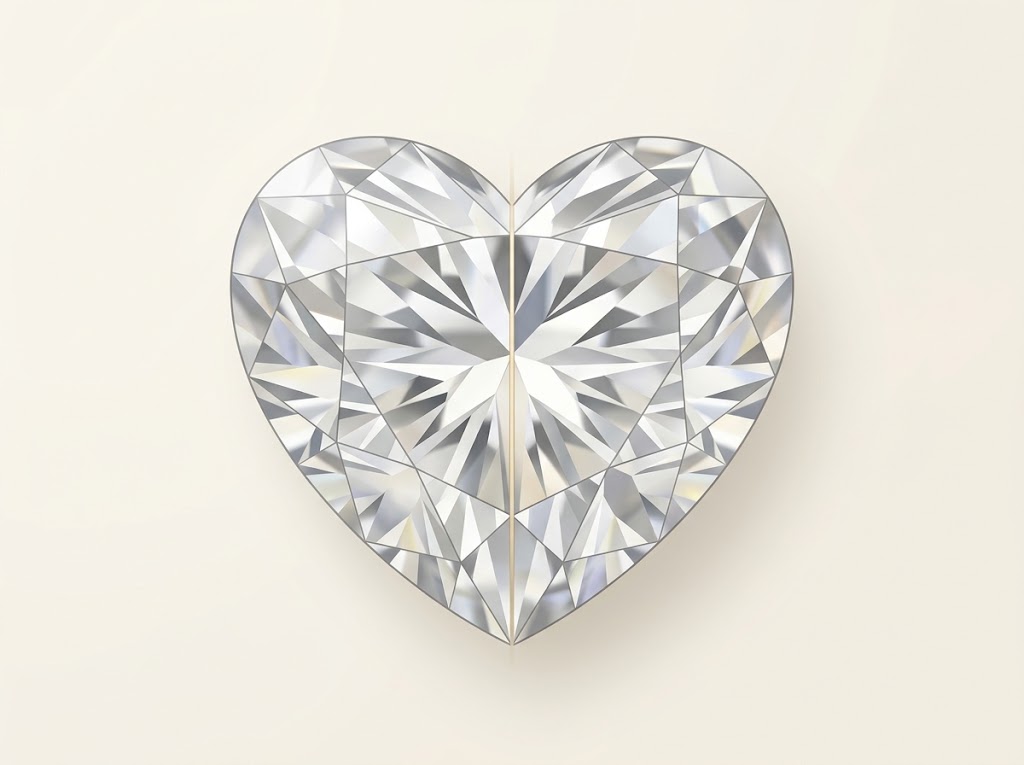
Some engagement rings communicate through subtle details. A heart-shaped diamond makes its meaning clear from the first glance.
Recognized as a symbol of love and emotional connection, the heart is one of the most distinctive fancy diamond shapes. Yet its familiar outline is more technically complex than it may appear. The lobes must feel balanced, the cleft should be recognizable, the wings should flow smoothly, and the lower point should appear centered.
For that reason, choosing a heart shaped engagement ring involves more than finding a preferred carat weight or clarity grade. The diamond’s outline, length-to-width ratio, light return, bow-tie visibility, and setting all contribute to the finished design.
This heart cut diamond guide explains how to evaluate those details while keeping personal style at the center of the decision.
Quick Answer: What Makes a Good Heart-Shaped Diamond?
A well-proportioned heart-shaped diamond generally has two visually balanced lobes, a clearly recognizable cleft, smooth wings, and a defined point. A length-to-width ratio around 1.00 creates a classic, balanced silhouette, while a higher ratio produces a more elongated heart.
However, no single ratio guarantees beauty or strong light performance. The most useful evaluation combines the IGI grading report with face-up images, video, millimeter measurements, and a setting designed to protect the pointed tip.
When comparing two heart diamonds, check:
- Whether the left and right halves appear balanced
- The fullness and smoothness of the lobes
- The definition of the center cleft
- The flow of the wings toward the point
- The diamond’s length-to-width ratio
- Any distracting bow-tie darkness
- Brightness and contrast as the diamond moves
What Does a Heart-Shaped Diamond Symbolize?
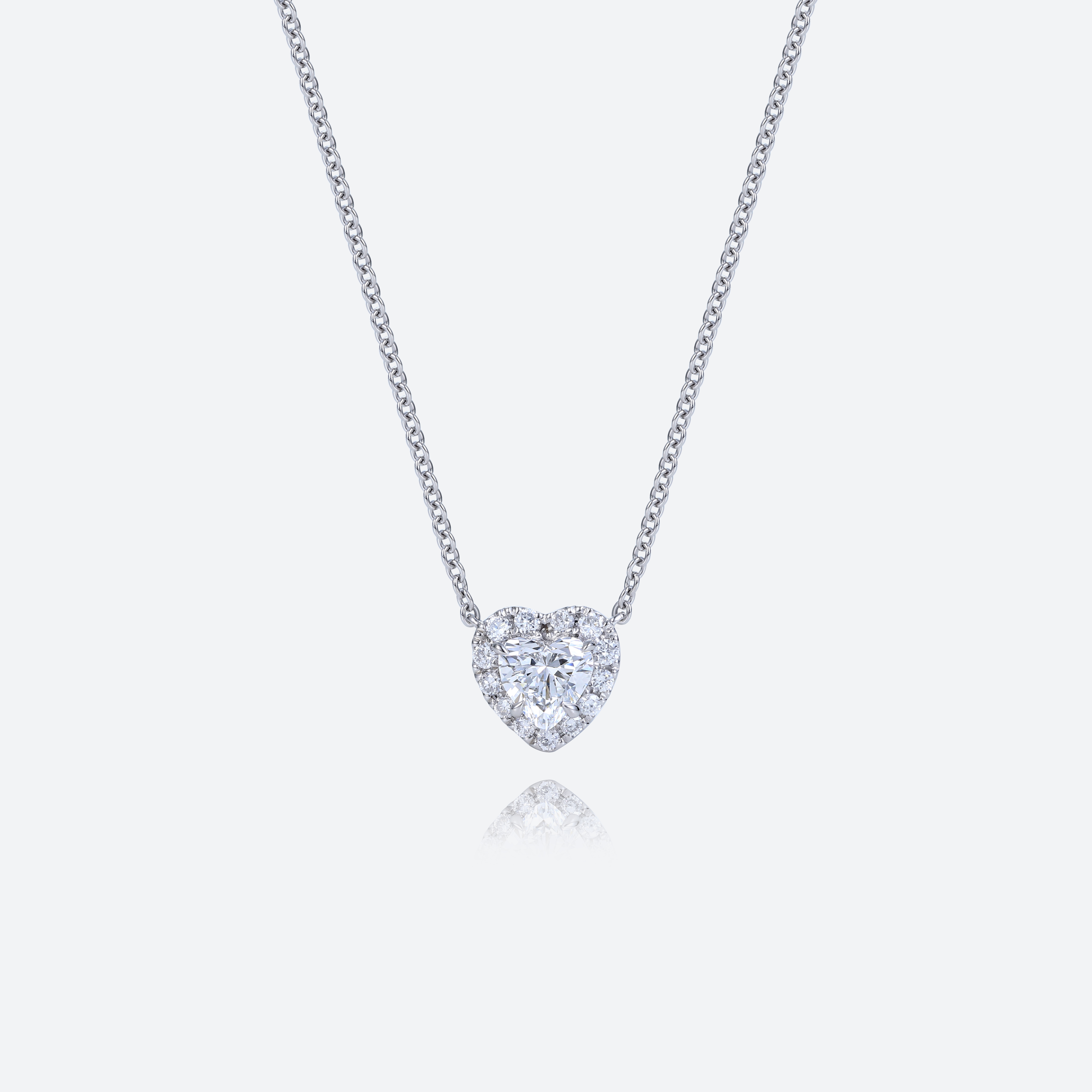
Heart-shaped diamonds are closely associated with love, affection, commitment, and emotional openness. Their meaning is direct, making them a natural choice for engagement rings, anniversary jewelry, promise rings, and other sentimental gifts.
That symbolism does not mean every heart-shaped ring must feel ornate or traditionally romantic. In a simple solitaire setting, the shape can look clean and contemporary. A halo can create a more glamorous interpretation, while a bezel may give the familiar heart motif a modern architectural edge.
Among romantic diamond rings, the heart shape stands apart because its meaning comes from the diamond’s outline rather than from added decorative details. It can therefore feel expressive even when the rest of the ring is minimal.
The shape is also a matter of personal taste. Some buyers appreciate its unmistakable symbolism, while others may prefer the visual subtlety of an oval, pear, or round brilliant. A heart-shaped ring works best when the wearer genuinely connects with both its meaning and distinctive appearance.
Understanding Heart-Cut Diamond Anatomy
Before comparing percentages and grading reports, it helps to understand the individual parts that create a recognizable heart.
Lobes
The lobes are the two rounded upper sections of the diamond. They should appear visually balanced in size, height, and curvature.
They do not need to look mechanically identical under extreme magnification, but one lobe should not appear noticeably flatter, narrower, or higher than the other. Full, smoothly curved lobes usually help the diamond read clearly as a heart rather than as an irregular pear.
Cleft
The cleft is the V-shaped indentation between the two lobes. Its depth and definition have a strong influence on the diamond’s personality.
A shallow cleft may create a softer, more subtle heart, but if it is too weak, the outline can begin to resemble a rounded pear. A deeper cleft creates stronger separation between the lobes, although an excessively dramatic cleft may make the top of the stone feel divided.
There is no universally preferred cleft depth. The goal is a recognizable heart shape with a smooth transition into both lobes.
Wings and Belly
The wings are the curved sides that narrow from the lobes toward the lower point. They help determine whether the heart appears full, slender, soft, or angular.
Look for continuous curves without distracting flat areas, abrupt bulges, or uneven transitions. A fuller belly tends to create a broader and more generous silhouette, while straighter wings can make the diamond appear longer and more directional.
Point
The point completes the heart at the bottom. It should appear clearly defined and reasonably centered beneath the cleft.
Because it is a narrow part of the diamond, the point should be considered when selecting a setting. A protective prong, V-prong, bezel, or another thoughtfully engineered structure may help shield it from direct impact. Upper prongs are generally better positioned on the lobes than inside the cleft, where too much metal could interrupt the heart outline. (4cs.gia.edu)
Heart Diamond Proportions and Length-to-Width Ratio
The length-to-width ratio is one of the easiest ways to describe the overall silhouette of a heart-shaped diamond.
It can be calculated as:
Length-to-Width Ratio = Diamond Length ÷ Diamond Width
The length is measured from the top of the diamond to the lower point, while the width is measured across its widest area. A ratio near 1.00 indicates that the length and width are similar. A higher ratio produces a longer, narrower heart.
A Practical Heart Diamond Ratio Guide
| Length-to-Width Ratio | General Appearance | What to Check |
|---|---|---|
| Below 1.00 | Broad and rounded | Make sure the diamond does not appear compressed |
| Around 1.00–1.05 | Classic and balanced | Check the cleft and matching lobe shapes |
| Around 1.06–1.15 | More elongated | Confirm that the wings remain smooth and full |
| Above 1.15 | Slim and dramatic | Make sure the outline still reads clearly as a heart |
These ranges describe visual tendencies rather than laboratory cut-grade boundaries. GIA’s consumer guidance places many symmetrical heart diamonds within a broader length-to-width range of approximately 1.00 to 1.20, but the most attractive ratio remains a matter of individual outline and preference. (4cs.gia.edu)

Is 1.00 the Ideal Heart Diamond Ratio?
A 1.00 ratio is a useful starting point, but it is not a universal ideal.
Someone who prefers a traditional heart motif may favor a ratio close to 1.00, with rounded lobes and a full belly. A slightly higher ratio can create a more elegant, elongated look that provides additional north-to-south coverage on the finger. A broader heart may feel softer or more sculptural.
Ratio also cannot describe the cleft, lobes, wings, point, or optical performance. Two diamonds with identical length-to-width ratios may have noticeably different outlines and light behavior.
IGI evaluates fancy-shape cut quality through a broader process that considers polish, symmetry, proportion qualifications, shape-specific craftsmanship requirements, and light return. This is why a heart diamond should not be accepted or rejected based on one proportion alone. (igi.org)
Symmetry, Bow Ties, and Light Performance
A pleasing heart shape needs more than matching measurements. It should also look balanced when viewed face-up and remain lively as it moves.
Visual Symmetry vs. the Symmetry Grade
Draw an imaginary line from the center of the cleft to the lower point. Then compare the two halves of the diamond:
- Are the lobes similar in height and fullness?
- Do the wings curve inward at a similar rate?
- Is the point centered beneath the cleft?
- Does one side appear flatter or heavier?
This face-up comparison is different from the Symmetry grade on a diamond report. The laboratory grade primarily evaluates facet alignment and related workmanship, while visual outline symmetry describes how balanced the heart looks to the eye. Both are useful, but one cannot fully replace the other.
Do Heart-Shaped Diamonds Have a Bow Tie?
Like oval, pear, and marquise diamonds, a heart-shaped diamond may display a bow tie—a darker band or area of contrast across the center.
A bow tie is not automatically a defect. Some contrast helps define the facet pattern and creates visual movement. The concern is whether the area appears excessively dark, wide, or motionless under different viewing conditions.
When reviewing a heart diamond online, look for a video that shows it:
- Facing the camera directly
- Tilting slowly from side to side
- Moving through more than one lighting environment
- At a realistic scale as well as under magnification
Pay attention to whether light travels evenly through both lobes and across the center. Avoid judging from a single still image, where the camera or phone may create temporary darkness that is not present during normal viewing.
How Carat, Color, and Clarity Affect a Heart Diamond
The familiar 4Cs still matter, but a heart diamond asks buyers to place extra attention on visible outline and millimeter dimensions.
Carat and Face-Up Size
Carat measures weight, not the exact size of the diamond when viewed from above. Two heart diamonds with the same carat weight may have different lengths, widths, and overall visual presence.
At smaller sizes, the cleft and lobes can become more subtle. That does not make a smaller heart undesirable, but it makes precision of outline especially important. A carefully shaped halo or bezel can also help reinforce the heart silhouette.
Color
Color may appear differently depending on the diamond’s size, proportions, setting metal, and lighting. White gold or platinum can create a crisp, cool presentation, while yellow or rose gold may introduce a warmer contrast.
There is no single minimum color grade required for every heart-shaped diamond. Compare the stone face-up and consider how its color interacts with the selected metal rather than choosing by the letter grade alone.
Clarity
Heart diamonds do not universally require a VS1 or higher clarity grade. An eye-clean diamond at another grade may offer an attractive balance of appearance and value.
Give additional attention to inclusions near the point, cleft, or areas where the prongs will contact the diamond. Review the IGI grading report together with magnified images and normal-scale video.
The same evaluation applies to natural and lab-grown diamonds. Lab-grown describes origin; it does not describe the quality of the heart outline, faceting, or light performance.
Best Settings for a Heart-Shaped Engagement Ring
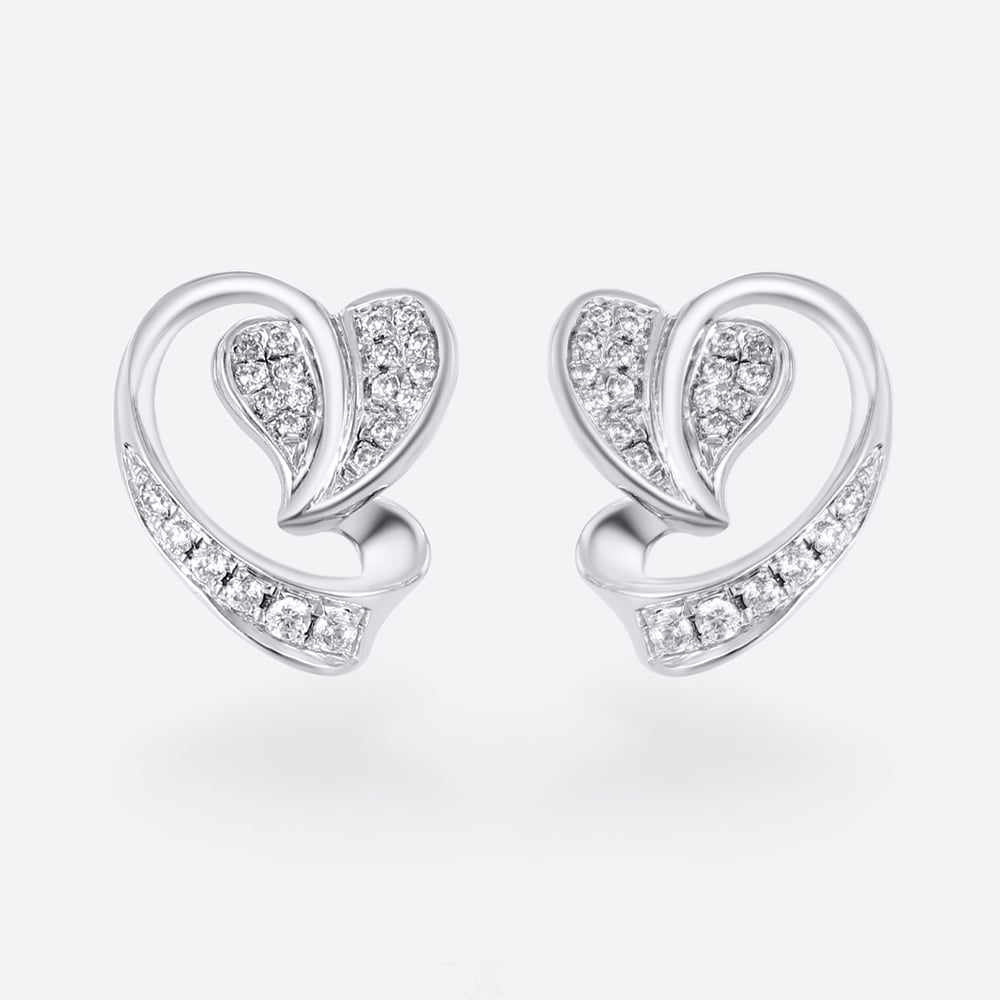
The setting should support the diamond while preserving the details that make the heart recognizable.
| Setting Style | Visual Effect | What to Consider |
|---|---|---|
| Solitaire | Clean and shape-focused | Prongs should protect the point without obscuring the cleft |
| Halo | Adds presence and reinforces the heart outline | The halo should follow both lobes and the center cleft accurately |
| Bezel or semi-bezel | Modern and defined | A thick metal border may reduce visible diamond area |
| Three-stone | Symbolic and substantial | Side stones should not compete with or distort the center outline |
| Pavé band | Adds delicate brilliance | Keep the center diamond visually dominant |
Heart-Shaped Solitaire Rings
A solitaire allows the outline to carry the entire design. It is an excellent option for someone who wants a heart shaped engagement ring that feels romantic without becoming highly decorative.
Prong size matters. Oversized upper prongs may make the lobes look uneven or partially close the cleft, while an insufficiently protected point may be more exposed to impact.
Halo and Bezel Settings
A halo can give a smaller heart diamond greater visual presence, but the surrounding stones should trace the shape precisely. A generic rounded halo may weaken the cleft and make the overall design look more oval than heart-shaped.
A bezel creates a clean metal outline and may provide greater edge coverage. However, the craftsmanship around the cleft and point needs to be precise so the metal enhances rather than softens the silhouette.
Protecting the Point and Choosing a Wedding Band
The pointed tip deserves thoughtful protection. Depending on the design, a jeweler may use a V-prong, a rounded protective prong, or a bezel-like structure at the bottom of the heart. Upper prongs are generally positioned on the lobes rather than directly inside the cleft.
Prong number alone does not determine security. The basket, metal thickness, contact points, and quality of construction all contribute to how well the diamond is supported.
Wedding-band fit is another design consideration. A low basket may prevent a straight band from sitting flush, while a raised gallery can sometimes provide additional clearance. If a gap remains, a curved or contoured wedding band can follow the point of the heart and create a more intentional pairing.
Is a Heart-Shaped Diamond Right for You?
Consider a heart diamond if you prefer:
- A clear and personal symbol of love
- A less conventional alternative to round or oval diamonds
- A shape that can feel romantic, modern, or bold
- A center stone with strong visual identity
Another shape may suit you better if you prefer a more understated symbol, a highly standardized outline, or a wider selection of ready-made settings.
A heart-shaped diamond is not limited to one personality or design style. The best reason to choose it is simply that its meaning and silhouette feel right to the wearer.
Heart-Shaped Diamond Buying Checklist
Before choosing a diamond, ask:
- Do the lobes look balanced?
- Is the cleft clearly recognizable?
- Are the wings smooth and evenly curved?
- Is the point centered and protected?
- Do I like the length-to-width ratio?
- Is the bow tie distracting?
- Does light move across both halves?
- Have I compared the millimeter measurements?
- Have I reviewed the IGI report and video?
- Will the setting work with the intended wedding band?
Final Thoughts
A heart-shaped diamond is meaningful because its outline speaks so clearly. The strongest examples combine that symbolism with balanced lobes, a defined cleft, smooth wings, lively light return, and thoughtful point protection.
Rather than searching for one perfect ratio, compare the complete diamond. Choose the heart that looks harmonious in motion, works naturally with its setting, and feels personal to the person who will wear it.
When exploring LisaJewelryUS romantic diamond rings, consider both the character of the individual diamond and the craftsmanship of the setting that completes it.
Frequently Asked Questions
What is the ideal ratio for a heart-shaped diamond?
A ratio near 1.00 creates a classic heart, while approximately 1.06–1.15 appears more elongated. These are visual preferences, not strict quality boundaries.
Are heart-shaped diamonds more expensive?
Not necessarily. Price depends on carat, color, clarity, cut quality, origin, availability, and the individual diamond—not shape alone.
Do all heart-shaped diamonds have a bow tie?
No, but many show some central contrast. Focus on whether the bow tie is excessively dark or distracting rather than expecting it to disappear completely.
What setting best protects a heart diamond?
A setting with thoughtful point protection is important. Depending on the design, this may include a V-prong, protective rounded prong, or bezel.
Do heart diamonds work at smaller carat weights?
Yes. At smaller sizes, prioritize a clearly defined cleft and balanced lobes. A precise halo or bezel may help emphasize the heart outline.
Is a heart-shaped diamond the same as a Hearts and Arrows diamond?
No. Heart-shaped describes the diamond’s external outline. Hearts and Arrows refers to an optical pattern associated with certain precision-cut diamonds.