

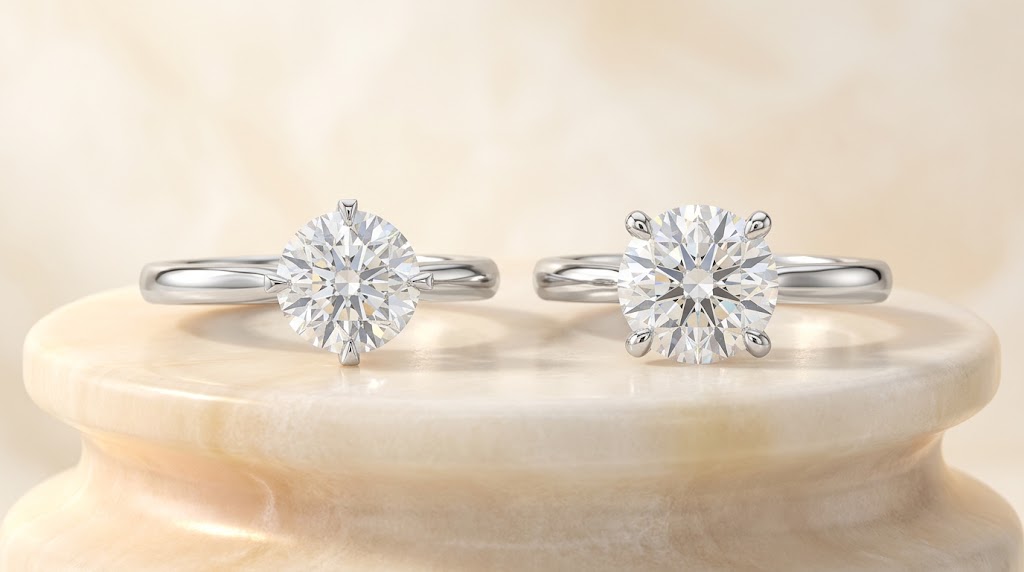
A solitaire engagement ring may look simple, but even a small change in prong placement can transform its personality. Instead of positioning four prongs diagonally around a diamond, a compass setting places them directly at the top, bottom, left, and right—like the cardinal points on a compass.
These north-south-east-west prongs create a distinct visual axis, giving a familiar solitaire a more graphic and architectural appearance. The effect can be especially noticeable on round, oval, and elongated diamonds, where the prongs interact with the stone’s outline in different ways.
But appearance is only part of the decision. Before choosing a compass prong engagement ring, it is worth considering how the arrangement affects the diamond’s silhouette, security, comfort, and compatibility with a wedding band.
Quick Answer: Compass Prongs vs. Traditional Prongs
Compass prongs position four prongs at the north, south, east, and west points of a diamond. Traditional four-prong settings commonly place the prongs diagonally or closer to the stone’s corners.
Compass prongs often create a directional, contemporary look, while traditional prongs tend to frame the diamond in a more familiar and visually balanced way. Neither arrangement is automatically more secure. Security depends on the number and construction of the prongs, their contact with the stone, the diamond shape, and the supporting basket or gallery.
In general:
- Choose compass prongs for a graphic, modern solitaire.
- Choose traditional prongs for a familiar and versatile outline.
- Consider six prongs if you prefer additional contact points and a more enclosed appearance.
- Evaluate the complete setting, not the prong position alone.
What Are Compass Prongs?
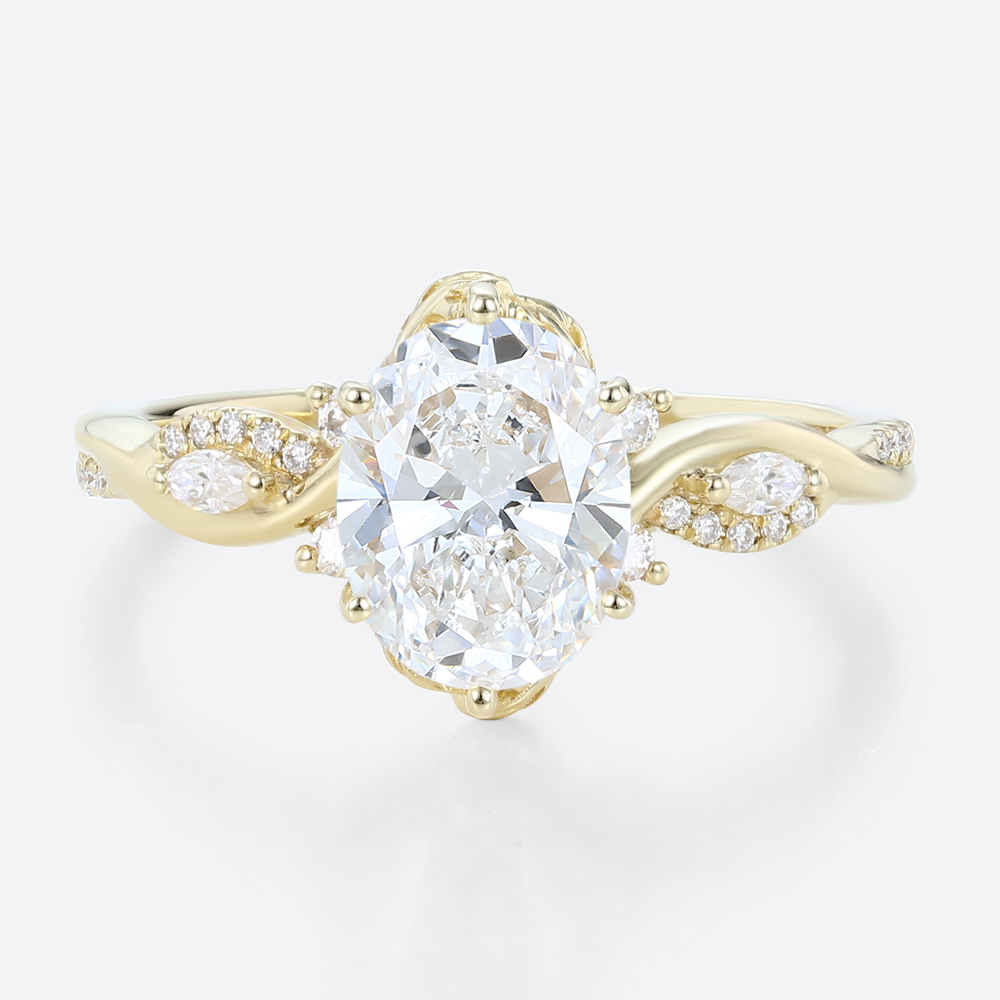
Compass prongs are usually four prongs positioned at the diamond’s cardinal points: 12, 3, 6, and 9 o’clock. When the ring is viewed from above, the placement creates a clear vertical and horizontal axis.
The name describes where the prongs meet the diamond. It does not describe the diamond’s shape, cutting style, or orientation.
On a round brilliant, compass prongs may introduce a subtle cross-like geometry. On an oval, the north and south prongs can reinforce the diamond’s length, while the east and west prongs mark its widest points. On a rectangular or cut-cornered stone, the same arrangement may leave the diagonal corners more visually exposed.
This is why compass settings can look very different from one ring to another. The final appearance depends on several details:
- The diamond’s shape and length-to-width ratio
- The thickness and length of the prongs
- Whether the prong tips are rounded, claw-shaped, or tab-like
- The size of the center stone
- The height and structure of the basket
- The color of the metal
A delicate claw-prong compass setting may appear light and refined, while wider tab prongs can give the same arrangement a bolder, more architectural character. Compass placement is therefore only one element within the broader category of modern solitaire prong styles.
Compass Prongs Are Not the Same as an East-West Setting
The terms “compass setting” and “east-west setting” are sometimes confused, but they describe two separate design decisions.
- Compass prongs describe the position of the metal prongs.
- East-west setting describes the orientation of an elongated diamond.
In a conventional north-south ring, an oval, emerald-cut, or marquise diamond follows the length of the finger. In an east-west ring, the same shape is rotated horizontally across the finger.
An elongated diamond can therefore be:
- Set north-south with compass prongs
- Set north-south with traditional prongs
- Set east-west with traditional prongs
- Set east-west with a customized compass-like arrangement
A ring can combine both ideas, but one does not automatically imply the other.
What Are Traditional Prongs?
“Traditional prongs” is a convenient comparison term rather than one single standardized setting design.
In a classic four-prong solitaire, the prongs are often arranged diagonally around a round stone or placed near the corners of a square or rectangular diamond. This creates a different frame from the north-south-east-west arrangement. Instead of emphasizing a vertical and horizontal axis, the prongs tend to guide the eye around the diamond’s overall outline.
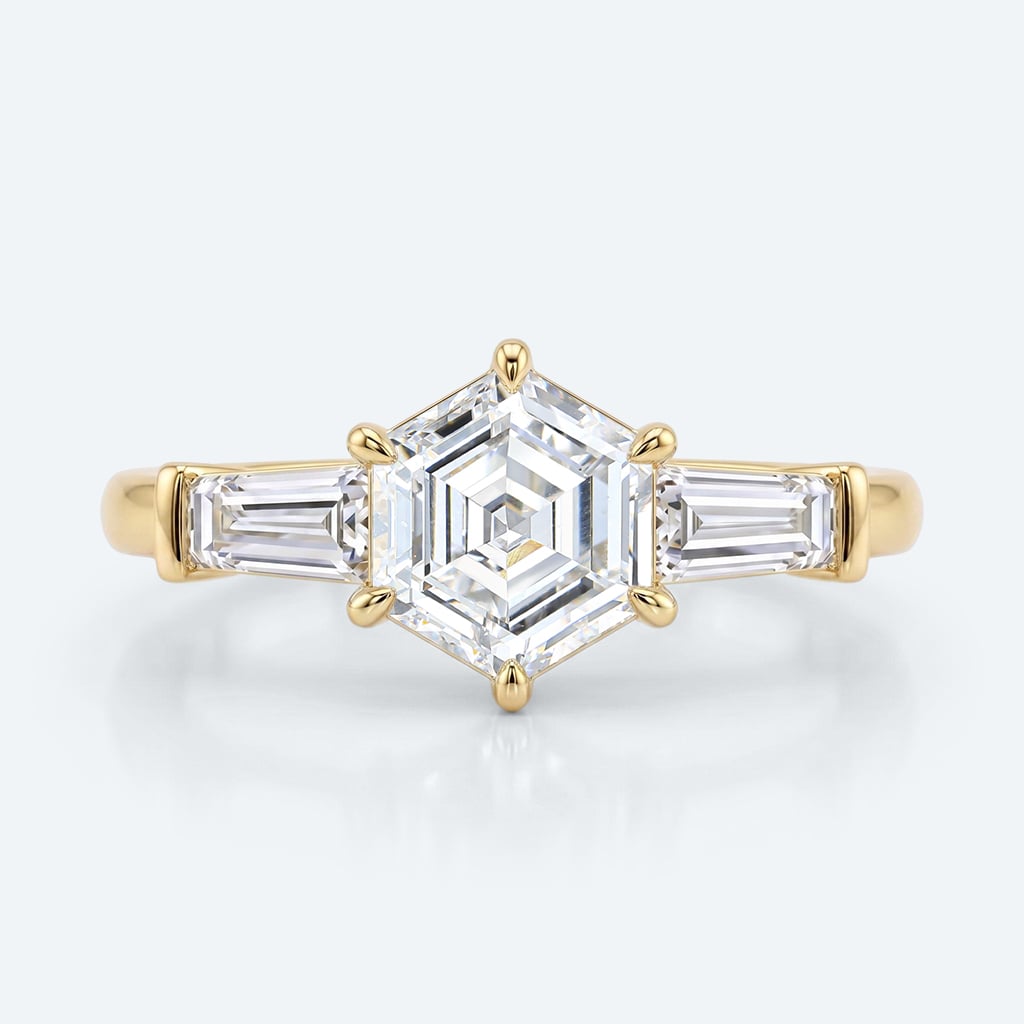
Traditional settings can also use six prongs. On a round brilliant, six evenly spaced prongs may create a crown-like effect and reinforce the stone’s circular silhouette. They also provide additional points of contact, although no prong count can eliminate the need for careful construction and routine inspection. The shape of the stone—and whether it has vulnerable corners or points—also influences the most suitable protection method.
It is helpful to separate two questions:
-
Where are the prongs positioned?
This is the compass-versus-traditional comparison. -
How many prongs are used?
This is the four-prongs-versus-six-prongs comparison.
A four-prong setting can be compass-oriented or diagonal. A six-prong setting may be evenly spaced or customized around a particular diamond. Prong count and prong placement work together, but they are not the same feature.
Compass vs. Traditional Prongs at a Glance
The following comparison summarizes the most common visual tendencies. Individual settings may vary depending on the diamond shape, prong style, metal, and basket construction.
| Feature | Compass Prongs | Traditional Prongs |
|---|---|---|
| Typical placement | 12, 3, 6, and 9 o’clock | Diagonal or corner-oriented |
| Overall appearance | Directional, graphic, contemporary | Balanced, familiar, classic |
| Effect on the outline | Emphasizes the horizontal and vertical axes | Frames the diamond diagonally |
| Open visual areas | Often leaves diagonal areas more exposed | Often leaves cardinal points more open |
| Design character | Architectural and distinctive | Timeless and versatile |
| Stone compatibility | Depends strongly on shape and setting design | Adaptable to many shapes |
| Security | Depends on complete construction | Depends on complete construction |
| Best suited to | A modern variation of the solitaire | A traditional or quietly refined solitaire |
These differences should be treated as visual tendencies rather than fixed rules. A compass setting with substantial rounded prongs can show more metal than a delicate traditional setting. Likewise, fine claw prongs may make either arrangement appear more open.
Prong placement also does not change the diamond’s actual dimensions. Compass prongs may reveal different areas of the outline, but they do not automatically make a diamond look larger. The apparent size still depends on the stone’s millimeter measurements, shape, proportions, and the scale of the surrounding metal.
How Compass Prongs Look on Different Diamond Shapes
The effect of compass prongs changes with the diamond’s outline. A placement that feels balanced on a round stone may interact very differently with cropped corners or pointed tips.
Round Brilliant
On a round diamond, compass prongs create a visible cross-axis that can make the silhouette feel more graphic. Traditional diagonal prongs often follow the circular outline more naturally, while six prongs may create a fuller, crown-like frame.
Oval and Elongated Cushion
Compass prongs can emphasize the length of an oval or elongated cushion. The north and south prongs mark the ends, while the east and west prongs sit near the widest areas. This directional effect is one reason the style works well in contemporary elongated-stone designs.
Emerald and Radiant Cuts
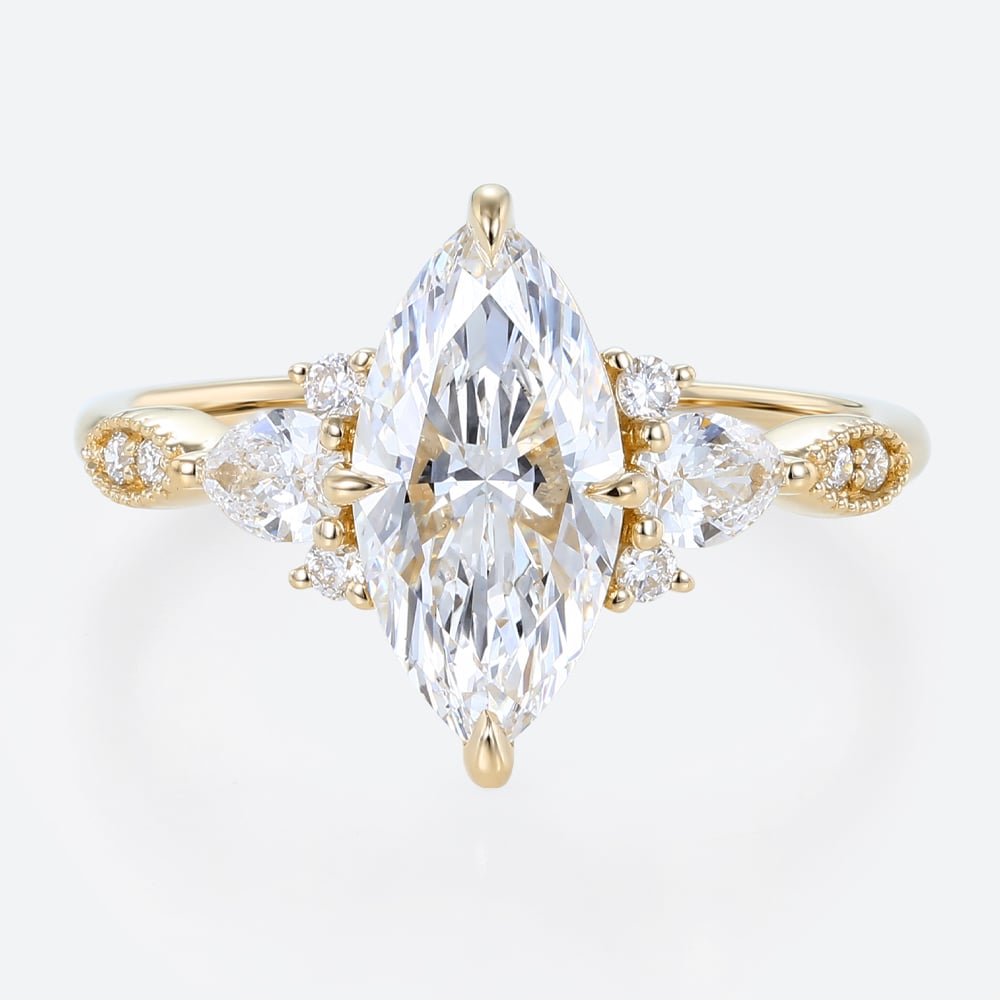
On cut-cornered shapes, compass prongs may leave the diagonal corners more visible. This can create an open, architectural look, but the setting should still provide appropriate support around the stone. Traditional corner-oriented prongs may frame the cropped corners more directly.
Pear, Marquise, and Princess Cuts
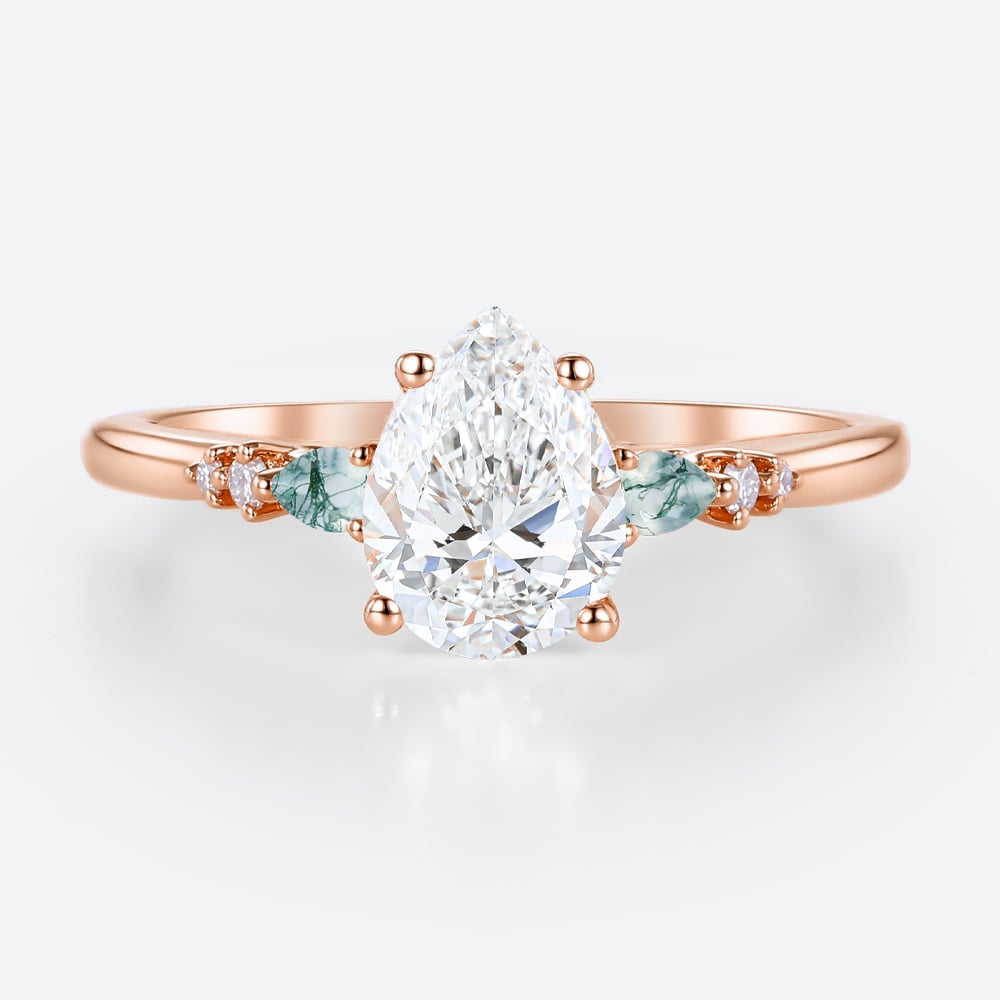
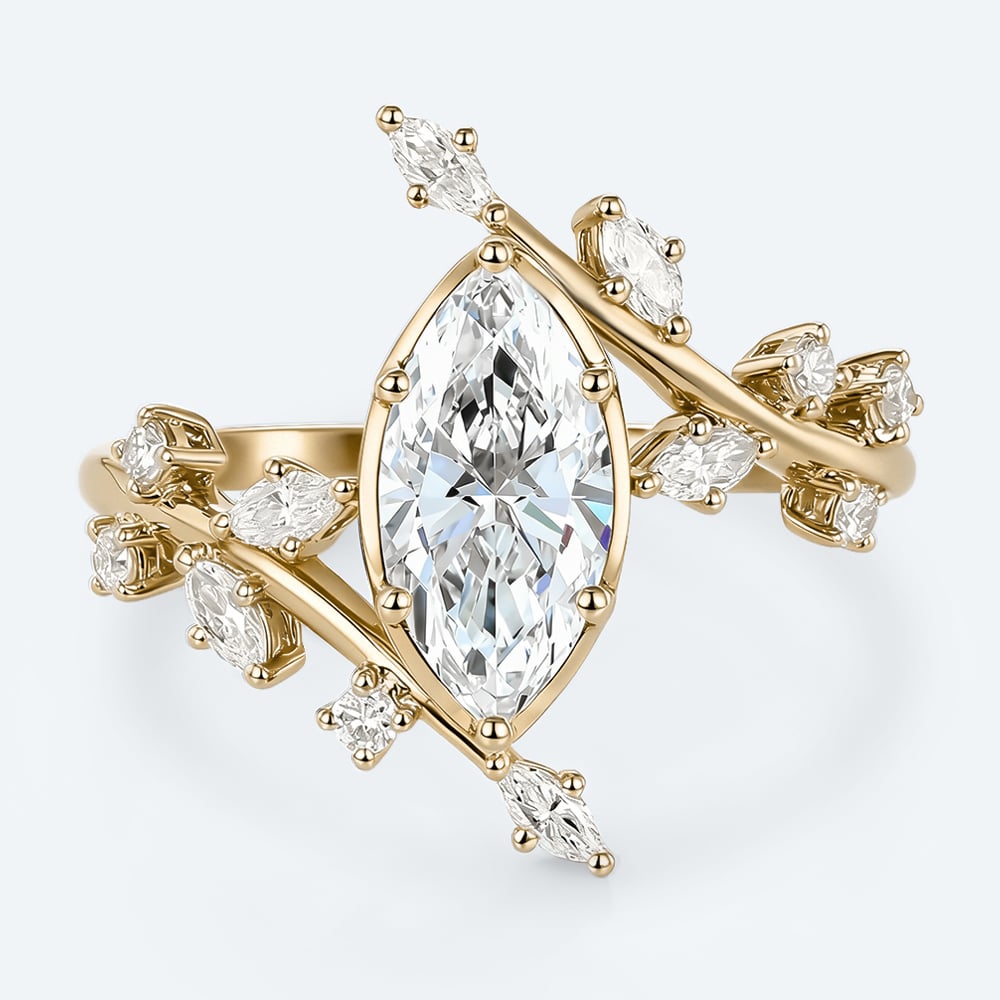
Pointed shapes require additional consideration. Pear and marquise diamonds may benefit from protective V-prongs at their tips, while princess cuts need thoughtful corner protection. A compass-inspired design can sometimes be adapted for these shapes, but the structure should be designed around the stone rather than forcing it into a standard four-prong layout.
Are Compass Prongs Secure?
A well-made compass setting can be secure, but “compass” describes only the position of the prongs—not their strength.
Security depends on:
- Prong number, thickness, and contact points
- Basket and gallery construction
- Diamond shape and corner protection
- Metal condition and workmanship
- Wear, impact, and regular maintenance
Four-prong settings generally expose more of the diamond, while six prongs add contact points and create a more enclosed appearance. However, four prongs are not automatically unsafe, and six prongs cannot guarantee that a stone will never loosen.
Check the ring if a prong appears bent or worn, repeatedly catches on fabric, or if the diamond begins to move. After a noticeable impact, professional inspection is safer than attempting to adjust the prongs at home.
Comfort, Snagging, and Wedding-Band Fit
Compass prongs do not necessarily snag more than traditional prongs. Snagging is more closely related to prong height, thickness, tip shape, and finishing. Fine claw prongs may look delicate but must be smoothly finished, while rounded prongs often create a softer profile.
A compass setting also does not automatically allow a wedding band to sit flush. Band fit depends primarily on the basket, gallery, and setting height. Review the ring from the side and, when possible, test it with the intended wedding band before making a final decision.
Which Prong Style Should You Choose?
Choose compass prongs if you prefer:
- A directional, geometric appearance
- A subtle variation on the classic solitaire
- Open diagonal areas around the diamond
- A modern, architectural design
Choose traditional prongs if you prefer:
- A familiar and balanced frame
- Greater flexibility across diamond shapes
- A classic solitaire appearance
- Corner-oriented protection where appropriate
Remember that placement is only one choice. Rounded, claw, tab, double-claw, and V-prongs can further change the appearance and function of either setting style.
Final Verdict
Compass prongs offer an elegant way to modernize a solitaire without adding a halo or elaborate decoration. Traditional prongs remain timeless because they adapt naturally to many shapes and setting structures.
Neither option is universally more beautiful, comfortable, or secure. The best choice is the one that supports the diamond’s outline, protects its vulnerable areas, works with the intended wedding band, and reflects the wearer’s personal style.
When comparing LisaJewelryUS engagement rings, consider both the face-up prong arrangement and the side profile. Together, they reveal how the finished setting will frame, support, and elevate the center diamond.
Frequently Asked Questions
Are compass prongs secure?
Yes, when properly constructed. Security depends on the complete setting, including prong thickness, contact points, basket design, diamond shape, and maintenance.
Do compass prongs make a diamond look bigger?
Not automatically. They may expose different areas of the outline, but visible size is primarily influenced by millimeter dimensions, proportions, and prong thickness.
What diamond shapes work well with compass prongs?
Round, oval, and some elongated cushion diamonds often suit the arrangement. Pointed or sharply cornered shapes may require customized protection.
Are compass prongs the same as an east-west setting?
No. Compass describes prong placement, while east-west describes the horizontal orientation of an elongated diamond.
Can a wedding band sit flush with a compass setting?
Sometimes. Flush fit depends more on the basket, gallery, and setting height than on the compass arrangement itself.