

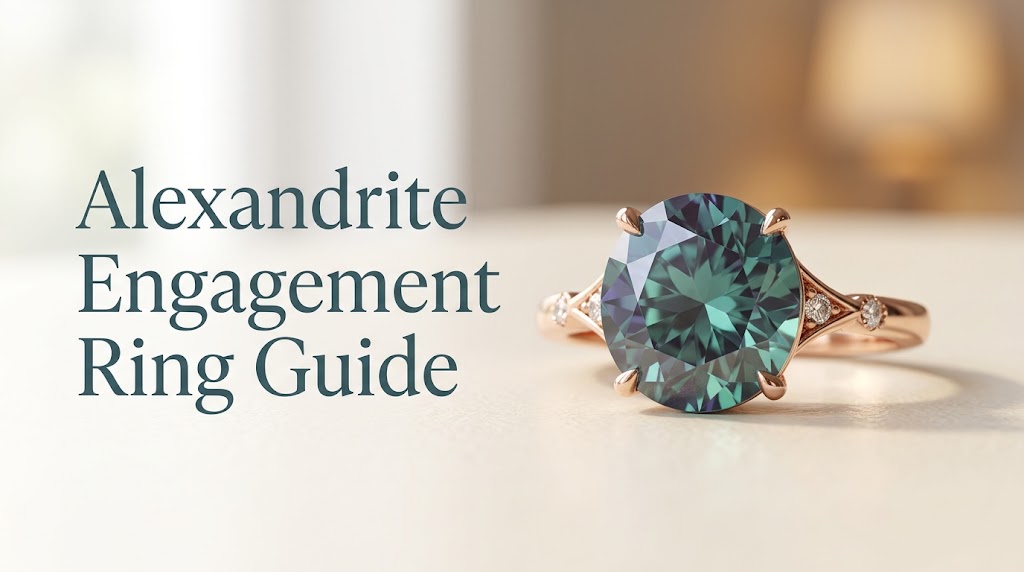
An alexandrite engagement ring is worth considering if you want a durable colored gemstone with a personality that changes with the light. Its appeal is not diamond-like sparkle alone: it is the contrast between cooler green tones and warmer reddish tones. The best choice depends on the actual stone, its natural or laboratory-grown origin, the setting, and your daily routine.
Before buying an alexandrite engagement ring, ask for clear material disclosure and videos in more than one light. Natural alexandrite can be extremely rare and expensive, while genuine lab-grown alexandrite offers the same type of color-changing phenomenon without the rarity of a mined gem. Neither category guarantees an identical appearance in every room.
Table of Contents
- Alexandrite Rings at a Glance
- What Is Alexandrite?
- Why Does an Alexandrite Gemstone Change Color?
- Natural vs. Lab-Grown Alexandrite
- Alexandrite Engagement Ring Meaning
- Is Alexandrite Durable Enough for Daily Wear?
- How to Choose Alexandrite for Your Engagement Ring
- Metals and Settings
- Alexandrite vs. Diamond
- Cleaning and Care
- Buying Checklist
- Frequently Asked Questions
Alexandrite Rings at a Glance
| Feature | What it means for your purchase |
|---|---|
| Mineral identity | Alexandrite is the color-changing variety of chrysoberyl, not emerald or diamond. |
| Typical appearance | A stone may show bluish green in daylight and purplish red in incandescent light; individual results vary. |
| Hardness | 8.5 on the Mohs hardness scale, with good toughness for everyday wear. |
| Origin | Natural alexandrite and laboratory-grown material should be clearly distinguished. |
| Buying priority | Judge the actual color change, cut, disclosure, and construction—not a dramatic product photograph alone. |
| Design options | Alexandrite rings suit solitaire, cluster, vintage, geometric, and bridal-set designs. |
An alexandrite engagement ring is especially appealing if you enjoy colored gemstones and prefer a unique alternative to a conventional diamond design. If consistent colorless brilliance is your priority, a diamond engagement ring may be a better fit.

What Is Alexandrite?
Alexandrite is a chrysoberyl variety associated with chromium and a distinctive response to different illumination. According to GIA's alexandrite overview, its characteristic appearance ranges from bluish green in daylight to reddish tones under incandescent illumination.
The familiar description “emerald by day, ruby by night” is shorthand for a color contrast, not a promise that every alexandrite stone will show vivid green and red. This color-changing gemstone needs to be judged individually. Alexandrite is neither emerald nor ruby, and a subtle change does not automatically mean a stone is an imitation.
Its early history is tied to emerald mine discoveries in the Ural Mountains of Russia during the 1830s. It was named for the future Tsar Alexander II and became associated with imperial Russia. The GIA’s history of alexandrite provides more context. Deposits elsewhere, including Brazil, Sri Lanka, and East Africa, are discussed in GIA's June birthstone guide.
Fine natural material is a rare gemstone, especially when attractive clarity, size, saturation, and strong color change occur together. That scarcity is relevant to a natural alexandrite engagement ring, not a reason to assign mined-gem value to laboratory-grown material.
Why Does an Alexandrite Gemstone Change Color?
The effect comes from how the gemstone absorbs and transmits parts of the visible spectrum. Daylight and an incandescent bulb supply different mixtures of wavelengths, so the perceived color can change even though the gemstone itself stays the same.
An alexandrite engagement ring may look blue-green beside a window and purple-red under a warm bulb. Depending on the light, an intermediate tone can also appear. Modern LEDs vary in spectral output; “warm white” on a bulb label does not guarantee the same result as incandescent light.
This color-shifting behavior is different from ordinary sparkle. Facets reflect light and influence brightness, but a photograph showing flashes of two colors is not enough to prove the characteristic color change.
How to Evaluate Color-Changing Beauty
Ask to see the same alexandrite stone in neutral daylight and a clearly identified warm light source. Ideally, request a continuous, unfiltered video of the exact gem or finished piece rather than edited before-and-after images of a different stone.
Look for three things:
- Contrast: Does the stone visibly change color between the two environments?
- Saturation: Are the stone’s colors appealing, or do they look overly gray or brown?
- Consistency: Is the stone’s change visible across the face, rather than only at an edge?
If a stone appears green in one image and purple-red in another, check the lighting conditions and whether the images show the same item. A stone displays its color-changing character most usefully when you can compare it under documented illumination.
Do not insist that your own ring reproduce a reference photo perfectly. Camera processing, screens, and different lighting can all alter the apparent color of the stone in an alexandrite engagement ring.
Natural vs. Lab-Grown Alexandrite
Natural Alexandrite: Scarcity and Individual Character
Natural alexandrite forms in the earth. Fine examples with strong color change are extremely rare, which can make a natural alexandrite engagement ring costly even when the center gem is relatively small.
Compare identity, treatment disclosure, color, clarity, dimensions, and documentation. A gemstone report can help establish what the material is; it is not automatically a market valuation or a guarantee of future resale value.
For a high-value gemstone purchase, independent laboratory identification is more reliable than judging authenticity from color alone. Avoid paying a rarity premium for an alexandrite engagement ring whose origin is unclear.
Lab-Grown Alexandrites: The Same Mineral, a Different Origin
Genuine lab-grown alexandrites are chrysoberyl produced in a laboratory. They have essentially the same chemical composition and relevant physical properties as the natural mineral. Lab-created stones can offer the same color-changing beauty as a phenomenon, but individual color contrast, clarity, and cutting still vary.
Lab-grown alexandrites are not mined rarities. They often make a larger or more elaborate alexandrite engagement ring more accessible, but compare the complete price, including metal, accent gems, and craftsmanship. Two lab-grown stones of the same size can look noticeably different. Compare each gemstone on its own merits.
Is It Real Alexandrite or an Imitation?
When shopping, a “real alexandrite” claim is not enough information to compare offers. Ask for the mineral identity and a clear natural or laboratory-grown disclosure. Natural alexandrite and laboratory-grown alexandrite are chrysoberyl; an imitation uses a different material.
Color-changing synthetic sapphire can be made to imitate alexandrite, but it is corundum rather than chrysoberyl. GIA’s introduction to synthetic gem materials explains the distinction and why a color change alone cannot establish identity.
Ask the seller: Is this real alexandrite chrysoberyl? Is it natural or laboratory-grown? Are any treatments disclosed? A clear answer matters more than an ambiguous “created gemstone” label. The FTC’s jewelry advertising guidance also distinguishes laboratory-grown gemstones from imitations and emphasizes clear labeling.
Alexandrite Engagement Ring Meaning
An alexandrite engagement ring can symbolize adaptability, individuality, and a relationship that grows through different stages of life. The gemstone's shifting colors provide a thoughtful metaphor for two people who change while remaining connected.
Alexandrite is also a June birthstone, making an alexandrite engagement ring especially personal for a June birthday, proposal, or wedding. Some couples connect its changing appearance with emotional depth or everlasting love; others simply love alexandrite for its unusual visual character.
These meanings are personal interpretations, not proven effects or promises of good fortune. The personal meaning of an alexandrite engagement ring comes from the story you attach to it, whether that is a shared milestone or a preference for an unconventional design.
Is Alexandrite Durable Enough for Daily Wear?
Yes. Alexandrite has a Mohs hardness of 8.5, excellent toughness, and no cleavage, making it a practical choice for an engagement ring. GIA's care and cleaning guide identifies it as suitable for daily wear with appropriate care.
The Mohs scale measures relative scratch resistance, not complete resistance to damage. What makes alexandrite durable is the combination of hardness and toughness—not hardness alone. A hard blow can still damage a gemstone, bend a prong, or loosen the center stone.
An alexandrite engagement ring is suitable for everyday wear when the setting is well made and the wearer removes it for activities that create impact or abrasion. Take the ring off for weightlifting, gardening, contact sports, heavy cleaning, and manual work.
Compared with a diamond, alexandrite is more vulnerable to scratches from harder materials. Keep alexandrite jewelry separate from diamond pieces in storage, and have a jeweler check the prongs if you notice movement, snagging, or a changed fit.
How to Choose Alexandrite for Your Engagement Ring
1. Prioritize the Actual Color Change
For an alexandrite engagement ring, a lively, pleasing transition is often more satisfying than size alone. Choose alexandrite based on colors you enjoy in places where you actually spend time.
If a gem appears green near a window but looks muted at your desk, decide whether that everyday appearance still appeals to you. Request examples in different lighting rather than assuming every office, restaurant, and home will produce a dramatic transformation.
The rare color-changing properties of fine natural material contribute to its appeal, but the best purchase is the stone you genuinely like. High-quality alexandrite should be assessed as a combination of color, clarity, cut, and identity—not by a single marketing phrase. GIA’s quality factors offer a useful reference for evaluating color, clarity, cutting, and size.
2. Consider Cut, Shape, and Visible Size
A well-cut stone balances brightness, color, and face-up appearance. Look for distracting dark areas, uneven brilliance, or an overly transparent center that makes the setting too visible.
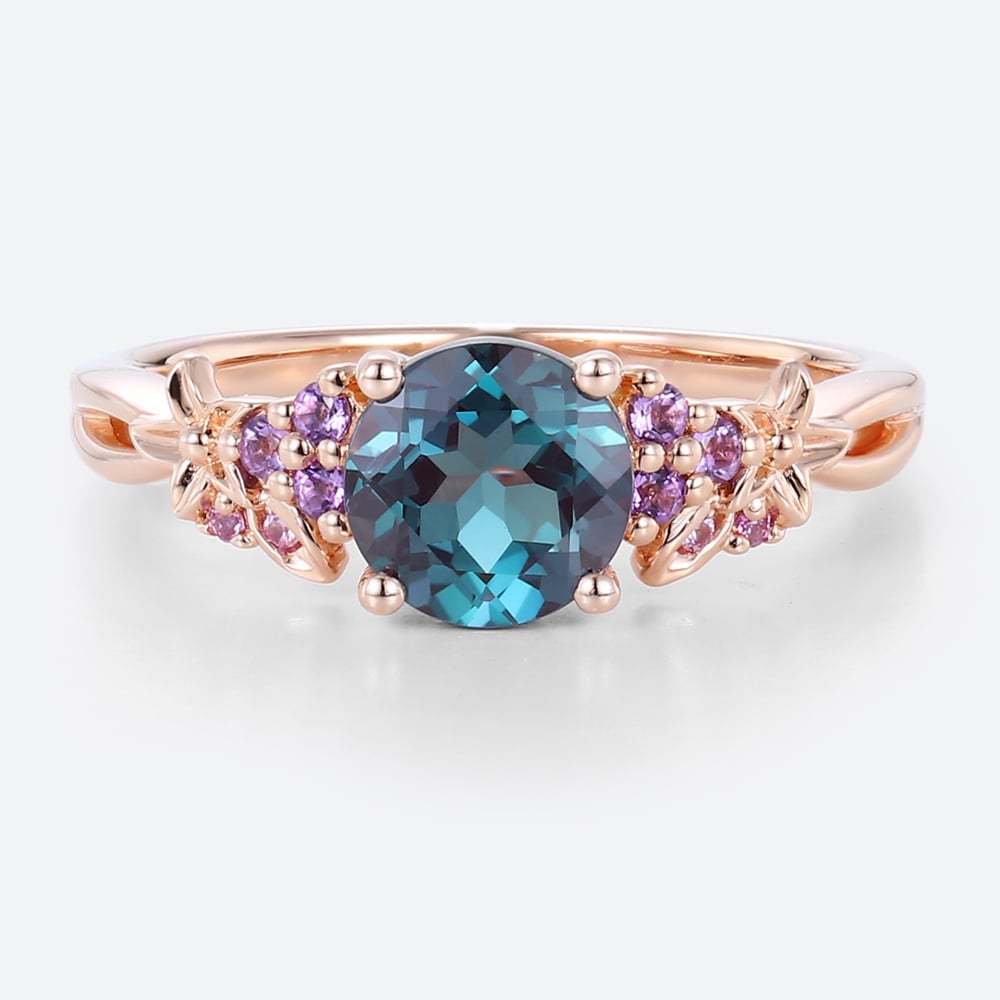
- Round: A balanced silhouette for a compact solitaire or floral cluster.
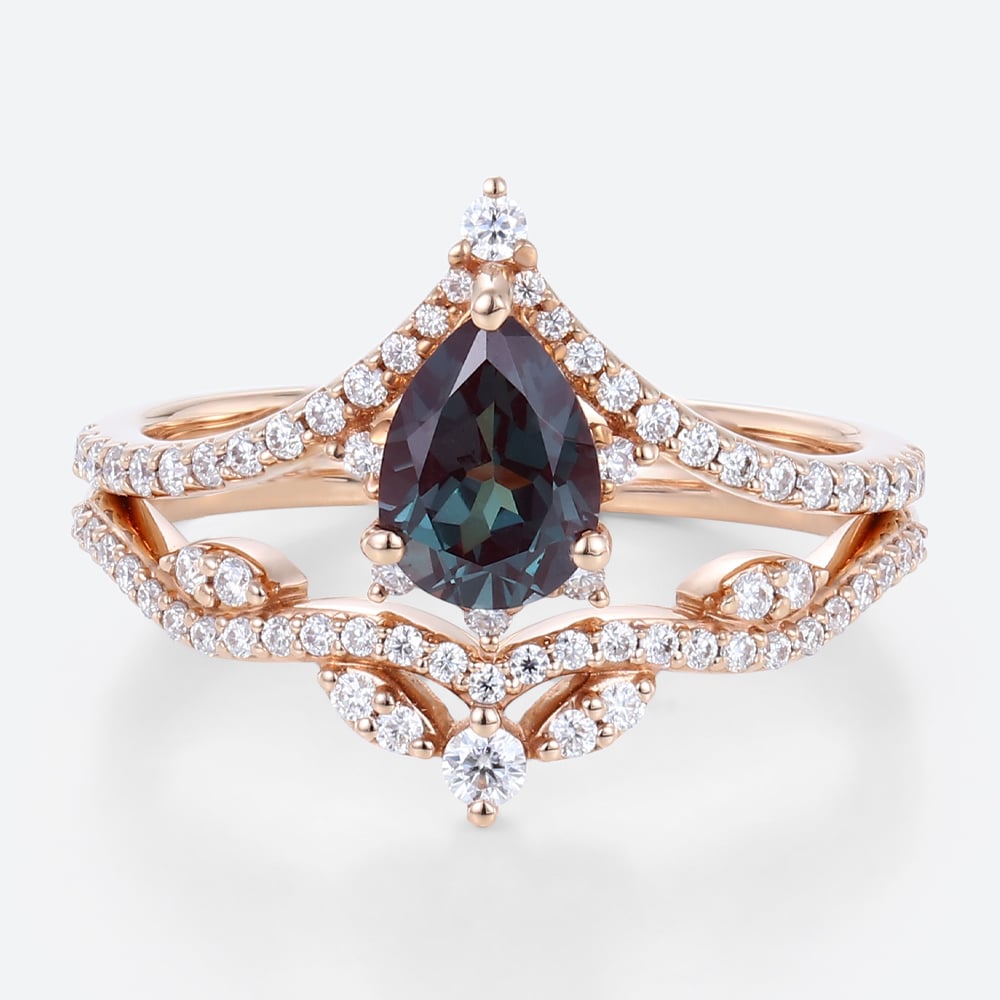
- Pear: An elongated outline; the point needs protection.
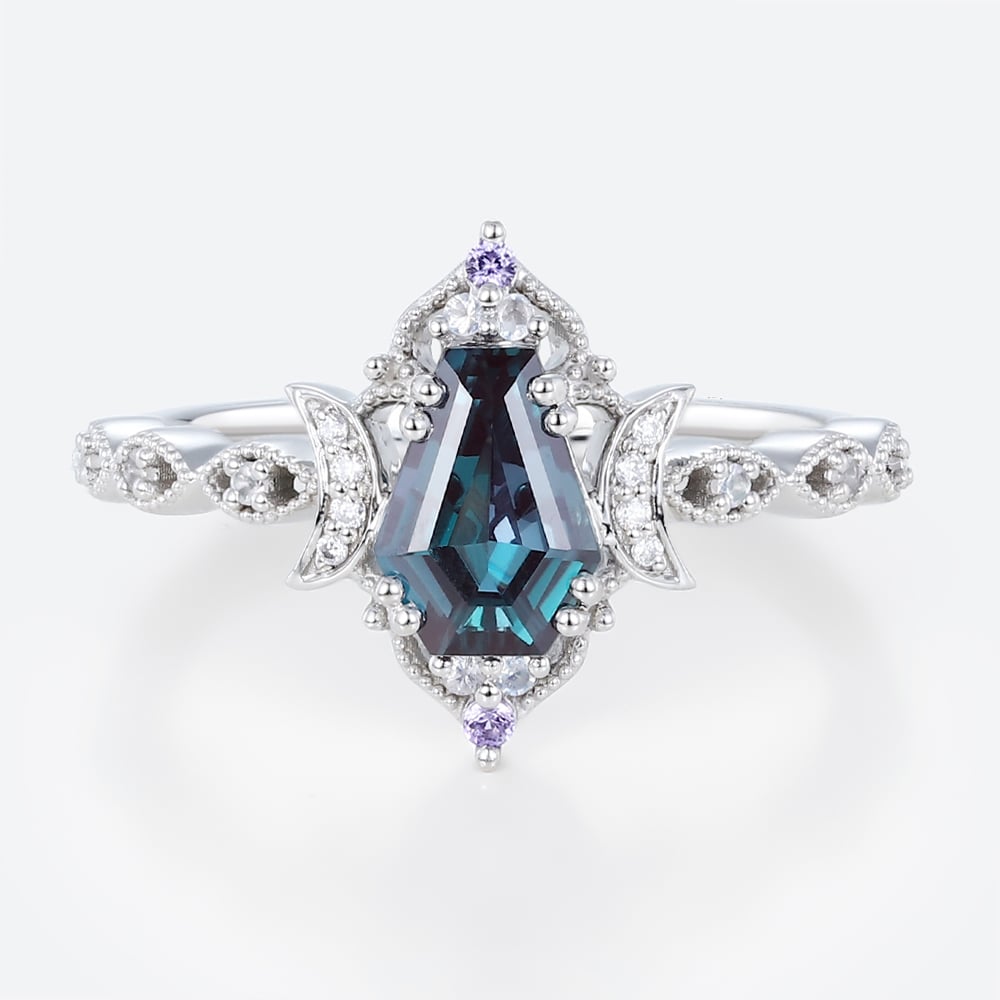
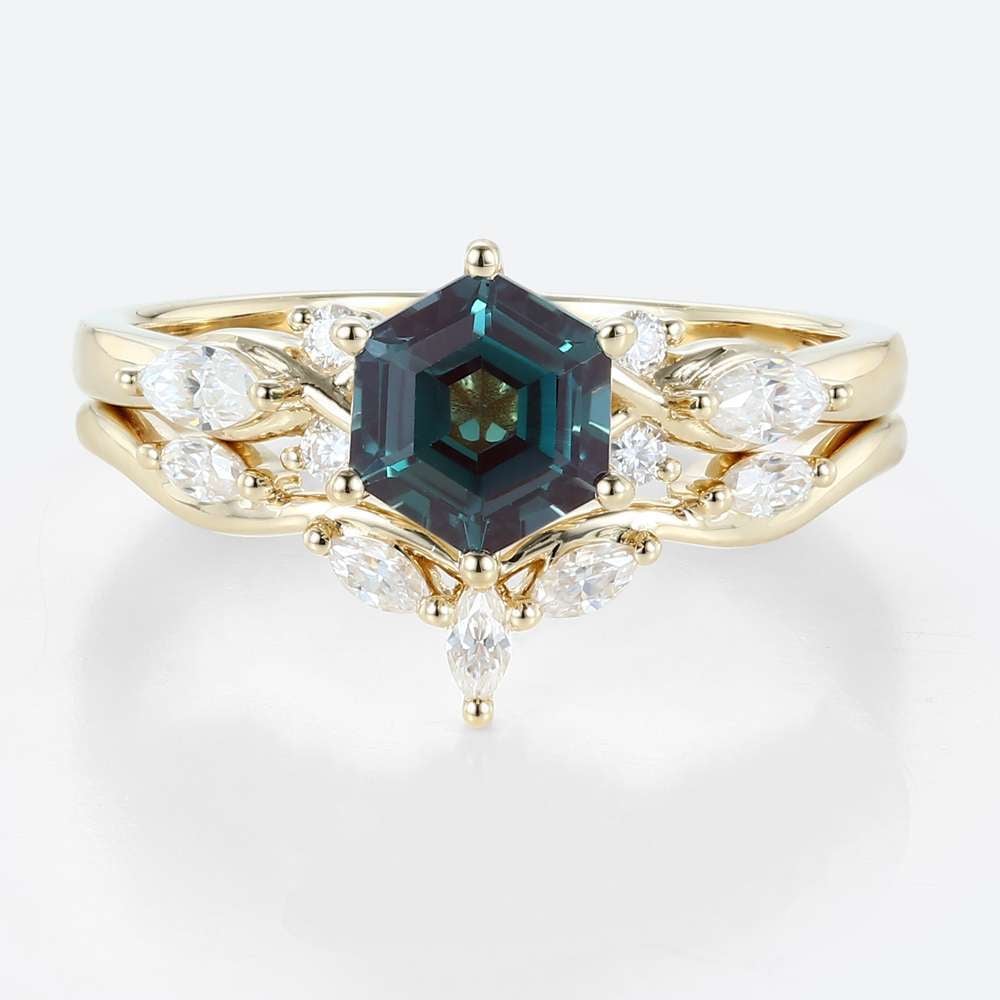
- Kite or hexagon: A geometric look, with attention to exposed corners.
- Coffin: A distinctive option for a gothic or celestial design.
Ask for the stone’s millimeter measurements as well as carat weight. An alexandrite engagement ring should have proportions that suit the hand and setting, rather than simply the largest advertised weight.
Some material can show a cat's eye effect and is cut as a cabochon to display it. That is a different appearance from a faceted alexandrite engagement ring; ask specifically about both the optical effect and color change.
3. Inspect Clarity and Construction Together
Small inclusions are not automatically a reason to reject a stone. Their visibility, location, and potential durability implications matter more than the mere fact that they exist.
For an alexandrite engagement ring, examine close images of the center gem and its mounting. Check whether the prongs are balanced, corners are protected, and the profile feels practical. A beautiful stone cannot compensate for poorly finished construction.
Metals and Settings for an Alexandrite Engagement Ring
Which Metal Color Should You Choose?
White gold gives a cool frame to green and blue tones and pairs easily with diamond accents. A white gold alexandrite engagement ring can look crisp and contemporary; ask about its finish and maintenance requirements.
Rose gold creates a warmer contrast and can complement reddish or violet appearances. A rose gold alexandrite engagement ring often suits romantic, botanical, or vintage-inspired designs.
Yellow gold provides rich contrast and a classic character. A yellow gold setting can work beautifully when you want the gem's changing tones to remain the focal point.
Metal color does not make a setting secure by itself. Alloy, construction, prong placement, band thickness, and maintenance are separate considerations.
Match the Setting to Your Routine
A solitaire lets the color-changing center stand out. A halo or cluster adds detail and diamond sparkle, while a bezel or thoughtfully designed basket can help protect vulnerable edges. Consider how high the gem sits and whether the ring catches on clothing.
For daily wear, prioritize a secure setting that supports the shape and does not leave sharp points unprotected. If you want a bridal set, check how the engagement ring sits beside the wedding band; neighboring pieces should not rub against exposed gems or delicate details.
LisaJewelryUS's custom engagement ring guide is a useful starting point if your dream engagement ring needs a different profile or center-stone shape, accent arrangement, or matching band.
Alexandrite vs. Diamond: Which Engagement Ring Suits You?
Alexandrite stands apart because this color-changing gemstone’s appeal changes with illumination. A diamond is usually chosen for brilliance, exceptional scratch resistance, and a more familiar appearance. Neither is the right answer for every buyer.
| Decision factor | Alexandrite | Diamond |
|---|---|---|
| Visual appeal | Color-changing greens, reds, and intermediate tones | Brilliance, fire, and, in colorless material, a neutral appearance |
| Scratch resistance | Mohs hardness 8.5 | Mohs hardness 10 |
| Price comparison | Natural rarity and laboratory-grown origin strongly affect cost | Natural or laboratory-grown origin and quality strongly affect cost |
| Daily wear | Practical with suitable construction and care | Highly scratch resistant, but still needs checks and protection from impact |
| Personal preference | Best for someone who enjoys changing color | Best for someone who prioritizes consistent sparkle |
Choose an alexandrite engagement ring if you enjoy a unique gemstone and are comfortable with variations depending on the light. Choose a diamond engagement ring if familiar brilliance and greater scratch resistance matter more to you.
You can also combine both ideas. Diamond accents add sparkle around an alexandrite center without replacing its distinctive appearance. For a different center-stone direction, compare LisaJewelryUS's lab diamond engagement rings.
How to Care for an Alexandrite Engagement Ring
For routine cleaning, use warm water, mild soap, and a soft toothbrush. Brush gently around the setting, rinse thoroughly, and dry with a soft cloth. Avoid cleaning over an open drain.
Warm soapy water is the conservative choice for an alexandrite engagement ring. Before using steam or an ultrasonic cleaner, ask a jeweler whether the gemstone’s condition, any treatments, accent materials, and mounting make it appropriate.
Good daily wear habits are straightforward:
- Remove the ring before rough work or exposure to harsh cleaning products.
- Store it in a separate compartment or pouch, away from diamond jewelry.
- Check for loose prongs or a moving center stone.
- Arrange professional inspection when the ring’s mounting shows wear or after an impact.
Care protects both the gem and the setting. The color-changing effect is a property of the material, not a coating that routine gentle washing should remove.
Alexandrite Engagement Ring Buying Checklist
Before ordering, confirm:
- Identity: Is the center real alexandrite chrysoberyl, rather than a color-changing imitation?
- Origin: Does the listing clearly say natural or laboratory-grown?
- Appearance: Have you seen the actual item or understood whether images are representative?
- Color: Is there a useful comparison under documented daylight and warm illumination?
- Dimensions: Are the measurements, carat weight, and ring size clear?
- Construction: Are vulnerable edges protected and the mounting suitable for your routine?
- Accents: Are the type and origin of any diamond or other accent gems disclosed?
- Terms: Have you reviewed resizing, production time, returns, and warranty details?
These checks make an alexandrite engagement ring easier to compare honestly with another design. No purchase should depend solely on a dramatic color-changing photo or a claim that all rare gems are investments.
Frequently Asked Questions
Are Alexandrite Rings Good for Everyday Wear?
Yes. Alexandrite rings can be suitable for daily wear because the material combines good scratch resistance with toughness. Choose a well-made setting and remove the piece for impact-heavy activities. Like a diamond engagement ring, the ring still needs occasional checks for loose prongs and mounting wear.
Is Lab-Grown Alexandrite Real Alexandrite?
Laboratory-grown alexandrite is chrysoberyl produced in a laboratory, not mined material. It is different from a color-changing imitation made of another mineral. Ask for clear identification and origin disclosure rather than relying on the word “synthetic” or a purple product image alone.
Do All Alexandrite Engagement Rings Change Color Dramatically?
No. The strength and colors of the transition vary by gem and illumination. An alexandrite engagement ring may show a subtle rather than dramatic contrast, especially under some LEDs. Review the exact item in daylight and warm illumination before deciding whether its appearance suits you.
Why Is Natural Alexandrite So Expensive?
Fine natural alexandrite is a rare gemstone, and the combination of attractive color change, clarity, cut, and size is difficult to find. Those factors can make a natural alexandrite engagement ring expensive. Laboratory-grown material does not share the same geological scarcity or rarity premium.
Is Alexandrite Better Than a Diamond?
It depends on your priorities. Alexandrite offers changing color and an individual look; diamond offers greater scratch resistance and familiar brilliance. A diamond engagement ring may suit someone who values consistent sparkle, while alexandrite is appealing to someone who enjoys changing hues.
Does Alexandrite Always Turn from Green to Red?
No. Blue, green, violet, reddish, and mixed tones can occur, and some transitions are less vivid than others. Few gemstones are as closely associated with this particular effect, but the phrase “emerald by day, ruby by night” should not be treated as a universal color guarantee.
How Can I Check an Alexandrite Gem's Authenticity?
Ask for the mineral identity, origin, treatment disclosure, and supporting documentation. An independent gemological laboratory can help distinguish natural alexandrite, laboratory-grown chrysoberyl, and imitations. A home lighting test can show color change, but it cannot reliably prove identity or natural origin.
What Should I Check When Buying an Alexandrite Bridal Set?
Check how the bands fit together, whether either ring rubs against exposed edges or prongs, and how the combined ring profile feels on your hand. Confirm sizing and resizing terms for both pieces. An alexandrite engagement ring with a coordinated band should be comfortable as well as visually balanced.
Explore Alexandrite Rings at LisaJewelryUS
An alexandrite engagement ring is a compelling choice when changing color matters more to you than a conventional look. What makes alexandrite memorable is the stone’s response to illumination, but the right purchase also needs clear disclosure, thoughtful construction, and an appearance you enjoy day to day.
Browse LisaJewelryUS alexandrite rings to compare silhouettes and coordinated designs. The collection's listed center stones were described as lab alexandrite when reviewed for this guide, so evaluate them as laboratory-grown options rather than natural rarities.
For a geometric design, consider the kite-cut lab alexandrite cluster engagement ring. For a coordinated silhouette, explore the pear-cut lab alexandrite bridal set. Confirm the current listing details, material disclosure, and customization options before ordering.